
Off-page SEO used to be a backlink scoreboard. Whoever stacked the highest domain authority count won the SERP. That model is fading fast.
ChatGPT, Perplexity, and Google AI Overviews now pull from a much wider signal set, and the brands they cite look almost nothing like the link-heavy winners of a few years ago. AI off-page SEO in 2026 rewards mentions, citations, and brand chatter far more than raw link volume.
You'll see what the new signals actually are, which digital PR moves earn AI citations, and the workflow shifts the top agencies are running. Real tools, real numbers, the parts most strategy decks still get wrong.
What Off-Page SEO Looks Like in 2026
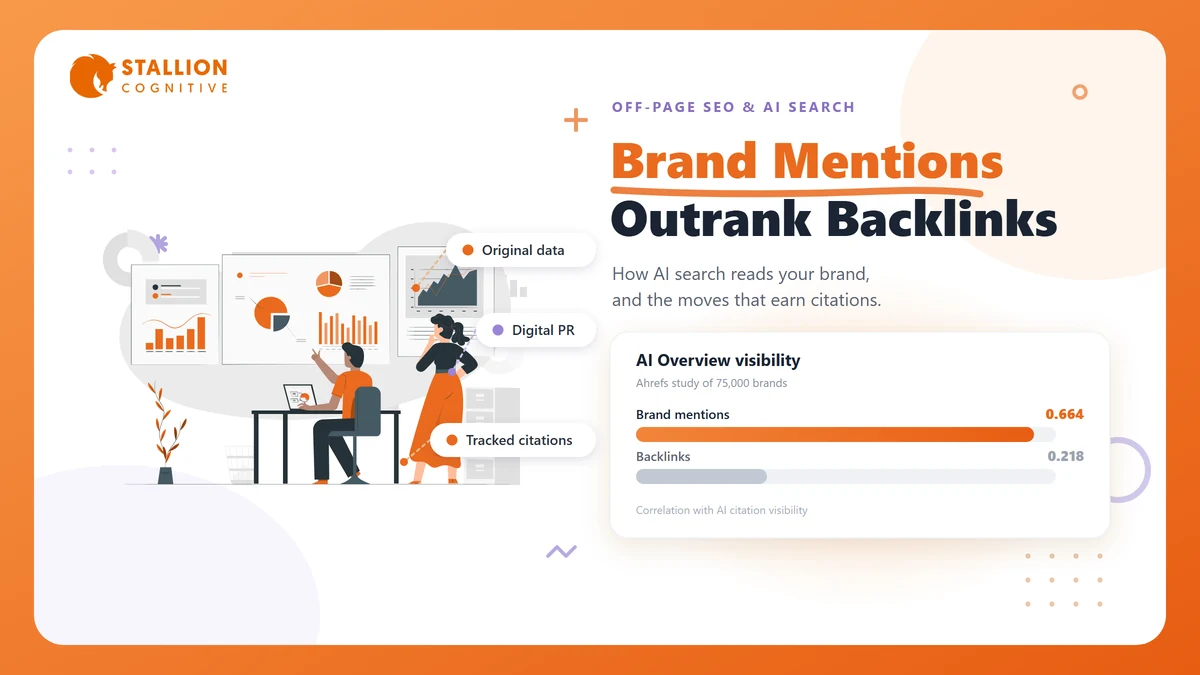
Brand mentions overtook backlinks as the top off-page signal sometime in late 2024, and the data caught up by mid-2025. An Ahrefs review of 75,000 brands found unlinked brand mentions correlate 0.664 with AI Overview visibility against 0.218 for raw backlinks. Language models trust the chatter about a brand more than the votes pointing at it.
That single shift rewrites the entire off-page model.
Old workflows assumed scale would win, treating 100 links as the path to outranking the brand sitting on page two. The new workflows assume context wins. Earn 20 high-trust mentions across the right surfaces and AI systems learn to associate the brand with the topic.
Old vs. New Off-Page SEO
| Old approach (pre-2024) | New approach (2026) |
|---|---|
| Backlink count | Mention quality and source mix |
| Domain Rating chasing | Topical authority across AI training surfaces |
| Guest post farms | Podcast guests, expert quotes, original studies |
| Anchor text optimization | Co-occurrence with topical entities |
| Disavow-heavy cleanup | Reputation and sentiment monitoring |
The shift maps to how Google, OpenAI, and Anthropic train their retrieval systems. They parse what trusted sources say about a brand. Link counts barely register in that signal layer.
The pattern shows up clearest in local search, where AI Overviews are restructuring how local businesses surface and a Reddit thread or local news mention often outweighs a map citation. Once that piece clicks, the real question becomes which mentions count and what the full signal stack looks like inside AI retrieval.
The Brand Signal Stack: 5 Assets AI Systems Actually Read
Five assets show up over and over inside content that AI systems cite. The full breakdown sits below, but the headline is that brand chatter weighs heavier than backlinks across every measurable AI surface in 2026. Most B2B brands ship three of the five and wonder why Perplexity skips them.
Word of caution: each asset has a quality threshold. Sloppy execution counts against the brand, since AI models pick up sentiment alongside topical relevance.
The Five Assets
- Original data and proprietary research. Surveys, internal benchmarks, and first-party studies. A single proprietary stat can pick up 40 to 80 citations over 18 months if it answers a real industry question.
- Podcast guest spots on shows your buyers already follow. Show notes, transcripts, and YouTube uploads create a wide footprint that AI training pipelines index repeatedly.
- Expert quotes inside trade press and trusted news. A quote on a high-authority site reads as third-party validation and AI models surface it as endorsement.
- Niche community presence. Reddit threads, Slack groups, Quora answers, GitHub READMEs depending on industry. Authentic comments compound. Drive-by promo backfires fast.
- Structured FAQ-style answers on third-party platforms. Software review sites, industry wikis, and Q&A platforms. These feed retrieval systems directly when users ask category questions.
The five compound. A brand running three of five at high quality outperforms one running all five at half quality.
For brands working in local services or multi-location categories, the same logic governs local link building tactics, with one extra layer for Google Business Profile signals stacked on top. The five assets describe what to build, and digital PR is the channel that gets them in front of the right surfaces.
How AI Is Rebuilding Digital PR From the Ground Up
Digital PR in 2026 starts with a journalist database that AI segments by beat, recent coverage, and pitch responsiveness. Tools like BuzzStream and Muck Rack run the discovery layer. The pitch itself still needs a human voice, because every PR pro on the planet is sending the same AI-generated template right now.
Here's the deal: AI cracked the parts of PR that scale with volume. Relationship work stayed where it was.
The 2026 Digital PR Workflow
- AI-assisted journalist mapping. BuzzStream, Muck Rack, or Prowly pull 200 to 500 journalists fitting brand and beat. AI ranks them by recent coverage relevance.
- Pitch personalization, drafted by AI, polished by human. Templates die fast. AI handles the first 60 percent of a draft. The human writes the hook, the angle, and the closing line.
- Story angles reverse-engineered from AI search demand. Pull recurring topics from Perplexity, Claude, and AI Overview citations. The angles AI surfaces inside answers are the angles journalists want next.
- Citation tracking across AI surfaces. Tools like Otterly, Profound, and Peec.ai surface unlinked brand mentions inside ChatGPT and Perplexity answers. The unlinked mention now functions as a legitimate ranking signal.
- Sentiment monitoring as a PR KPI. Negative chatter caps the upside of every PR win. AI sentiment tools flag issues inside hours rather than weeks.
A 2025 industry analysis on off-page SEO and AI visibility reports that 48.6 percent of 518 SEO practitioners now rank digital PR as their top link-building approach. Which brings the conversation to the part most strategists still argue about, whether traditional link building earns its budget at all.
Is Link Building Dead, or Filtered Differently?
Links still count, though their weight inside AI search has shifted heavily toward source quality and topical fit. Google's John Mueller noted in early 2025 that quality and relevance outweigh sheer count, and the data lines up. Brands winning AI citations earn 40 to 60 percent fewer links than volume-era averages but rank higher across AI Overviews and Perplexity citations.
Fair warning: a portfolio of garbage links still tanks rankings. The bar for clean linking work moved up. The bar for spammy linking dropped to zero ROI fast.
The shift mirrors what's happening across other SEO categories. Generative engine optimization absorbed half the budget that used to go to anchor text manipulation, and most agencies report higher returns from the swap.
What Counts Now Inside AI-Era Link Building
- Editorial mentions earned through digital PR, with or without a follow link attached.
- Topical co-occurrence, where a brand and a concept appear together inside trusted publications.
- Mentions inside AI training surfaces, including Reddit, Wikipedia citations, and high-trust review sites.
- Internal linking architecture that signals topical depth to crawlers and language models simultaneously.
Old-school link metrics still matter for traditional ranking, and they sit alongside a brand signal layer that AI search treats as primary. The bigger story sits inside the SEO vs GEO vs AEO conversation, where the channel is splitting rather than dying. Knowing the rules and executing on them are different problems, which the framework below resolves.
Building a Brand AI Models Trust: A 6-Step Framework
The six steps below come from watching what AI search cites and reverse-engineering the pattern across roughly 40 client portfolios. Start with proprietary data, expand to podcast circuits, then push into expert quote distribution. Each step compounds, and skipping any one collapses the brand signal stack by around 30 percent.
We've run versions of the framework for SaaS, professional services, and local multi-location brands. The cadence shifts. The order does not.
The 6-Step Framework
- Publish one piece of proprietary data per quarter. Survey, benchmark, or internal study, packaged with quotable stats and a public methodology.
- Pitch the data through a journalist segment that already covers your topic. Aim for 5 to 8 placements within the first 90 days.
- Convert the same data into a podcast tour. Twelve to twenty shows over six months, each one expanding the entity footprint AI models index.
- Distribute expert quotes through platforms like Featured.com, Help a B2B Writer, and Qwoted. Five to ten placements monthly compounds inside trade press fast.
- Build a niche community presence under a real account. Reddit, Slack, Quora, or industry forums. Twenty meaningful interactions weekly beats 500 drive-by posts.
- Track unlinked mentions and AI citations weekly. Profound, Otterly, or Peec.ai give the dashboard. Treat citation count as the primary KPI rather than a vanity metric.
The framework reads simple. Execution takes 12 to 18 months for most brands, longer in regulated industries where compliance review slows every PR cycle. Frameworks need tools, and tools without judgment fail loudly in PR, which sets up the final layer.
Tools, Workflows, and Where Human Judgment Still Wins
AI handles the parts of off-page SEO that scale poorly with humans, like media list building, sentiment monitoring, and citation tracking across 50-plus AI surfaces. Relationship work stays human. We've watched plenty of teams automate the entire pitch sequence and lose three months of inbox replies because journalists smelled the AI.
You might be wondering where the line sits in 2026. The split is sharper than it was twelve months ago.
What AI Should Do, What People Should Do
- AI owns: journalist discovery, beat segmentation, sentiment analysis, citation tracking across ChatGPT, Perplexity, Claude, and Gemini surfaces, brand mention monitoring, and competitor citation audits.
- AI assisted, human finalized: pitch drafting, study summaries, podcast pitch hooks, and expert quote tightening for publication.
- Human only: journalist relationships, podcast host warm intros, quote validation, sensitive PR responses, and story angle judgment when the data points in two directions.
A 2026 industry analysis on AI search and link building reports that 66.2 percent of practitioners now track AI-generated citations as a primary KPI, a metric that did not exist a year earlier.
The bigger picture across GEO, AEO, and SEO for local marketers confirms the same split. Discovery and tracking automate cleanly. Trust signals stay human. The teams that internalize that division in 2026 will outpace the teams still treating AI as either a magic button or a threat.
Conclusion
Off-page SEO sits at one of those rare inflection points where the rules actually changed under everyone's feet. Backlinks earned brands a decade of growth, then quietly slid behind brand mentions, AI citations, and topical co-occurrence inside trained models. The brands moving first on data publishing, podcast circuits, and citation tracking are setting up moats that will take competitors years to dismantle.
What does the next six months look like for your brand? Are you building the signals AI search rewards, or still buying links that carry diminishing returns inside the new retrieval layer? If a brand audit and signal-stack plan would help map the next quarter, the team at Stallion Cognitive runs them weekly across SaaS, professional services, and local multi-location accounts.
Frequently Asked Questions
Is off-page SEO still relevant in 2026 if AI generates most answers?
More than most marketing decks admit. AI systems pull from publicly indexed mentions, citations, and reviews to decide which brands surface inside answers. Off-page SEO is the channel that builds those signals, and it now drives AI visibility as heavily as it drives organic ranking.
How long does it take to see AI citation results from off-page SEO?
Six to twelve weeks for unlinked mention pickup when the work runs concentrated. Full citation patterns across ChatGPT, Perplexity, and Google AI Overviews typically need three to six months of consistent publishing, PR placements, and community presence layered together.
Are backlinks still worth building given the brand signal shift?
Backlinks earn traffic, ranking, and authority transfer. Their relative weight dropped, and the ROI now ties to source quality and topical fit rather than count. A handful of editorial placements outperforms 200 directory submissions across almost every measurable metric in 2026.
Which AI tools matter most for off-page SEO and brand monitoring?
Profound, Otterly, and Peec.ai handle AI citation tracking. BuzzStream and Muck Rack handle journalist research. Brand24 and Mention.com cover unlinked mention monitoring. Most teams run two or three across the stack rather than one all-in-one platform.
Can small brands compete with larger competitors under the new off-page SEO model?
None of the new signal layers require a huge budget. Original data, podcast appearances, and niche community presence reward small operators who execute consistently. We've watched 8-person SaaS teams outpace enterprise PR departments inside AI citation rankings.