
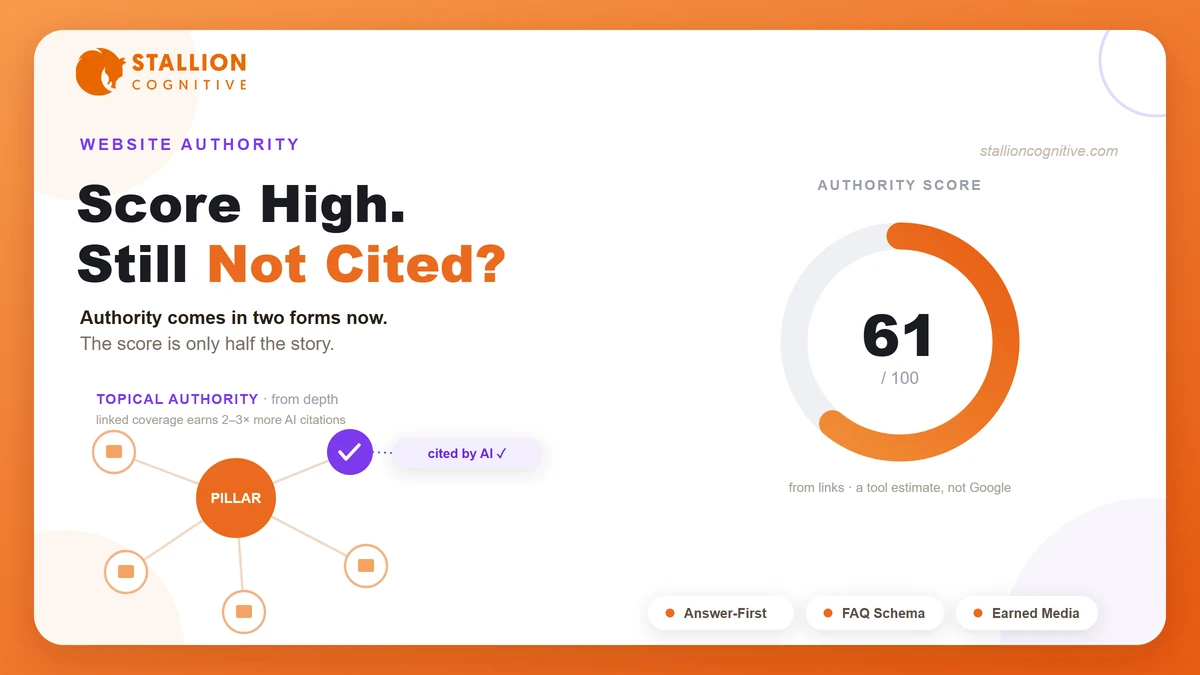
Ranking well isn't enough anymore.
You can write a clearer, more helpful, more complete post than everyone above you and still lose. It sits on page two while a weaker page holds the top spot. Worse, the AI answer box names a rival and never mentions you at all.
The reason comes down to authority.
When you learn to analyze website authority, the guessing stops. You start to see why search engines and AI tools trust some pages and skip others.
We've watched this play out across hundreds of client pages at Stallion Cognitive. The winners are rarely the biggest sites in the room. They're the ones that read their authority correctly and act on what they find.
In this guide, you'll learn what website authority means in 2026, how to check yours, and how AI engines decide which pages they quote. Then you'll turn all of it into content that ranks and gets cited.
Let's get started.
What Does Website Authority Actually Mean in 2026?
Website authority is how much trust your site has earned with search engines and AI tools.
In 2026, it comes in two forms.
One is domain authority, built on links. The other is topical authority, built on deep coverage of a single subject. You need to read both.
Most people only check the first one, and that's the mistake.
A small site with deep, well-linked coverage can beat a big brand that touches the topic once.
Domain Authority: Trust Built on Links
Domain authority is a score that guesses how strong your backlinks look.
Moz calls it Domain Authority. Ahrefs calls it Domain Rating. Semrush calls it Authority Score.
None of them come from Google.
Each tool crawls its own set of links and runs its own math. So the same site can score 42 in one tool and 58 in another. Treat the number as a rough guide, never gospel.
Topical Authority: Trust Built on Depth
Topical authority is earned the slow way.
It grows when you cover a subject fully, link the pages together, and keep them correct over time. Search engines read that depth as real expertise.
The payoff is huge in AI search.
Structured topic clusters pull 3.2 times more citations in AI engines than single pages, per Yext's 2025 AI Citation Study.
| Type | What it measures | Built from | Where it wins |
|---|---|---|---|
| Domain authority | Backlink strength | Quality links from other sites | Comparing you to rivals |
| Topical authority | Depth on a subject | Linked, accurate coverage | Google rankings and AI citations |
So the score tells you where you stand today.
Your topic coverage decides where you go next. And the reason to care about both has everything to do with what AI just did to your traffic.
Why Website Authority Matters More in the AI Era
Authority used to be an SEO talking point.
Now it decides whether AI tools quote you at all.
Google shows an AI answer on about half of all searches, per Leapd's 2026 analysis. When that answer names a few sources, everyone else disappears.
The traffic gap is real. Here's what the data shows when your page gets cited:
- Pages cited in AI Overviews earn 35% more clicks than the pages sitting next to them.
- Visitors from Perplexity sign up at roughly 11 times the rate of normal Google traffic.
- Only about 17% of the sources Google's AI cites also rank in the classic top 10, BrightEdge found in early 2026.
Read that last point again.
You can rank well and still get skipped by AI. You can also rank poorly and still get cited, if your page answers the question better.
That single shift is why AI Overviews changed how search works. And it's why an honest authority check now includes AI visibility.
So how do you measure where you stand? Start with the tools.
How Do You Check Your Website Authority?
Three tools own this job.
Each one scores authority a little differently. Pick the one that fits your need and your budget, because you rarely need all three.
The table below gives you the quick view, then we break down each one.
| Tool | Main metric | Best for | Starts around |
|---|---|---|---|
| Semrush | Authority Score | All-in-one checks | $140/month |
| Ahrefs | Domain Rating | Backlink depth | $129/month |
| Moz | Domain Authority | Tight budgets | $49/month |
Semrush Authority Score
Semrush mixes backlinks, traffic, and spam signals into one score. That makes it the most rounded read of the three.
- Best for: marketers who want authority, keywords, and gaps in one place.
- Metric: Authority Score, plus referring domains and traffic.
- Standout: Backlink Analytics puts your score next to a rival's in seconds.
- Pricing: paid plans start around $140 a month. There's a free authority checker for quick looks. Confirm current prices on their site.
Ahrefs Domain Rating
Ahrefs keeps Domain Rating focused on one thing, your links, and its index runs deep. When backlinks are your question, this is the clean answer.
- Best for: teams focused on link building.
- Metric: Domain Rating, scored 0 to 100.
- Standout: Content Explorer shows which pages in your niche pull the most links.
- Pricing: plans start around $129 a month, with a free DR checker. Verify before you buy.
Moz Domain Authority
Moz made this idea famous, and its score is still a fast benchmark. The free Link Explorer handles light checks well.
- Best for: smaller budgets and quick comparisons.
- Metric: Domain Authority, plus Spam Score.
- Standout: DA history shows your trend over months, well beyond today's number.
- Pricing: Moz Pro starts around $49 a month. Prices shift, so check the page.
One question always comes up here.
What counts as a good score?
For most niches, 40 to 50 is a solid mid-range. 60 or higher is strong. Compare against your real rivals, since the bar moves by industry.
But a score on its own means little. It earns its keep the moment you run it through a real process. You can also dig into more options in our roundup of the best tools for SEO success.
How to Run a Website Authority Analysis, Step by Step
A full authority analysis takes about an hour.
The goal is a short list of decisions you can act on. Not a pile of screenshots.
Follow these five steps in order, and you'll know exactly what to fix.
- Lock your baseline score.
- Compare three real rivals.
- Map your topic coverage.
- Find the gaps worth filling.
- Check your AI visibility.
Step 1: Lock In Your Baseline First
Run your site through one tool.
Write down the score, referring domains, and traffic. That's your starting line.
You can't prove progress against a number you never saved.
Step 2: Compare Three Real Rivals, Not Ten
Pick the three sites that beat you for the keywords you want. Pull their scores beside yours.
That quick competitor analysis tells you whether you're losing on link strength or on topic depth. Each problem needs a different fix.
Step 3: Map Where Your Coverage Is Thin
List the subtopics inside your main subject.
Mark which ones you cover well, which are thin, and which are missing. Use this short checklist:
- Pages that rank but have no supporting articles around them.
- Real questions your buyers ask that you've never answered.
- Topics rivals cover in depth that you mention once.
- Old posts that fell out of date and now drag your trust down.
Step 4: Find the Gaps Worth Filling
Not every gap deserves a page.
Rank gaps by business impact first, then by search demand. A thin spot next to a page that makes you money beats a high-volume topic that never converts.
Step 5: Check Your AI Visibility
Open ChatGPT, Perplexity, and Google. Ask the questions your buyers ask. See who gets named.
If rivals show up and you don't, you just found your real gap. A quick site audit at this stage shows whether AI bots can even reach your pages.
Now you have a clear map.
The next part is the one most guides skip. You need to know how AI engines actually choose what to quote.
How AI Engines Decide What to Cite
AI engines don't read your whole page.
They break it into chunks and pull the parts that answer the question best. So the way you write and structure a page decides whether you get cited.
The pages that win share four traits. They're easy to read, full of facts, fresh, and trusted off-site. We'll break each one down below, using two large 2026 studies as the backbone.
Put the Answer First
AI tools grab the top of your page more than any other part.
The first third of a page accounts for 44.2% of all AI citations, per Zyppy research cited by Leapd.
So answer the question in the first two lines of every section. Give the direct reply, then explain.
Pages that bury the answer under three setup paragraphs lose to pages that lead with it.
Make Each Section Stand on Its Own
AI pulls single passages, so each one has to make sense alone.
If a paragraph says "this method works better" but never says better than what, the AI has nothing it can quote.
Write each section like it might be lifted out by itself. Restate the key point where it's needed. Clear headings and short blocks help the engine find your answer fast.
Back Every Claim With a Number and a Source
Most content fails right here. Which is also your fastest win.
AI engines cite facts over opinions. "Adults need protein" gets ignored. "Adults need about 0.8 grams of protein per kilogram of body weight" gets cited.
The data backs this hard:
- Adding statistics can raise AI visibility by 22%, and adding direct quotes can lift it by 37%.
- AI-cited articles carry 62% more facts than uncited ones on the same topic.
- A Google patent on AI summaries names information density as a selection factor, so aim for two to three data points per short block.
Keep Your Content Fresh
AI tools love recent pages.
Perplexity cites content from the last 30 days 82% of the time. Adding the year to a title can lift citations by about 30%.
There's a catch worth knowing, though. Time-sensitive pages hit a three-month citation cliff, where they get cited a lot and then fade if you never refresh them. Update the real content first, then the date stamp.
Add Schema and Clear Author Details
Schema is code that tells engines what your page contains.
FAQ schema alone links to about 40% higher citation weight in ChatGPT. Add Article, FAQPage, and author markup to your key pages.
Trust signals help too. Pages with strong author bylines, dates, and credentials show 22% higher visibility in AI answers. Show who wrote the page and why they know the topic.
Build Your Brand Beyond Your Own Site
AI engines weigh what the wider web says about you.
Spreading content to outside publications can raise AI citations by up to 325% versus posting only on your own blog. Reddit and YouTube mentions carry real weight, since they get cited across every major engine.
The table below maps the strongest signals to their reported effect:
| Signal | What it does | Reported lift |
|---|---|---|
| Answer in the first third | Matches where AI pulls citations | 44.2% of citations come from here |
| Statistics in the text | Gives AI facts to quote | +22% visibility |
| Direct quotes | Treated as primary evidence | +37% visibility |
| FAQ schema | Helps AI read your page | +40% citation weight (ChatGPT) |
| Earned media | Builds off-site trust | Up to +325% citations |
Together, these signals are the heart of answer engine and generative engine optimization.
Get them right, and your authority work starts paying off in real citations. Now let's turn the analysis into a content plan.
How to Turn Your Analysis Into Better Content
Your gap list is raw material.
A content plan turns it into a shape search engines read as expertise. The best shape is the topic cluster: one deep pillar page plus several support articles, all linked together.
The numbers make the case.
Sites with 10 or more linked pages on one topic earn AI citations at 2 to 3 times the rate of single pages, per Slate's 2026 benchmark. Smart internal linking pushed citation rates from about 12% to 41% on pillar topics.
Build the Pillar Page First
Your pillar is the big, clear page on the core subject.
It answers the main question in full and links out to every support article. Think of it as the front door to your expertise.
Wire the Support Pages Together
Each support page covers one subtopic in real depth. It links back to the pillar and to its sibling pages.
Build the cluster in this order:
- Start with the subtopic closest to a sale, even if the volume is small.
- Add the questions that show up in AI answers but have weak sources.
- Fill the depth gaps where rivals out-cover you today.
- Refresh your old pages before you write brand-new ones.
Write Each Page So Both Humans and AI Win
Lead with the answer.
Use short paragraphs, simple words, and question-style headings that match how people ask. Add a number and a source to every claim you make.
The result?
You get a page that reads easily for a busy human and a hungry AI at the same time.
Get this right and authority stops being a score you check. It becomes an asset you own. The fastest way to start is a simple checklist you run before every post.
Your Pre-Publish Authority Checklist
Run this list before you hit publish.
Each item maps to a signal that AI engines and Google reward. Miss them, and even great writing can go uncited.
- The answer to the main question sits in the first 150 words.
- Every section opens with a direct reply, then the detail.
- Each claim has a number and a linked source.
- Headings are written as real questions people ask.
- The page has FAQ and Article schema added.
- An author name, bio, and update date are visible.
- The page links to your pillar and two related posts.
- The content is fresh, with real updates and the current year where it fits.
- AI bots are allowed in your robots file, and the page loads fast.
Tick every box and you've got a page built to rank, get cited, and earn trust.
The best part? It compounds. Every clean post makes the next one easier to cite.
Ready to Read Your Site Like AI Does?
The sites pulling ahead in 2026 aren't the ones with the biggest scores.
They're the ones that read their authority with clear eyes, fix the gaps fast, and build clusters that get cited again and again. Your next post can be the first piece of one.
So what would change if your content started answering the exact questions your buyers ask AI today?
The SEO team at Stallion Cognitive can run your authority analysis and map the content plan with you.
Frequently Asked Questions
How long does it take to build website authority?
Topical authority can move within two to three months once you publish a linked cluster. Domain scores move slower, often six months or more, because they depend on other sites linking to you over time. AI citations can come faster, sometimes within days, if your page is fresh and answers a question well.
Is domain authority a Google ranking factor?
None of these scores come from Google or feed its algorithm. Moz, Ahrefs, and Semrush each built their own estimate. They predict strength well enough for comparing rivals, and that's the only job they do well.
Can a small website get cited by AI?
More often than you'd think. AI engines reward the page that answers the question best, regardless of size. Lead with the answer, pack in real facts and sources, keep the page fresh, and a focused small site can beat a big brand that covers the topic once.
Do AI tools and Google use the same sources?
Far less than people assume. One study of 680 million citations found that only 11% of domains were cited by both ChatGPT and Perplexity. Each engine has its own taste in sources, so check your visibility on each one separately rather than treating AI search as a single channel.
Which is more important, domain authority or topical authority?
For most informational and AI-driven queries, topical authority wins. Depth on one subject earns citations faster than a high link score alone. Domain authority still helps you compete, so the smart move is to build deep topic coverage first, then earn links to support it.