
You typed your own business name into Google, scrolled, and found nothing of yours. Then you typed the service you actually sell and got the same result.
So the question forms on its own. Why is my website not showing up on Google?
Before you pay anyone to fix it, work out which of three problems you have. All three produce an identical symptom. All three need completely different work, and the wrong work costs you months.
Most articles hand you a list of causes and leave you guessing. We would rather hand you a test.
Let's start with the split that nobody draws.
Is your site missing from Google, or missing from page one?
Those are two different problems. A site absent from Google's index cannot rank for anything at all. One sitting at position 47 is fully indexed and simply losing.
A third state has grown fast since 2025. You rank, somebody searches, and an answer appears above you.
Each state has its own symptom, its own test, and its own fix.
| State | What you see | What it means | Your first move |
|---|---|---|---|
| Soft suspension | Profile still on Maps, edits get rejected | Google doubts one field, usually the name or a category | Correct that field, then appeal |
| Hard suspension | Profile gone from Maps and Search | The listing lost its verification entirely | Fix the violation, then use the appeals tool |
| Account restricted | Every profile on the account is unavailable | The restriction sits at account level | Appeal once from the account, never per listing |
| Duplicate conflict | Another listing holds your address | Two profiles claim one location | Request a merge, and edit neither |
Read that table before you buy anything. The fixes share almost no work, so guessing gets expensive.
If your site once appeared and then disappeared, the recovery order for a traffic drop works differently.
Why doesn't a site search prove your website is indexed?
Google's own documentation says it doesn't. Every competing article tells you to type your domain after site: in the search bar, and Google calls that an unreliable way to count what is indexed.
Its guidance on the site operator is blunt.
"The list of URLs returned is not always exhaustive. Bigger sites shouldn't expect to see all their URLs in the results."
The same page then removes the guarantee altogether.
"If a URL is indexed in Google, it can show up in search results for site: queries that are related to the URL, however it's not guaranteed."
Read that second line slowly.
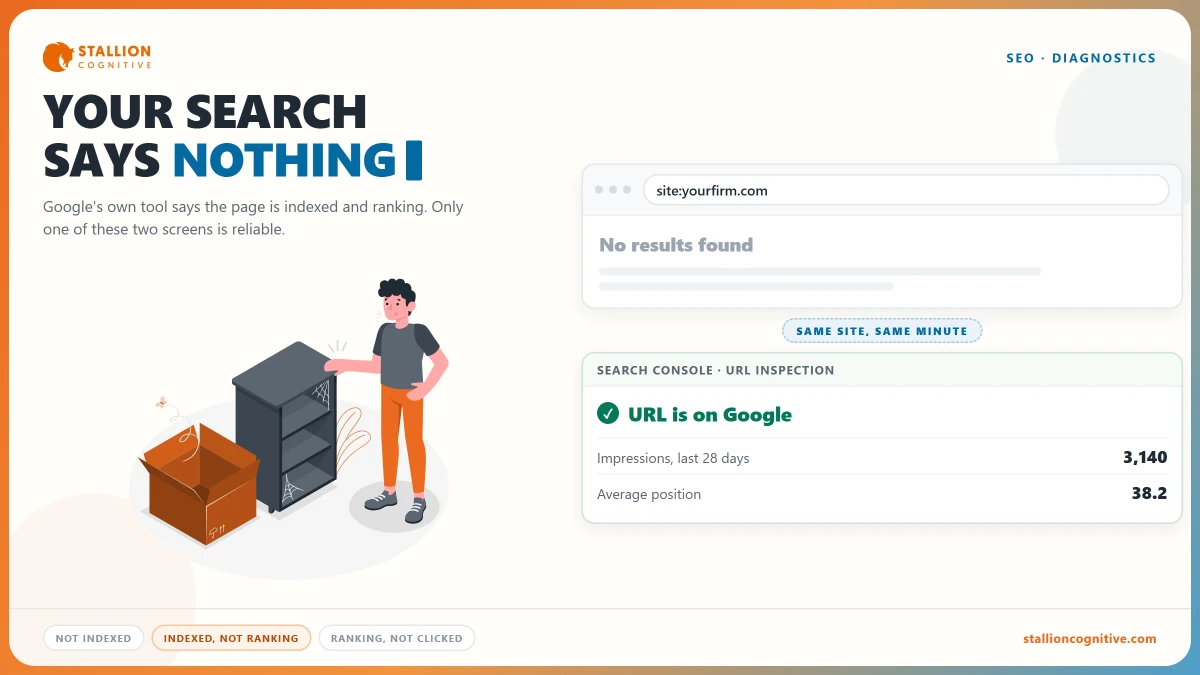
A page can sit in Google's index, rank, and earn impressions daily while your site: search returns nothing. So an owner running that check reaches exactly the wrong conclusion. They diagnose an indexing emergency, buy an indexing fix, and the real problem was never indexing.
Two more habits make the DIY check worse.
- Your results are personalized. Google shapes results by location, history and device, so your screen is not your prospect's.
- Brand-name searches flatter you. Almost every site ranks for its own company name, which says nothing about the service terms you want.
What is the test Google actually recommends?
The URL Inspection tool inside Google Search Console. Google names it on the same page that undercuts the site: search, and it returns a definite verdict for one URL at a time.
"If a URL doesn't show in a site: query, use the URL Inspection tool to make sure the URL can be indexed and to submit the URL to indexing."
You need a verified Search Console property first. If nobody at your firm has one, start there, and it is free.
How to check if your site is indexed, in five steps
- Open Search Console and pick your property: Paste your homepage address into the inspection bar across the top.
- Read the verdict line: "URL is on Google" means indexed. "URL is not on Google" means absent, with the reason underneath.
- Repeat on five real pages: Use your main service page, two practice pages, one blog post, and contact.
- Open the Pages report, once called Index Coverage: It groups every URL by status, so you see scale.
- Open the Performance report and set the range to 28 days: Write down total impressions and average position.
That last figure is the one nobody hands you, and it settles what follows.
What the impressions number tells you
An impression records a time one of your pages appeared in somebody's results. A page cannot record one unless it is indexed and ranked somewhere.
So the reading is short.
- Zero impressions across 28 days: Treat it as an indexing problem and work through the next section.
- Impressions in the thousands with clicks near zero: You are indexed, and the problem lives in your position or your listing.
Your website is not indexed by Google. What now?
Work the blockers in order of how often they cause it. Most are single-line mistakes a developer undoes the same afternoon.
Google lists the mechanical ones on its page about missing pages.
"You are blocking the page with a robots.txt file, a noindex directive, or some other mechanism, such as password protection."
The five that are somebody's mistake
- A noindex tag left on after launch: The most common cause we find. A staging site carries noindex by design, then ships to production with it.
- robots.txt blocking the crawler: One stray line in a text file at your root closes off the whole site.
- Password protection or a maintenance plugin still switched on for part of the site.
- A canonical tag pointing elsewhere, which tells Google your page duplicates another and to index that one.
- A manual action for spam, reported in Search Console under Manual Actions, which an earlier agency may have earned on your behalf.
When nothing is blocked and Google still has not come
Sometimes there is no fault to find. Google is candid that reaching every page is beyond it.
"The web is immense, and Google doesn't get to every page, though we try to!"
That sentence is worth more than any vendor's promise. Submitting an XML sitemap asks for indexing and never commands it, so a clean site can still sit in the status Search Console calls "Discovered, currently not indexed".
Resubmitting the same unchanged URL achieves nothing. Links from pages Google already crawls do change the odds, which is why we wire every new page into two or three existing ones on launch day, and why internal linking beats any submit button.
If your site builds content with JavaScript, add one check, because JavaScript rendering can leave a page that looks finished to you and empty to a crawler.
What if you are indexed but not ranking?
Then your work is content and authority, and the technical fixes above are money wasted.
A two-partner law firm in the Capital Region came to us certain Google had dropped their site, because their own search returned nothing. URL Inspection showed 41 of their 44 pages indexed. The Performance report showed 3,140 impressions over 28 days at an average position of 38.2.
Their $2,800 quote was for a problem that did not exist.
Position 38 means Google crawled the site, understood it, filed it, and ranked a dozen other firms above it. Nothing about that is a bug.
| Your setup | Passes Google's rule | What to do |
|---|---|---|
| Owned or leased office, staff present in business hours | Yes | List the street address, set no service area |
| Co-working desk with your signage and your own staff | Yes, where both hold | Keep the signage and staffed hours provable |
| Co-working mailbox, no signage, no staff of yours | No | Switch to a service area with no street address |
| Registered office at an accountant's or agent's address | No | List the working location instead |
| Home office where you meet no clients | No | Hide the address and list a service area |
That table also answers the question owners ask most. Your firm name is unusual, so you rank for it without trying. "Tax attorney" in your city is contested by directories, review sites and every competitor nearby, and that is a different fight.
Our limit is worth stating plainly. We will not quote a number before seeing URL Inspection on five pages and 28 days of Performance data. We have turned down two projects this year over refused access.
The scale of this is easy to underrate. Ahrefs studied around 14 billion pages and found 96.55% get no traffic from Google, a figure published in December 2023 from its own crawl rather than Google's index. It does not prove those pages are unindexed. It does show that being filed and being found are separate achievements.
How long should a new website take to show up?
Google publishes no answer, and that absence is the most useful fact here.
Search its documentation for an indexing time frame and none exists. No target, no published average. Every "4 days to 4 weeks" and "up to six months" figure in circulation traces to a vendor blog or a platform help page, with no methodology attached.
So take our own observed pattern, labeled as that. A new page on an established domain usually appears within days. A brand new domain with no history and no links is the slow case, and we have watched those take weeks.
Two habits shorten the wait, and both are free.
- Verify Search Console and submit the sitemap on launch day.
- Publish finished pages, because a thin one crawled early can sit unindexed long afterwards.
A new website not showing on Google in its first fortnight is usually normal. One still absent after two months, with a verified property and clean reports, is a real problem.
You are showing up and getting no clicks. What changed?
The results page itself changed. You can hold a solid position, record thousands of impressions, and still watch clicks fall, because the answer now sits above your link.
Pew Research Center tracked 900 US adults across 68,879 Google searches during March 2025. The gap it measured is wide.
- Users who saw an AI summary clicked a traditional result in 8% of visits.
- Users who saw no summary clicked one in 15% of visits, close to twice as often.
- Clicks on a source cited inside the summary happened in 1% of visits.
- Around 18% of all searches in the study produced a summary.
Those are US consumer browsing figures rather than professional-services search, so treat the direction as the finding.
For your firm the consequence is concrete. Impressions holding steady while clicks slide means you are being read without being visited, and repairing that is a different job from ranking. The work becomes being the source an answer quotes, which is why AI search citations now sit beside rankings, and why AI Overviews reshaped local results first.
Your title and description carry more weight than they did two years ago.
Which fix is worth paying for?
Match the invoice to the state you measured. Everything else is somebody guessing with your money.
We sell SEO, so weigh the next three lines with that in mind.
- Zero impressions plus a blocked verdict: You need a developer for an hour or two. Nobody needs a monthly retainer to delete a noindex tag.
- Impressions at position 30 to 60: Content and links are the work, it takes months, and any promise of a fixed date is invented.
- Strong positions with falling clicks: The job is titles, descriptions and quotability. An indexing audit finds nothing to bill for.
The proposals to refuse are the ones written before anyone looked. A quote arriving without Search Console access is a guess, and the warning signs of that habit show up inside one call.
One more check if you serve a local market. Your site can be indexed and ranking while your map listing is gone, because a suspended Business Profile is a separate outage.
The two numbers that decide your next move
Open Search Console, set the Performance report to 28 days, and write down two figures.
- Total impressions: Zero points at indexing, and anything above zero rules it out.
- Average position: It separates losing at ranking from losing at clicks.
Those two numbers place you in one of the three states above, and the state chooses the work. Most firms we meet have never opened that report, which is how a $2,800 quote for a nonexistent problem nearly gets signed.
What will your own 28 days say? If you would rather not guess at it, our free SEO audit starts from your Search Console data instead of a sales script.
Frequently Asked Questions
Does running Google Ads help our pages get indexed faster?
Paid placement and organic indexing run on separate systems. An ad puts you on the results page for as long as you fund it, and stopping the campaign removes it. Your organic pages still have to be crawled and indexed on their own merits.
Can our web host or website platform stop pages from reaching Google?
Some builders and hosts ship a global search-visibility switch, and a few block crawlers on trial plans. Check the visibility setting in your platform before assuming Google is at fault. Squarespace, Wix and WordPress all expose one.
Should we keep resubmitting the same URL every week?
Repeated submissions of an unchanged page achieve nothing, and they burn weeks you could spend earning links to it. Submit once, then change something real about the page.
What happens to our old addresses after a redesign changes them?
Old URLs need a permanent redirect to their closest new equivalent. Without one, every ranking signal the old page earned is stranded and visitors reach an error screen. Spot-check twenty URLs after launch.
Do Bing and AI chatbots need their own check?
Bing Webmaster Tools reports a separate index that often disagrees with Google's. Chatbots draw on several indexes plus their own crawlers, so a Google-only check leaves gaps.