
You've built a keyword strategy that works at home. Then you expand into Germany or Brazil, push your English terms through a translation tool, and watch the traffic never arrive. International SEO keyword research is where most global expansions quietly stall, because search behavior doesn't travel the way words do.
The good news? The process is learnable, and it runs in a clear order. This guide walks you through that order, from choosing between country and language targeting to pulling real local search volume, reading intent in the local SERP, and picking tools that won't lie to you about demand.
What International SEO Keyword Research Actually Is (And Why Translation Breaks It)
Strip away the jargon and it's one idea: find the words real people in each market type into search, then build pages around them. Sounds obvious. It falls apart the second you assume a French shopper searches the way a translated English phrase suggests. They don't, and that gap costs you rankings before you've published a word.
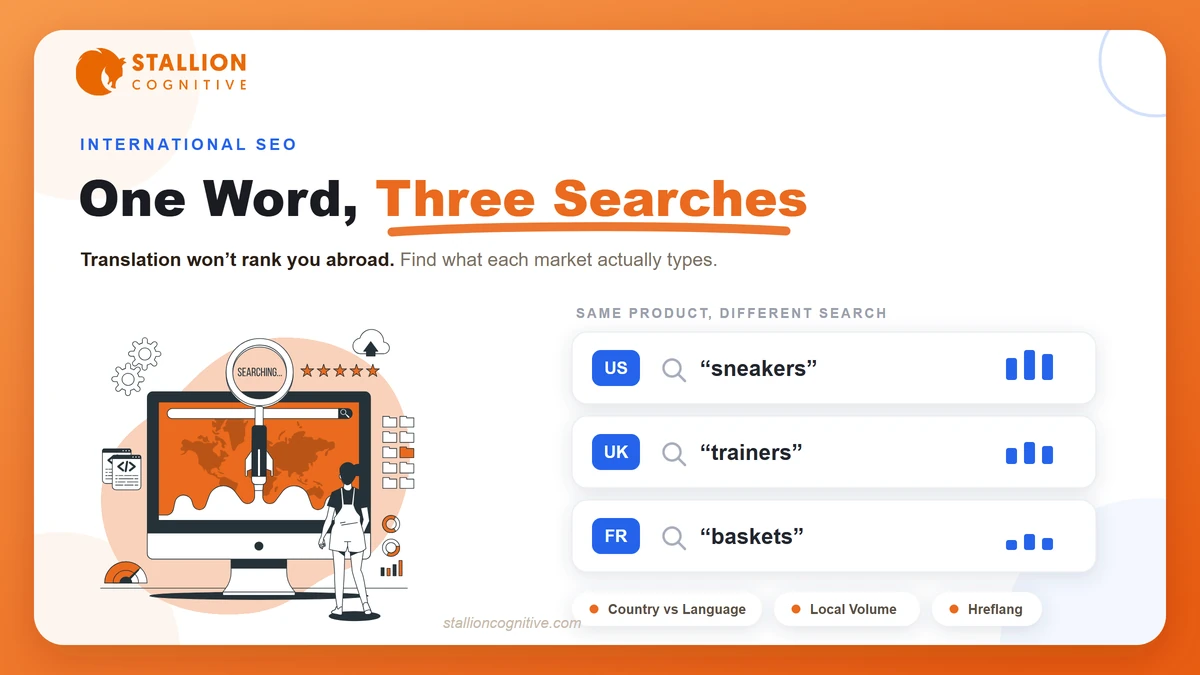
Here's the deal: translation swaps words, localization swaps meaning. A US store selling "sneakers" needs "trainers" for the UK and a different term again across parts of France. Same product, three searches, almost no overlap if you only translate. Search engines reward the page that matches the searcher's actual language, so the translated version sits invisible while a local competitor takes the click.
| Approach | What it changes | What it does for rankings |
|---|---|---|
| Translation | Words, literally, language to language | Often misses local terms, slang, and spelling, so pages rank thin |
| Localization | Meaning, tone, and the search phrase itself | Matches real local queries and intent, so pages compete |
| Transcreation | Message rebuilt for the culture and market | Strongest fit for high-value commercial and brand pages |
Knowing how much vocabulary shifts between markets also reshapes how many keywords to target per page, because one English term can split into three local ones. That split is exactly why your first real decision has nothing to do with keywords at all.
Country Targeting or Language Targeting? Decide This First
Get this wrong and every keyword you collect points at the wrong audience. Country targeting aims at people in a specific place, where currency, shipping, regulation, and local rivals shape what they search. Language targeting aims at everyone who searches in a language, wherever they sit. A SaaS tool sold in English worldwide leans language. A retailer shipping only to Canada leans country.
Most teams need a blend, and the split decides your site structure, your hreflang tags, and which search volumes even matter.
| Decision | Best when | Watch out for |
|---|---|---|
| Country targeting | Pricing, logistics, or law differ by region | Same language, different markets (US vs UK vs AU English) |
| Language targeting | One language spans many countries | Regional terms inside one language still vary |
| Blended | You serve several countries and languages | Mapping the matrix gets complex fast, plan structure early |
Google leans on hreflang annotations to serve the right version to the right searcher, and getting that right depends on a clean internal linking structure across your language and country folders. Once the targeting call is locked, the research itself follows a repeatable sequence.
How to Do International Keyword Research, Step by Step
Most guides hand you a tool and wish you luck. The order matters more than the tool. Run these five steps in sequence for each market, and you'll skip the rework that sinks rushed expansions, where teams collect 800 keywords nobody in the target country actually types.
Step 1: Map Your Markets Before You Touch a Tool
Start on paper. For every target, write down the country, the language, the regional spelling variant, and one local competitor already ranking. A single "Spanish" line is a trap, because Spain, Mexico, and Argentina search differently.
Map these per market first:
- Country and primary search language
- Regional dialect or spelling (e.g. Latin American vs European Spanish)
- One or two local competitors already winning organic
- Currency, units, and any local buying terms
Step 2: Pull Local Search Volume, Not Global Numbers
Global volume is a vanity metric. A keyword showing 40,000 global searches might pull 200 in the country you care about. Set every tool to the exact country and language before you read a single number, then judge demand market by market.
Step 3: Localize Seed Keywords With Native Input
Run your seed list past a native speaker or a market-specific source rather than a translation engine. Forums, Reddit threads, and local subreddits reveal the slang and buying language tools miss. The same instinct that powers good AI prompts for keyword research applies here: feed the model local context instead of raw English, or it hands back textbook translations.
Step 4: Validate Intent in the Local SERP
A word can mean two things in two countries. Search your localized keyword on Google set to the target region, then read what ranks. If the page-one results don't match what you sell, the intent is off. Pay attention to conversational search queries too, since voice and AI Overviews surface long, spoken-style phrasing that differs by market.
Step 5: Map Keywords to URLs and Hreflang
Every validated keyword needs a home. Assign each to a specific localized URL, then confirm your hreflang and XML sitemap setup tell Google which version serves which audience. Skip this and your German and Austrian pages compete against each other instead of their rivals.
With the method clear, the tools become a force multiplier rather than a crutch.
The Best Tools for International Keyword Research
No single tool wins every market, so most teams run two or three together. The ones below all filter by country and language, which is the only feature that counts here. Treat pricing as directional and confirm current plans on each vendor's page, since these categories change month to month.
| Tool | Best for | Starts around | Country/language filters |
|---|---|---|---|
| Semrush | All-in-one research at scale | $140/month | 140+ country databases |
| Ahrefs | Local volume and SERP depth | $129/month | 200+ countries |
| Google Keyword Planner | Free baseline volume | Free (with Ads) | Country and language settings |
| AlsoAsked | People Also Ask by region | Free tier, paid from ~$15/month | City-level, all Google languages |
| Google Trends | Demand direction over time | Free | Country and sub-region |
Semrush
The default for teams that want one platform. Its country-level keyword databases make side-by-side market comparison painless.
- Best for: Agencies and in-house teams running multiple markets
- Standout features: 140+ geo databases, keyword gap, local SERP features
- Pricing: Paid plans start around $140/month
Ahrefs
Strong where you need accurate local volume and a deep look at who already ranks.
- Best for: Competitive analysis in specific countries
- Standout features: Per-country volume, parent topic, SERP overview
- Pricing: Paid plans start around $129/month
Google Keyword Planner
Free, and still useful if you set location and language tightly. Built for Ads, so volumes come in ranges.
- Best for: A no-cost starting point per market
- Standout features: Native country and language targeting, forecast data
- Pricing: Free with a Google Ads account
AlsoAsked
The fastest way to see how questions shift across regions and languages.
- Best for: Mapping People Also Ask and intent clusters
- Standout features: City-level targeting, every Google language, visual question maps
- Pricing: Free tier, paid plans from roughly $15/month
Google Trends
Not a volume tool, a direction tool. Use it to compare two terms or spot a rising market before you commit budget.
- Best for: Validating demand trend and seasonality
- Standout features: Region and sub-region breakdowns, related rising queries
- Pricing: Free
Good tools still won't save a process built on the wrong assumptions, which is where most international programs leak.
Mistakes That Quietly Kill International Rankings
These rarely show up as one big failure. They bleed traffic slowly, and by the time the report looks wrong, months are gone. The cost is real, with cross-border ecommerce projected to reach roughly $7.9 trillion by 2030 according to Statista, so an underperforming market is money left on the table.
Watch for these:
- Translating instead of localizing. The single most common error, and the one that makes whole markets invisible.
- Trusting global search volume. A big global number can hide near-zero demand in your actual target country.
- Ignoring hreflang. Without it, Google serves the wrong language version and your pages cannibalize each other.
- One keyword set for a whole language. Spanish for Spain is not Spanish for Mexico, and treating them as one flattens both.
- Forgetting AI search. Generative engines and AI Overviews answer differently per market, so generative engine optimization now belongs in the same research pass.
Avoid these five and you're already ahead of most brands expanding abroad.
Where This Leaves You
International keyword research isn't harder than domestic work. It's just less forgiving of shortcuts, because every assumption you carry across a border gets tested by a different audience. Nail the targeting decision, pull local volume, validate intent in the SERP, and the rankings follow.
Ready to expand into new markets without guessing which keywords actually convert there? See how the team at Stallion Cognitive builds international SEO strategies that turn local search into local revenue.
Frequently Asked Questions
How long before international keyword research pays off?
More than most teams expect when they start. New localized pages typically need three to six months to gain traction in a fresh market, longer in competitive categories. Local backlinks and consistent publishing speed it up, but no tool shortcuts the trust a new domain or folder has to earn.
Can free tools handle international keyword research?
Google Keyword Planner, Google Trends, and AlsoAsked's free tier cover a surprising amount of ground for a single market. Where they fall short is scale and accurate volume across many countries at once. Run free tools to start, then add a paid platform when you're managing several markets together.
Should I research keywords before or after translating my site?
Before, always. Researching first tells you which terms each market actually searches, so your localized pages target real demand instead of translated guesses. Translate-then-research wastes effort on phrasing nobody types, and you end up redoing the content anyway.
Do AI search engines change international keyword research?
They add a layer rather than replacing the work. Generative engines and AI Overviews pull answers differently by region and language, so question-style and conversational phrasing matter more now. Research the long, spoken queries people ask alongside the short head terms a keyword tool surfaces.
How many countries should I target at once?
Start with one or two markets you can resource properly. Spreading thin across five countries usually means five half-built sites that rank nowhere. Win one market, document what worked, then port the approach to the next with the local terms swapped in.