
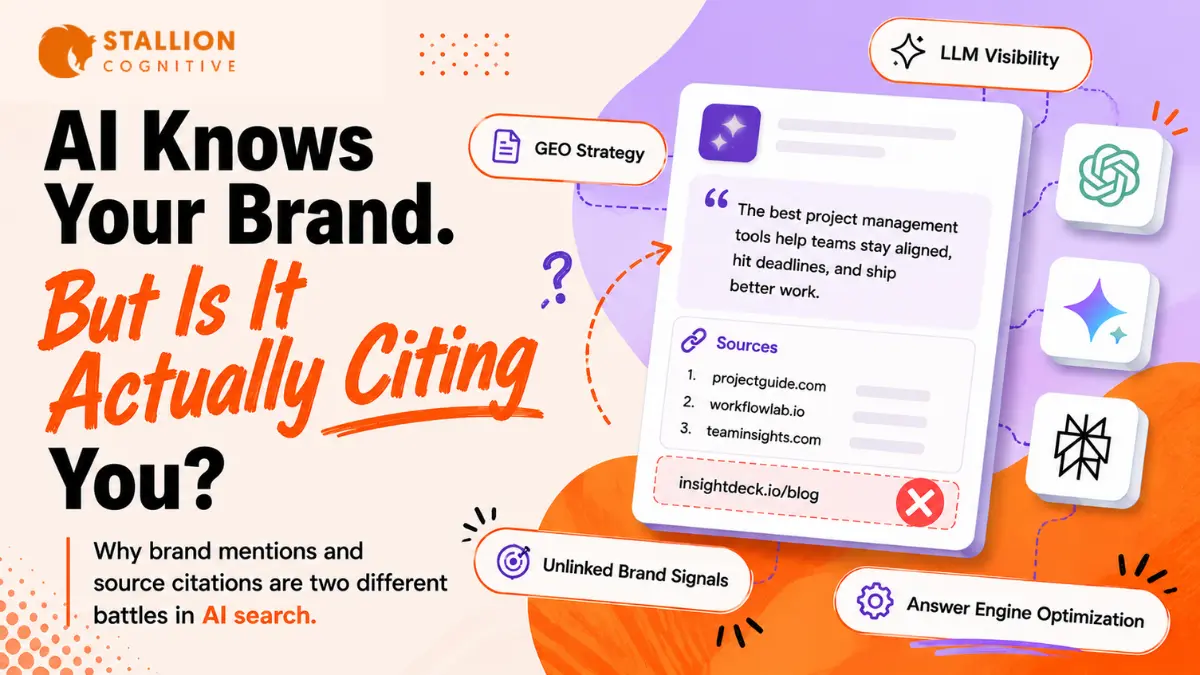
You ask ChatGPT to recommend the best option in your category, and it names three competitors. Then, down in the footnotes, it cites your own blog post as the source. That gap sits at the heart of brand mentions vs citations in AI search, two signals that look alike but do completely different jobs.
Most marketers chase one and ignore the other. They either obsess over getting linked as a source or assume a handful of mentions will carry them. Both halves matter, and the brands pulling ahead in AI visibility treat them as two separate goals.
Let's start with what actually separates a mention from a citation.
What's the Real Difference Between an AI Mention and a Citation?
Think of a citation as a footnote and a mention as a recommendation. When ChatGPT links your pricing guide at the bottom of an answer, that's a citation. When it types your brand name into the recommendation itself, that's a mention. Same brand, two very different outcomes for your pipeline.
The distinction sounds small until you watch it play out in real answers. One signal credits your research. The other credits your reputation. Here's how they stack up side by side.
| Old role of GBP | 2026 role of GBP |
|---|---|
| Map pack ranking signal | Map pack signal plus AI citation source |
| Updated quarterly at audit time | Updated weekly minimum |
| Phone-call attribution | Phone-call plus AI-referred conversion |
A citation tells the reader where the facts came from. A mention tells the reader who to call. If you only understand one of these, the rest of your AI search strategy rests on a guess, which is why grasping the wider shift in GEO, AEO, and SEO pays off before you go deeper.
That difference isn't just semantic. It comes from how these systems are built.
Why AI Search Treats Mentions and Citations as Separate Signals
Ahrefs studied 75,000 brands and found that branded web mentions correlate with AI Overview visibility at 0.664, while backlinks limp in at 0.218. That gap exists because language models read your brand as text scattered across the web, then judge separately whether your pages are worth quoting.
In other words, two different engines are running. One asks whether your brand belongs in the conversation. The other asks whether your content is solid enough to reference.
- The evidence check earns citations. AI scans whether a page is accurate, specific, and quotable, so a data-rich comparison post often gets pulled as a source.
- The recommendation check earns mentions. AI weighs how often your brand surfaces across trusted places before it names you out loud.
The mentioned engine rewards presence. The same Ahrefs data shows brands in the top quartile for web mentions average 169 AI Overview mentions, against just 14 for the quartile below, and 26% of brands register zero. Sit in the bottom half of web chatter and you're close to invisible, which is the same dynamic now reshaping how AI Overviews work for local results.
Once you see the two engines, a frustrating pattern starts to make sense.
Being Cited Without Being Mentioned: The Trap Most Brands Fall Into
Zapier ranks as the number one cited source in digital tech, yet sits at number 44 for brand mentions. SEMrush calls this gap the Mention-Source Divide, and it snares brands that pour everything into content while building none of the reputation signals that earn a recommendation.
It's a quiet failure, because the analytics look healthy. You're getting cited. Traffic trickles in. Meanwhile the buyer never sees your name at the moment of choice. You might be wondering whether this is your situation right now. Three signs give it away:
- Your domain shows up in the source list, but your brand name never appears in the answer body.
- AI describes your category accurately using your research, then recommends three rivals.
- You rank well on Google for the topic yet stay absent when someone asks AI for a pick.
SEMrush found that only 6 to 27% of the most-mentioned brands also rank as top cited sources, depending on the industry. So most companies are quietly winning one race and losing the other without realizing two races exist. The fix starts with understanding why winning both changes everything.
Why Both Signals Matter More Together Than Apart
One signal alone is fragile. A brand that gets cited but never named informs the market while a competitor closes the sale. A brand named without a citation looks popular yet thin on proof. Pair the two and your visibility starts to compound, resurfacing across answer after answer.
Vertical data makes the split concrete. A Victorious study of 177 brands across eight AI platforms tracked mention rate and citation rate as separate numbers, and the patterns by industry were striking.
- Financial services was the one vertical where citations slightly outran mentions, because AI trusts editorial media like Bankrate before it trusts a single brand.
- Legal firms get cited constantly yet rarely named, since AI pulls their articles but struggles to attach them to a recognizable firm.
- Ecommerce brands get named but sourced elsewhere, usually Amazon and review aggregators rather than their own pages.
Each of those gaps is money left on the table. And there's room to claim it. The same study found 89.8% of tested brands had zero AI mentions in early 2026, so the field is wide open for anyone who moves with intent. Whether you believe SEO is really dead or just evolving, the brands closing both gaps are the ones buyers will meet first. Closing them comes down to a handful of deliberate moves.
How to Earn More AI Mentions and Citations
Start where AI already reads. The platforms feeding AI answers, think G2, Reddit, and industry media, are where mentions get built, while your own well-structured pages are what earn citations. You win each one differently, so treat them as two projects running side by side.
Word of caution: Piling on more blog posts only feeds the citation engine. Mentions need a different kind of effort. Work these four moves in order:
- Show up where AI already looks. Find the three to five sources AI cites in your category, then get your brand named there with real context rather than a banner ad.
- Publish data only you have. A named benchmark or original survey gives AI something concrete to quote and tie back to your brand.
- Make your own pages quotable. Swap vague claims for specs, pricing, and verifiable numbers AI can lift cleanly into an answer.
- Earn brand-rich mentions off-site. Strong local link building tactics and digital PR push your name across the web, which is the signal AI weighs most.
None of this works as a one-off campaign. It's a steady drumbeat that lifts both numbers over time. Which raises the obvious question of how you actually measure those numbers.
How to Track Your Mentions and Citations Across AI Platforms
Semrush, Ahrefs Brand Radar, and Profound all track AI visibility now, and they exist because eyeballing ChatGPT once a week tells you nothing useful. You want two figures per platform. How often your brand gets mentioned, and how often your domain gets cited.
The catch is that every platform reads a different slice of the web, so a win on one says little about the others. SEMrush found Reddit dominates ChatGPT answers while Google AI Mode leans on commercial sites like Bankrate, which means one strategy won't cover all of them.
| AI Engine | Primary GBP Signals | Refresh Cadence |
|---|---|---|
| Google AI Overviews | Category, reviews, attributes, Q&A, posts | Daily for active profiles |
| ChatGPT (web search mode) | NAP, hours, website content via Bing | Near real-time on prompt |
| Perplexity | Web index, structured data, citation graph | 24 to 72 hours |
| Gemini | Full GBP, Knowledge Graph, review text | Daily |
Track three things every month and the picture gets clear fast:
- Mention rate: how often your brand is named across a fixed set of category prompts.
- Citation rate: how often your domain shows up as a source.
- The overlap: where you earn both, the pattern that actually sticks.
Pairing the right best AI marketing tools with a monthly check turns AI visibility from a guessing game into a scoreboard you can move. The brands treating it that way are already pulling ahead.
Conclusion
The brands winning the next year of AI search are the ones treating mentions and citations as two scoreboards instead of one. Most competitors still chase a single number, which leaves the door wide open for anyone paying attention to both. So the real question is simple. When a buyer asks AI who they should hire in your space, does your brand come up, and does your work back it up?
If you're not certain, that's exactly where the team at Stallion Cognitive can help you build your AI visibility from both sides.
Frequently Asked Questions
Do brand mentions need a backlink to influence AI search?
None of these mentions require a hyperlink to count. Language models learn from raw text, so your brand name appearing in a review, a forum thread, or industry coverage shapes AI answers even when no link is attached. That's why unlinked mentions now carry real weight.
How long before a brand starts appearing in AI answers?
More than most timelines admit, because AI visibility builds on accumulated web presence rather than a single push. Expect a few months of consistent mentions and fresh content before patterns shift, and longer in crowded verticals where established names already own the conversation.
Can paid search ads increase AI brand mentions?
Spending on ads barely moves this needle. Ahrefs found branded ad traffic and ad cost showed weak correlations with AI Overview presence, far behind earned mentions. Paid search can support awareness, but it won't buy your way into the body of an AI-generated recommendation.
Are AI mentions the same as ranking on Google?
They overlap without being identical. Strong traditional rankings help, since AI systems often draw from top web results, but a page can rank well and still go unnamed in AI answers. Brand presence across third-party sources is what tips a citation into a recommendation.
Should a B2B brand worry about AI visibility this early?
Early movers hold the advantage here. With roughly nine in ten brands still earning zero AI mentions, the competition in most categories is a handful of incumbents rather than the whole field. Building presence now is far cheaper than clawing it back once rivals lock it in.