
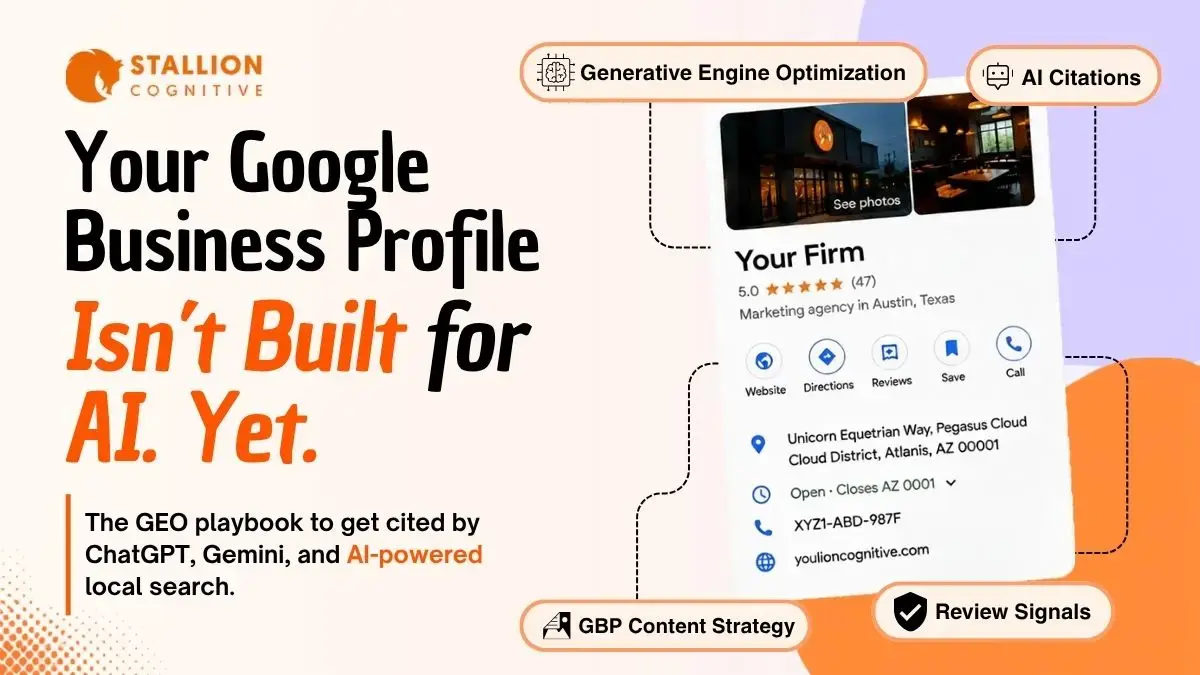
You finished your Google Business Profile last year. You post weekly, the photos are sharp, the review average is solid. Then a buyer searches "best [your service] near me" inside ChatGPT and the recommendation goes to your competitor down the road.
Walk through the 2026 Google Business Profile GEO blueprint and you can close that gap inside a quarter. We'll cover what AI engines actually pull from your profile, the six fields that decide citations, how reviews function as AI source-of-truth, post and photo cadence that signals freshness, and the tracking setup that tells you whether any of it is working.
Why GBP Is Ground Zero for Local GEO in 2026
Most local business owners still think of their Google Business Profile as the thing that gets them into the map pack. That's outdated framing. In 2026, your profile is the single most-cited source AI engines pull from when someone asks Gemini, ChatGPT, or Perplexity for a local recommendation.
The shift happened quietly. AI Overviews now appear in roughly 16% of searches according to Search Engine Land, and they pull GBP data directly into their answers. Meanwhile ChatGPT and Perplexity both index your profile through Bing's crawl plus Google's structured business data.
The role has shifted in a way most agencies still haven't priced in:
| Old role of GBP | 2026 role of GBP |
|---|---|
| Map pack ranking signal | Map pack signal plus AI citation source |
| Updated quarterly at audit time | Updated weekly minimum |
| Phone-call attribution | Phone-call plus AI-referred conversion |
Your profile now does two jobs at once. It ranks you in the map pack, and it feeds AI summaries that increasingly answer queries before a user clicks anything.
The traffic math has changed too. Organic search still sends more visits than every AI engine combined, but AI-referred traffic converts at higher rates because the user arrives pre-qualified by the model's recommendation. A buyer who shows up via ChatGPT has already been told you're the right answer.
The agencies treating GBP as a checklist artifact are losing visibility share to agencies treating it as a living data product. We've seen profiles with monthly updates outperform identical competitors who set up once and never touched the profile again, even when the second group had more reviews.
For the strategic frame behind these shifts, our breakdown of how AI Overviews are changing local search covers the data layer driving them.
What AI Engines Actually Pull From Your Google Business Profile
Different engines pull different fields. Google's AI Overviews lean heavily on category, reviews, and Q&A. ChatGPT and Perplexity scrape your profile through Bing and through direct web crawls, which means your name, address, hours, and structured attributes all feed downstream AI answers.
The cadence varies by engine. Some refresh in hours. Others wait a week.
| AI Engine | Primary GBP Signals | Refresh Cadence |
|---|---|---|
| Google AI Overviews | Category, reviews, attributes, Q&A, posts | Daily for active profiles |
| ChatGPT (web search mode) | NAP, hours, website content via Bing | Near real-time on prompt |
| Perplexity | Web index, structured data, citation graph | 24 to 72 hours |
| Gemini | Full GBP, Knowledge Graph, review text | Daily |
Incomplete or stale GBP data leaves you invisible across every major AI engine simultaneously. The same feed handles four different surfaces, so the cost of neglect compounds.
Only 11% of domains get cited by both ChatGPT and Perplexity according to recent platform analysis. That gap means a complete GBP plus consistent web citations matters more than chasing one specific AI engine. You're building entity confidence, and entity confidence is platform-portable.
Want the comparison frame across GEO, AEO, and SEO so the team isn't pulling in three different directions? Our deep dive on GEO vs AEO vs SEO for local marketers handles that handoff.
The GBP Fields That Drive AI Citations
Six fields decide most AI visibility outcomes. The rest are hygiene. Get the right ones locked in and you've handled roughly 80% of what an AI engine needs to recommend your business by name.
Now: the priority order, ranked by observed impact on AI citations.
- Primary category. AI engines use this as the first-pass filter when matching queries. A dentist categorized as "Dental clinic" gets cited for general queries. The same business categorized as "Cosmetic dentist" gets cited specifically for cosmetic-intent queries.
- Services list. Each service you add becomes a separate matching signal. Most agencies add five services. Add fifteen, each with a specific 200-character description.
- Business description (750 chars). Write for the AI engine first and the human second. Lead with the city, the primary service, and the specific buyer problem you solve. Skip the "established in 1998" filler.
- Attributes. Wheelchair accessible, women-led, free Wi-Fi, and the rest of the relevant tags Google maintains. AI engines pull these to answer specific-intent queries.
- Photos with geo-data. Photos uploaded with location metadata anchor your entity to a physical place.
- Q&A section. Owner-posted questions and answers feed AI engines a structured FAQ they can quote verbatim.
One field most owners ignore: the Q&A section. You can post your own questions and answer them, and Google permits this explicitly. That's free AI training data written in your phrasing.
Google's own guide to AI optimization calls out structured business data as the most important signal AI surfaces consume. Categories, services, and attributes all carry that structured weight.
For agencies running this work across dozens of profiles, our multi-location local SEO guide addresses the systems side of GBP at scale.
Reviews and Q&A: The Strongest AI Trust Signals You Have
AI engines treat customer reviews as ground truth. When someone asks Gemini about "the best dentist in Naperville for nervous patients," the model looks for businesses whose review text contains words like "gentle," "patient," and "sedation." Your star rating gets you in the room. Your review content gets you cited.
The implication changes how you ask for reviews. Generic prompts produce generic reviews, which produce zero AI matches for specific buyer queries.
Train customers to write specific reviews using these prompt patterns:
- After a service appointment: "Would you mind mentioning which service you came in for and what stood out?"
- For first-time visitors: "What were you nervous about before coming in, and how did we handle it?"
- For repeat customers: "What keeps you coming back? Specifics help."
- For service-area businesses: "Where in [city] are you coming from? Mentioning the neighborhood helps neighbors find us."
Specificity beats volume past a certain threshold. A business with 80 reviews containing specific service names, neighborhoods, and use cases gets cited more often than a business with 400 reviews that all read like "great service, friendly staff."
Word of caution: review velocity matters. Twenty reviews in a week after twelve months of silence reads as manipulation to both Google and the AI engines pulling from Google. Steady cadence matching your real customer volume protects you.
The Q&A side pays off faster and gets less attention. Post the top five questions buyers ask before they call, and answer each one with the specific keywords AI engines need for matching. Our local SEO audit checklist includes the Q&A audit step most agencies skip.
Posts, Photos, and the Cadence That Keeps AI Updated
Google Business Profile posts age out at seven days for offers and stay indefinitely for updates. AI crawlers treat that recency window as a freshness signal. Businesses posting weekly with specific facts (new service, seasonal hours, location-specific inventory) end up cited more often than profiles that haven't been touched in months.
Cadence is where most owners stumble. Posts go up when someone remembers, or only when something specific happens, and AI engines penalize the inconsistency.
The cadence that actually moves AI visibility:
- One "update" post per week covering a specific service, neighborhood, or seasonal angle.
- One photo upload per week with geo-tagged metadata and a descriptive filename.
- One Q&A entry per month added by the owner, with a complete answer.
- Monthly attribute audit to catch any new Google attributes relevant to your business.
- Quarterly photo refresh of cover and logo to keep visual identity current.
Fresh facts beat polished filler. A post that says "We added Saturday hours at our Frisco location starting March 1" pulls more AI weight than a post that says "We pride ourselves on great service." AI engines look for new, verifiable, citable facts.
Fair warning: don't recycle the same post text. AI engines and Google both detect templated content. Vary your hooks, your specifics, and your call-to-action.
Photos carry more weight than most owners realize. Geo-tagged photos with descriptive alt text (yes, you can name your image files before uploading) anchor your entity to a real-world location. For the broader system view of how GBP work fits the full GEO stack, our breakdown on generative engine optimization for local services maps it out.
Once cadence is locked, the next question becomes whether any of this is actually showing up in AI answers.
Measuring AI Visibility Without Wasting Your Sunday
Forget rank tracking for a minute. The metric that matters now is whether your business shows up when someone prompts an AI engine. Tools like Otterly, Profound, and AthenaHQ run automated prompt audits across ChatGPT, Perplexity, Gemini, and Google AI Overviews. Three prompts per week is enough to see whether your GEO work is landing.
For small businesses or agencies running fewer than ten locations, manual checks still work. The lean version:
- Five branded prompts: Run queries that include your business name. Are AI engines pulling your service list correctly? Mentioning the right cities? Quoting your reviews?
- Five competitive prompts: Run queries that match your top three buyer intents (e.g., "best [service] in [city]") without naming your business. Note who gets cited.
- Track over 90 days: Log results weekly and read the trend line across the full window.
The metric that matters most is citation share. Out of the businesses an AI engine names in answer to your target queries, what percentage of the time is yours one of them? Citation share moves slowly. Expect 8 to 12 weeks of consistent work before you see meaningful change.
Here's the thing: AI visibility doesn't reduce to a single ranking number. You're measuring whether a model trusts you enough to name you by brand in a generated answer. The work to influence it compounds quietly.
For the platform-specific weighting frame across engines, Moonrank's analysis on AI search ranking factors breaks down what each one prioritizes and where the differences hit.
Conclusion
AI engines aren't going to wait for your annual GBP audit. The brands getting cited in 2026 treat their profile as a living data product with fresh posts, accurate categories, and real photos tied to real locations. The work is unglamorous and compounds quietly.
Want an audit of your Google Business Profile for GEO readiness across multiple locations and AI platforms? Stallion Cognitive builds local visibility programs for agencies and multi-location brands who want AI citations alongside their blue-link rankings.
Frequently Asked Questions
How long until my Google Business Profile shows up in AI answers?
More than most agencies admit. AI engines cache training data and refresh web snapshots on different cycles. ChatGPT's web search reads your profile in near real-time. Gemini updates faster than Perplexity. Expect 2 to 6 weeks for consistent citations after a clean audit.
What happens if my NAP data is inconsistent across the web?
The transition is where things break. AI engines weight entity confidence by how consistently your name, address, and phone appear across directories. Conflicting data lowers citation probability on every AI platform. Yelp, Apple Maps, Bing Places, and your own site all need to match exactly.
How often should I post on Google Business Profile for GEO?
Once a week minimum. Two posts a week if you can sustain it without recycling content. Each post should add a new fact: a new service, a seasonal offer, a specific neighborhood you serve. AI treats fresh facts as confidence signals.
Which tools track whether my business shows up in ChatGPT?
Otterly, Profound, and AthenaHQ run automated prompt audits across ChatGPT, Perplexity, Gemini, and AI Overviews. Manual checks work for small businesses. Run five branded and five competitive prompts per week, log the citations, and watch the trend over 90 days.
Does buying reviews speed up AI visibility?
None of the shortcuts hold up. AI engines and Google both flag review velocity spikes, duplicate IP patterns, and templated language. A 90-day suspension cancels every GEO gain you'd built. Earn reviews the slow way through real customer experience and post-purchase follow-up.