
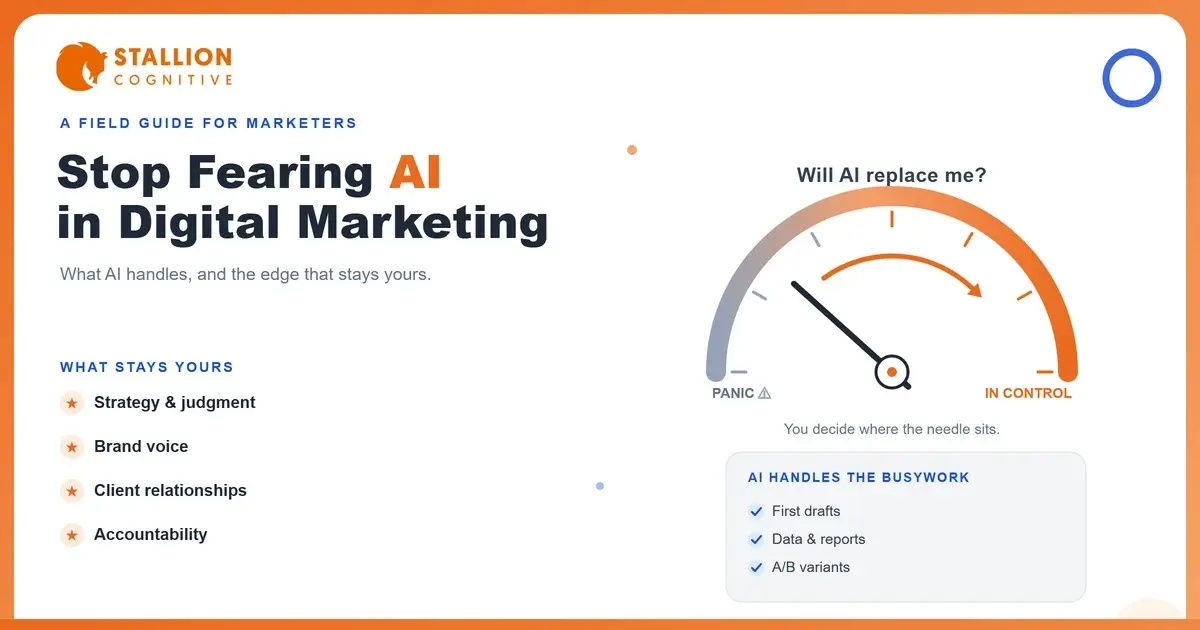
You opened a shiny new tool, watched it draft a full campaign in ninety seconds, and felt your stomach drop. That reaction is everywhere right now. Most people working in AI in digital marketing have hit that exact moment, somewhere between impressed and quietly threatened.
Good news. The fear is actually useful information. Pointed in the right direction, it shows you precisely where a human still earns the paycheck.
The guide ahead covers what the tools can and can't do, whether your role is actually at risk, and the concrete moves that turn AI into an advantage instead of a layoff notice. No hype, no doom.
Why the AI Panic Is Real, and Where It Comes From
Start with the number that explains the mood. A 2025 survey found that 81.6% of digital marketers worry AI will replace them, and that worry isn't paranoia. Roles are shifting, budgets are tightening, and the tools really do handle slices of the work now.
So the feeling is rational. What's irrational is letting it freeze you. Fear tends to spike loudest right when a skill is about to change, and marketing is mid-change.
Here's the deal: most of the dread traces back to a handful of specific triggers rather than some vague sense that robots are coming. Naming them shrinks them.
- Speed shock: A tool drafts in seconds what used to eat your afternoon, and the gap feels like a threat instead of a gift.
- Quiet layoffs: Headcount cuts framed as "efficiency" make everyone read the room.
- Skill whiplash: The thing you got hired for, churning out volume, is the thing AI now does cheapest.
- Silence from leadership: When nobody says how AI fits the plan, people assume the worst.
Once the triggers have names, you can answer them one by one. The biggest one deserves its own section, because the honest answer is more reassuring than the panic suggests.
Will AI Replace Digital Marketers, or Just Reshape the Job?
Reshape, mostly. The World Economic Forum's Future of Jobs Report 2025 projects 170 million new roles created and 92 million displaced by 2030, a net gain of 78 million, with nearly 40% of required skills changing along the way. Marketing sits right in that churn.
Adoption backs this up. McKinsey's 2025 State of AI found 71% of organizations regularly using generative AI, and marketing and sales ranked among the functions where companies most often report revenue gains from it. Read that again. The teams using AI are growing revenue, which means they need people who can run it.
The job doesn't disappear; it divides into the parts a machine can take and the parts that still need you. Some tasks slide over, and the rest get more valuable because a person owns them.
| AI handles this well | A human still owns this |
|---|---|
| First drafts, headline variations, ad copy at volume | Brand voice and the final yes-or-no on tone |
| Crunching analytics and building reports | Deciding what the numbers actually mean |
| Keyword clustering and on-page checks | The angle, the story, the reason anyone cares |
| Routine personalization at scale | Trust, relationships, and the awkward client call |
Word of caution: the marketers who get squeezed are the ones clinging to the left column. The ones who move right become harder to replace every quarter. That move starts with knowing exactly what the tools fumble.
What AI Still Can't Do in Marketing (Your Real Edge)
Watch a model write for an hour and the cracks show. It produces fluent, confident, on-brand-ish copy that says almost nothing new. AI is a brilliant pattern-matcher and a poor original thinker, and that single gap is where your value lives.
The cracks are predictable, which makes them easy to defend:
- Net-new strategy: A model remixes what already exists. It can't decide that your accounting client should bet the year on a bold tax-season campaign nobody else is running.
- Taste and judgment: It doesn't feel the difference between a line that lands and one that's merely correct.
- Accountability: When a campaign tanks, "the AI suggested it" is not a sentence you can say to a client.
- Real relationships: Trust gets built on calls, in rooms, over years. No tool shortcuts that.
- Lived context: It has never sat in your market, watched your buyers hesitate, or read the subtext in a sales call.
A quick example. A model can generate fifty blog intros about local SEO in a minute. It cannot tell you that a law firm in a saturated metro should ignore generic rankings and chase a hyper-specific practice niche instead. That judgment call is the job.
But here's the kicker: defending the edge has nothing to do with working around AI. It comes from routing the boring work to the tool so you keep room for the work it can't touch.
How to Turn AI From Threat Into Teammate: 5 Moves That Work
Stop treating AI as a referendum on your career and start treating it as an intern who never sleeps. Below are five moves, in order, that take you from anxious to in-control. None require a coding background. All of them work this week.
Move 1: Audit Your Week and Tag the Truly Repeatable Parts
Before automating anything, see clearly. Track one normal work week and mark every task as "thinking work" or "repeatable work." Drafting meta descriptions, reformatting reports, first-pass research: those are repeatable. The strategy behind them isn't.
Most marketers find 40 to 60% of their week sitting in the repeatable bucket. That bucket is your AI starting line, and nowhere near your whole job.
Move 2: Rebuild One Workflow Around AI Before Touching the Rest
Now: pick a single workflow and rebuild it end to end with AI in the loop. Just one. Trying to automate everything at once is how people burn out and quit the whole experiment by Friday.
Blog production is a strong first pick. Let the tool handle outlines and first drafts while you own the brief, the angle, and the edit. Get that humming, then move to the next workflow.
Move 3: Prompt Like You're Briefing a Junior Writer
Weak prompts produce the generic slop everyone complains about. Strong prompts read like the briefs you'd hand a junior writer: audience, goal, voice, constraints, examples. The skill transfers directly from the briefs you already write.
If you want a head start, our breakdown of AI prompts for keyword research shows the level of detail that separates a usable output from a throwaway one.
Move 4: Become the Editor Who Sharpens Every Draft
The value isn't in producing words anymore. It's in judging them. Treat every AI draft as a rough lump of clay: cut the filler, kill the AI tells, add the specific example only you know, and sharpen the point.
Editors who can spot weak reasoning and lifeless copy in seconds are about to be worth a lot more than fast typists ever were.
Move 5: Climb Into Strategy, GEO, and Measurement
Spend your reclaimed hours moving up. Learn how AI search surfaces brands, because the rules already shifted. Our guide to how AI Overviews are changing search and the deeper dive on generative engine optimization map the territory most marketers haven't touched yet.
Strategy, GEO, and clean measurement are exactly where AI is weakest and clients pay most. Land there and the panic quietly disappears, replaced by a much better problem: too much demand for your time.
The AI Marketing Skills Worth Building in 2026
Forget learning to "use ChatGPT." That's table stakes now, like knowing Excel. The skills with real shelf life sit one layer up, where human judgment steers the machine. The WEF data already flagged this: roughly 40% of job skills are turning over, and the marketers who reskill early get the runway.
Here's a short, honest list of what to build, roughly in order of payoff:
- Prompt design as briefing: The single highest-impact habit, and the easiest to start.
- AI output editing: Spotting hallucinations, generic phrasing, and weak logic fast.
- GEO and AEO: Getting cited inside AI answers, well beyond a page-one ranking.
- First-party data and measurement: Proving what actually drove revenue when attribution gets murky.
- Tool fluency: Knowing which tool fits which job, which our roundup of the best AI marketing tools walks through for lean teams.
Notice the pattern. Every skill on that list is about directing AI rather than competing with it. Build two or three and you stop being a person who fears replacement and become the person your team can't replace.
Where This Leaves You
The marketers losing sleep over AI and the ones thriving with it are often doing the same job. The difference is which column they decided to live in. So which task are you handing your tireless new intern first, and what will you finally have time to build once you do?
If you'd rather have a team that already runs AI-assisted SEO and content without losing the human edge, talk to Stallion Cognitive and put the fear to work.
Frequently Asked Questions
Is it too late to start learning AI marketing in 2026?
Two quarters of steady, hands-on practice is enough to get comfortable and useful. The marketers who feel behind usually haven't started at all. Pick one tool, one workflow, and reps beat reading every time.
Which AI tools should a small marketing team start with?
A general assistant like ChatGPT or Claude for drafting, plus one SEO platform with AI features for research and clustering. Resist stacking ten tools early. Two used well outperform a bloated subscription list nobody fully learns.
Will AI-written content hurt my SEO rankings?
None of Google's guidance penalizes AI assistance directly; it penalizes unhelpful, low-effort content regardless of who typed it. Raw AI output published unedited tends to be thin and generic, which is what actually sinks rankings. Edit hard and add real expertise.
How do I prove my value when AI does the grunt work?
The risk is staying measured by output volume after volume got cheap. Shift the conversation to outcomes you influenced: strategy calls, conversion lifts, retained clients. Document the judgment behind the work, because that's the part no tool delivers.
Should I tell clients I use AI?
More transparency helps than hurts, as long as you frame it right. Clients care about results and accountability over your toolchain. Position AI as how you move faster while a human owns quality, and most see efficiency rather than corner-cutting.