
Open your Google Ads account today and your campaigns look the same as last year. The control behind them does not.
Across Google and Meta, the platforms now make the calls you used to make by hand. They decide which searches trigger your ad, which headline a person sees, and which page the click lands on. You set the direction, and the machine drives. That swap is the real story of paid media in 2026.
For a financial advisor, an accountant, or a law firm buying leads, this changes how every dollar gets spent. Some of the shifts even arrive on a fixed date, ready or not.
Here's what changed, and how to stay in control of the results.
What actually changed in paid media in 2026?
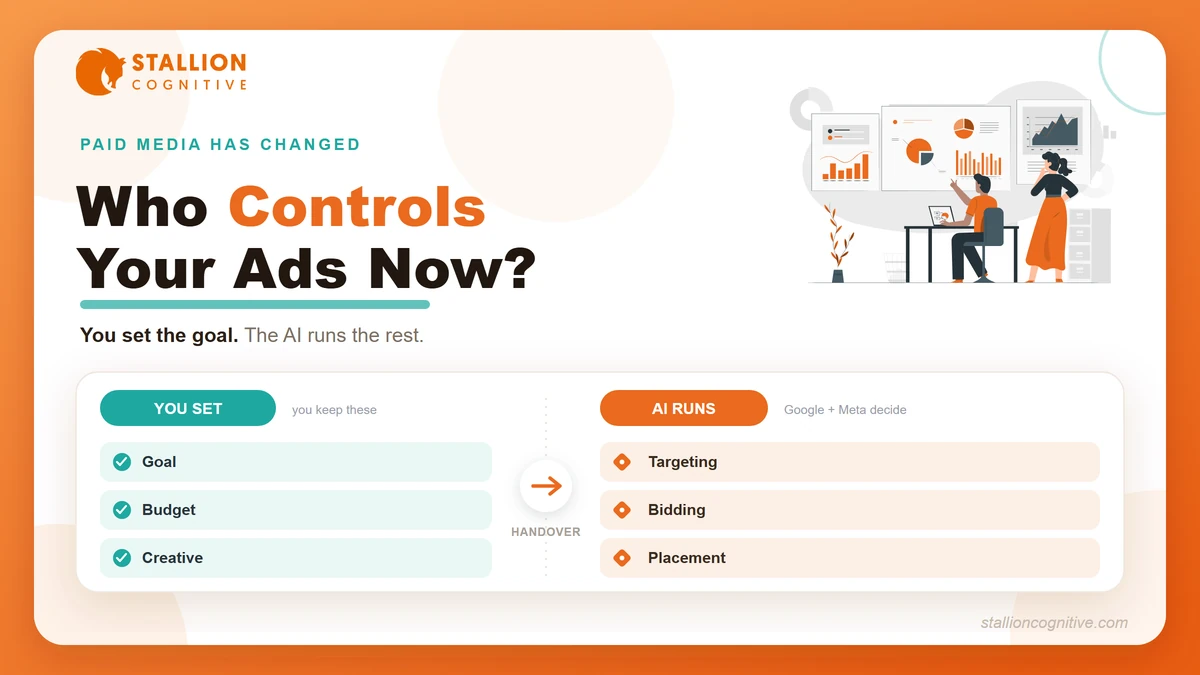
One change sits under all the others. You used to run the campaign, and now the platform's AI runs it for you, on Google and Meta alike.
You still bring the goal, the budget, and the creative. From there the system decides who sees the ad, when it shows, and where it points. Your inputs shape the outcome, but you no longer touch the dials yourself.
The one shift under all the noise
A Search campaign used to run on your decisions. You picked the keywords, wrote the ad, chose the landing page, and set the bids. When results dipped, you knew which lever to pull, because you had built every part of it. That hands-on model is what flipped in 2026.
Now you hand the platform an objective, a budget, and a set of assets, and its AI matches your ad to the people it judges likely to convert. Google brands its version AI Max. Meta brands its version Advantage+. They share one direction.
Your job moved with it, from operator to editor. You feed the system good inputs and set guardrails, then read the results and adjust. Feed it clean signals and automation works in your favor. Feed it weak ones and it spends your budget on the wrong clicks.
| Decision in your campaign | You used to control it | In 2026 the AI controls it |
|---|---|---|
| Which searches show your ad | Your keyword list | Intent matching (AI Max broad match) |
| Which audience sees it | Manual audiences | Your signals plus the platform's model |
| Which headline and image show | You wrote and picked them | Gemini and Advantage+ assemble them |
| Which page the click lands on | You chose the URL | Final URL expansion can change it |
| How the budget paces | Manual bids and schedules | Automated bidding |
So you make a real trade here. You gain reach, and you lose visibility into how that reach happens. That trade runs through every change below.
Why Google and Meta switched now
Two forces made this happen at the same time.
First, the AI got good enough to read intent better than any keyword list you could write. Second, search itself moved into AI answers, where a fixed keyword bid no longer fits. You can watch the second force in your own habits, as more questions end inside an AI summary instead of a page of blue links. That is the same shift reshaping generative engine optimization on the organic side, and paid ads are taking the same road into those answers.
There is a business reason too. More automation means more of your spend flows through the platforms' own systems, so the technology and the incentive point the same way.
Google's 2026 changes, in order of urgency
Google has four changes worth your attention this year. Only one of them comes with a deadline.
That one is AI Max, because it switches on by itself. Ads inside AI surfaces and the steady growth of Performance Max count too, but they arrive gradually instead of on a set date. Start with the change you cannot postpone.
AI Max is becoming the default on Search campaigns
If you run Search campaigns, this is the one with a clock on it. Google is turning AI Max on automatically, in two waves. Broad match and automatically created assets upgrade in September 2026. Dynamic Search Ads follow in February 2027.
Once it is on, AI Max changes three things at once.
- Matching: Your ads show for searches well beyond your keyword list.
- Creative: It rewrites your headlines and descriptions to fit each query.
- Destination: It can send the click to whichever page Google judges best.
You still keep three levers: your budget, your bid strategy, and your negative keyword lists. What you hand over is some control over matching and creativity.
Because the switch is automatic, doing nothing is itself a choice. Your account changes on the date whether you prepared or not. Google Ads AI Max breaks down the exact defaults and the prep window worth clearing before yours lands.
Ads are moving into AI Mode and AI Overviews
Google is putting ads inside its AI answers, well beyond the old spots above the links. Ask a question in AI Mode and Gemini can surface a relevant offer, then write a short explainer for why it suits you.
At Google Marketing Live 2026, Google rolled out ads built for AI Search and reported that AI Mode now passes a billion monthly users, with 75% saying they make faster, more confident decisions. This is where attention is heading. Three formats stand out:
- AI-powered Shopping ads: Gemini picks your product and writes a custom explainer for the searcher.
- Direct Offers in AI Mode: Your deals appear inside the AI answer as people weigh their options.
- Business Agent for Leads: A chat agent answers a prospect's questions inside the ad, pulled from your website.
For a lead business, that last one is the piece to watch. A chat agent can qualify a prospect before they ever reach your form. Say an accountant runs an ad during tax season. The agent can answer a question about pricing or turnaround on the spot, and the visit becomes a real lead instead of a bounce.
Paid media now sits on the same surface as organic AI search. It is the same space behind AI Overviews in local search, where your ads compete for the answer. So ask yourself one thing. Would an AI agent find accurate answers about your services on your site today? That readiness has become a paid-media asset on top of an SEO one.
Performance Max keeps expanding
Performance Max is Google's fully automated campaign type, and it keeps taking ground. It runs across Search, YouTube, Gmail, Maps, Display, and Discover from a single setup, and the AI decides the mix.
On a small lead budget, Performance Max can perform well when your tracking is clean and your assets are strong. It struggles when the data is thin, because it keeps spending while it guesses. The real question is whether you feed it enough conversions each month for the model to learn from. We come back to that under cost control below.
| Google change | What it does | Your deadline |
|---|---|---|
| AI Max on broad match and auto-created assets | Widens matching and rewrites creative | September 2026 (automatic) |
| AI Max on Dynamic Search Ads | Adds final URL expansion | February 2027 (automatic) |
| Ads in AI Mode and AI Overviews | Places ads inside AI answers | Rolling out through 2026 |
| Performance Max expansion | Spreads spend across all channels | Ongoing |
Meta's 2026 changes for lead-focused advertisers
Meta made automation the default, just as Google did. Its Advantage+ system now runs your targeting, placement, creative selection, and bidding. You bring the budget, the offer, and the creative, then set the limits around them, and the model handles the rest.
Advantage+ is the standard now
Advantage+ began as an option for online stores. In 2026 it became the standard structure for most Meta advertisers, and the older manual setups are being retired. The platform now expects you to describe an outcome and let its model chase it.
How well that goes comes down to what you feed it.
- Works well when: You give it room, strong creative, and clear signals about what a good lead looks like.
- Works poorly when: You box it in with narrow settings or feed it weak conversion data.
What it means when you run leads instead of e-commerce
Most of Meta's automation grew up around online sales, so lead campaigns need extra care. The model optimizes toward whatever you call a conversion. Tell it a form fill is the goal and it will chase form fills, even the junk ones. The fix is to feed it your real outcomes instead.
Send back which leads turned into booked calls or clients, through offline uploads or your CRM, and the model learns to find more like them. In regulated fields, compliance for financial advisors still shapes what you can target and claim, because automation has to respect the rules your industry runs on.
Creative carries more weight than ever here. When the system owns placement and audience, your offer is what makes you stand out, and the same thinking behind lead generation for financial planners carries straight into a paid feed.
Your tracking is going cookieless, and that breaks the rest
The quiet change that can undo all the others is your tracking. Every bit of this automation runs on conversion data. As third-party cookies fade and privacy rules tighten, the signal feeding the AI gets weaker. Fix your tracking, or even the smartest campaign optimizes toward noise.
Consent Mode v2 and cookieless pings
Google now expects your site to pass consent choices through Consent Mode v2, which adds two signals, one for ad data and one for ad personalization. When a visitor declines cookies, your tags send cookieless pings in place of stored data, so Google can still model conversions with less detail.
The takeaway is simple. An old or missing consent setup shrinks your conversion numbers and leaves your bidding half-blind.
Server-side tracking and your conversion data
Server-side tracking moves measurement out of the visitor's browser and onto your own server. It does two things for you.
- Steadier data: It keeps measuring as browsers block more client-side scripts.
- Cleaner conversions: It feeds stronger signals back to Google and Meta.
You do not have to build this yourself, since a developer or your analytics partner sets it up once. The firms keeping accurate numbers in 2026 are the ones who already moved server-side, and the same care behind tracking AI traffic in GA4 applies to your paid conversions.
When did you last confirm your conversion tracking actually fires? For many accounts, that one audit recovers more than any new campaign.
Why your ad costs feel higher in 2026
Costs are climbing across most competitive niches, and three forces stack up at once.
- More automation: Advertisers lean on bidding that competes hard for the same conversions.
- Fewer ad slots: AI answers take space the old block of ads used to own.
- Weaker targeting: Privacy gaps mean more of your spend lands on the wrong clicks.
Put together, that shows up as a higher cost per lead.
Where the pressure comes from
Automated bidding chases conversions wherever the model sees them, which drives up the price of the clicks everyone wants. At the same time, AI answers take more room at the top of the results, so the ad inventory that remains gets more contested.
Industry trackers have shown rising digital ad costs over recent years, and most service firms feel it as a creeping cost per lead rather than one headline number.
What protects your cost per lead
Three habits keep that number in check while the platforms automate around you.
- Clean conversion data: The better the AI understands a real lead, the less budget it burns on weak clicks.
- Tight negatives and exclusions: These stay yours under AI Max, and they keep your spend out of junk searches.
- Fast, focused landing pages: A quick page that answers the searcher lifts your conversion rate, which lowers your effective cost per lead.
Page quality and ad cost are linked directly. The steps in boost your conversion rate move that number further than most bid tweaks ever will.
How to adapt before the deadlines hit
You do not need to fight any of this. You need to feed it well and fence it in. Five moves cover most of the work, whether you lean into automation or hold some control back. Start with the ones tied to a date.
| Priority | Move | Do it before |
|---|---|---|
| 1 | Fix conversion tracking (server-side plus Consent Mode v2) | Now |
| 2 | Feed back real outcomes (booked calls clients) | Now |
| 3 | Set guardrails (negatives exclusions budget caps) | September 2026 |
| 4 | Strengthen creative and local landing pages | Ongoing |
| 5 | Decide your AI Max opt-in timing | Before your upgrade date |
The order is deliberate. Tracking comes first, because every other move depends on the data it produces. Guardrails come before September, because that is when AI Max begins widening your matching on its own.
The opt-in timing is a real call. Turn it on early to test a well-built account, or wait closer to the deadline if you still have gaps to close.
A quick readiness check for your account
Run your account through these questions before your next planning session. Each gap points straight back to one of the changes above.
- Does your conversion tracking still fire correctly after recent browser updates?
- Are you sending real outcomes back to the platforms, or only counting raw form fills?
- Have you set your negative keywords and exclusions ahead of the AI Max switch?
- Would an AI agent find accurate answers about your services on your site?
- Do you review each automated campaign weekly, or leave it running blind?
A "no" anywhere is not a crisis. It is just your next task, and most of these take an afternoon.
Where this leaves you
Paid media in 2026 rewards the advertiser who feeds the machine well and keeps a close eye on it. The platforms will keep absorbing the manual work, and that part is out of your hands now. Your edge is the quality of the signals, the creative, and the tracking you hand them.
That is also where accounts quietly lose money, by letting automation run on weak data. Want a second set of eyes on your setup before the September deadline? Start a conversation with our team and we will look at what your account needs.
So which change will you fix first?
Frequently Asked Questions
Are these paid media changes only a problem for big advertisers?
Small budgets feel them most. Automated bidding and cookieless tracking hit accounts with fewer conversions hardest, because the AI has less data to learn from. Clean tracking and a clear conversion goal protect a small spend more than a large one.
Can I still run a manual, keyword-based campaign in 2026?
Standard Search campaigns with your own keywords remain available for now, though Google keeps steering accounts toward automation. The AI Max upgrade widens matching on top of your keywords rather than removing them, so careful setup keeps some manual control.
Do I need a developer to keep my conversion tracking working?
Most server-side and Consent Mode v2 setups need a developer or an analytics partner for the initial build. After that, the upkeep is light. The cost is small next to the budget you waste when broken tracking feeds your campaigns bad data.
Is Performance Max the same as AI Max?
They are different things. Performance Max is a standalone campaign type that runs across all of Google's channels. AI Max is a setting you switch on inside a Search campaign, which keeps your keywords and reporting while widening how your ads match.
Which platform should a lead-focused business start with, Google or Meta?
Most service firms start with Google Search, where people actively look for help. Meta works well for awareness and retargeting once you have conversion data to feed it. The right mix depends on your sales cycle and how warm your audience needs to be.