
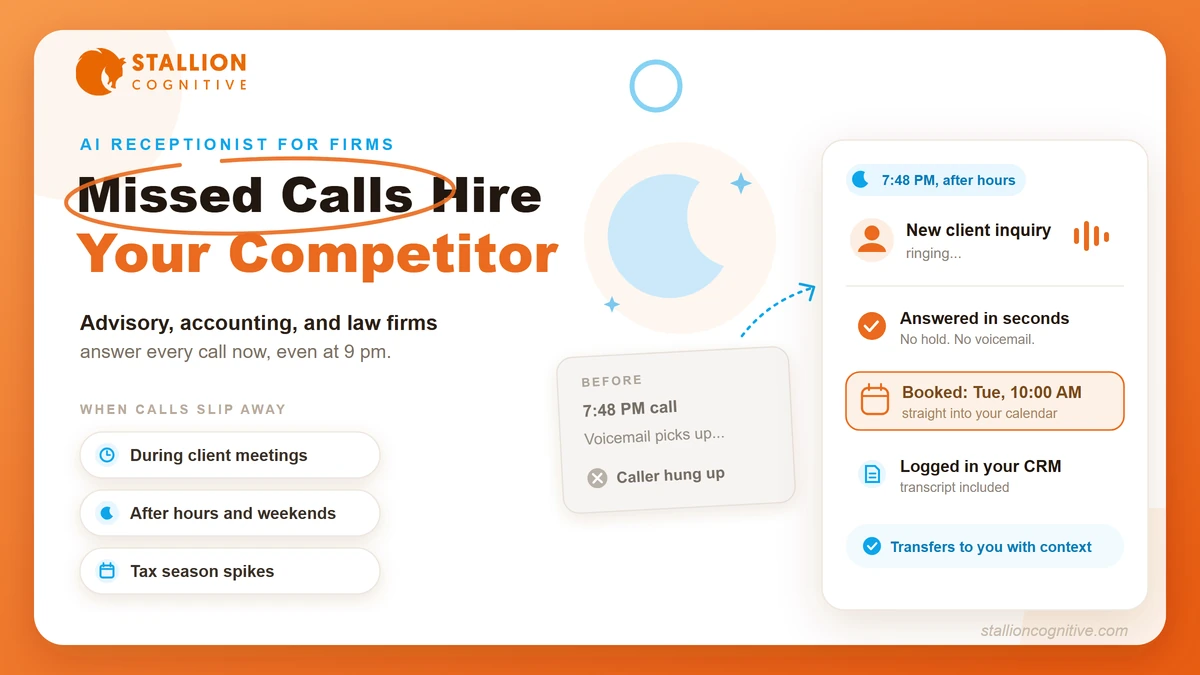
Your phone rang three times yesterday while you were with a client. Do you know what those calls were worth?
Most firm owners can't answer that, and the honest answer stings. The AI receptionist for financial advisors, accountants, and law firms exists because of that blind spot. It answers when you can't, books the appointment, and captures the caller who would otherwise dial the next firm on the list.
The pitch sounds too clean, though, and you've probably wondered what these tools actually handle, what they cost against a real hire, and whether your callers will hate them.
All three are fair questions, and this post works through each one. Let's get started.
The Missed-Call Math Nobody Runs
Missed calls don't feel expensive because you never see the invoice. The caller who gets your voicemail rarely leaves a message, and almost never calls back. They just move down their search results and become someone else's new client.
Voicemail is where a new client quietly disappears.
We've seen the same pattern across advisory, accounting, and law practices of every size. Calls cluster at the worst possible moments.
- During billable work: The hours you're with clients are the hours prospects call.
- Lunchtime and end of day: Callers use their own breaks, which overlap with yours.
- After hours and weekends: Someone researching a financial advisor on Sunday night calls the first firm that picks up Monday, and often the one whose site chat answered Sunday.
- Seasonal spikes: The weeks your team is most stretched are the weeks the phone rings hardest.
Now put rough numbers on it.
Take your average client value, count last month's unanswered calls from your phone system's log, and assume even a modest fraction were prospects.
The total is usually uncomfortable.
That log check takes ten minutes and settles the whole question of whether this problem deserves a budget. What was your number?
What Is an AI Receptionist, and What Can It Actually Handle?
An AI receptionist is software that answers your business phone with a natural conversational voice, around the clock. It answers routine questions, takes messages, books appointments into your calendar, and transfers calls that need a human, passing along what the caller already said so nobody repeats themselves.
The technology moved fast in the past two years. Early versions were glorified phone trees, while the current generation holds a real conversation and handles several callers at once.
In day-to-day use, the workload splits like this.
- Handled fully by the AI: Hours and location questions, service and fee basics, appointment booking and rescheduling, message taking, intake questions.
- Handled and escalated: Anything sensitive, upset callers, complex situations, and existing-client matters that need judgment, all transferred with context.
- Still yours: The actual advice, the relationship, and every decision that touches money or law.
The direction of travel is clear in the research, too. Gartner predicts agentic AI will autonomously resolve 80% of common customer service issues by 2029, with operational costs dropping around 30% along the way.
You don't need the 2029 version, though.
The current one only has to beat voicemail, and that bar sits on the floor.
What Does an AI Receptionist Cost Compared to the Alternatives?
Directionally, an AI receptionist runs from under a hundred to a few hundred dollars per month, sitting far below a part-time hire and roughly in line with a decent answering service. Pricing changes fast in this market, so treat every figure below as a starting point and confirm on the vendor's page.
The real comparison is coverage per dollar.
| Option | Coverage | Directional cost | Where it wins |
|---|---|---|---|
| Full-time front desk | ~40 hours a week | Salary plus benefits | Judgment, relationships, in-office work |
| Traditional answering service | Hours you pay for | Per-call or monthly fees | Human voice, message taking |
| AI receptionist | 24/7, unlimited concurrent calls | Monthly subscription | Never busy, books directly, logs everything |
A human front desk earns its cost in ways software can't touch, and most firms that have one should keep it. The gap an AI receptionist fills is everything outside those 40 hours, plus the moments inside them when the line is already busy.
HubSpot's research points in the same direction, finding companies that use AI in customer service cut operational costs around 20% while satisfaction improved.
There's also a quieter saving. Every call gets logged, transcribed, and pushed into your CRM, which means your lead generation follow-up stops depending on sticky notes.
How Do You Choose One for a Professional Services Firm?
Buy on evidence rather than demo polish. The market is young, and McKinsey's survey found that while 62% of organizations are experimenting with AI agents, far fewer have taken them to scale, which tells you plenty of products are still maturing.
An AI receptionist for financial advisors carries an extra duty, since a wrong sentence about returns or fees creates a compliance problem rather than a customer service one. So for an advisory, accounting, or law practice, five checks separate the serious tools from the toys.
- Transfer with context: When the AI hands a call to you, it must pass the caller's name and reason along. A transfer that starts the conversation over is a fancy hold button.
- Calendar and CRM integration: Booking should land directly in the systems you already run, without a copy-paste step that someone will eventually skip.
- Data handling you can defend: Ask where recordings and transcripts are stored, who can access them, and whether your data trains the vendor's models. Client confidentiality doesn't pause because a robot answered.
- Script control: You decide what it says about fees, services, and compliance-sensitive topics, and you should be able to change that in minutes.
- Transcripts you'll actually read: Weekly review is how you catch the AI promising something you don't offer. If transcripts are hard to pull, quality will drift unseen.
Timing shapes the decision as much as features do. An accounting firm evaluating in November is really buying for the weeks when its tax season strategy already has every human at capacity.
One more filter helps. A receptionist tool is one piece of a bigger AI automation stack, and the vendors that integrate cleanly with the rest of it age better than the ones that lock you in.
Roll It Out Without Annoying Your Callers
The safe rollout starts where the risk is zero. After hours, your current "receptionist" is a voicemail box most callers hang up on, so the AI only has to beat silence.
- Weeks 1 and 2, after-hours only: Keep business hours exactly as they are. Every after-hours call the AI catches is a call you were losing anyway.
- Weeks 3 and 4, add overflow: Let the AI pick up when the line is busy or unanswered past three rings. Humans still get first crack.
- Every week, read the transcripts: Fix wrong answers in the script the day you find them. Ten minutes of review protects your reputation better than any feature.
- Month 2, decide with numbers: Count appointments booked and messages captured against your old missed-call log. Widen the AI's role only when the math says so.
Somewhere in week three, a pattern usually shows up. The same questions arrive again and again, which tells you what your website fails to answer.
Feed those questions back into your site. Firms that build a website with AI tools can fold the fixes in the same week, and the site chat can run the same intake logic as the phone.
The phone and the website stop being separate channels at that point, and start working as one intake system that never sleeps.
The Phone Is Still Where the Money Is
Search, ads, and referrals all end the same way for a service firm, with a phone call from someone ready to talk. Everything you spend on marketing gets judged at that moment, by whether anyone answers.
An AI receptionist makes that moment reliable for less than most firms spend on coffee.
Pull last month's call log this week and count what slipped through. If the number bothers you, talk to our team about wiring call capture into a site and system built to convert, and see what a month of answered calls does to your pipeline.
Frequently Asked Questions
Do callers know they're talking to an AI?
Disclosure practices vary by vendor and by state law, and several states now require it for recorded calls. The safer route is a natural-sounding agent that identifies itself as an assistant, which most callers accept without friction when it solves their problem quickly.
What happens when a caller is upset or has a complex situation?
Good systems detect frustration and escalate immediately, transferring the call with the context already gathered. During off hours they capture the details and flag the message urgent, so a human can respond first thing rather than discovering it days later.
Does an AI receptionist sound robotic?
Modern voices are close enough to human that most callers stop noticing within a sentence or two. Quality varies widely between vendors, though, so call your own number during the trial and judge with your own ears.
Do you have to change your business phone number?
Almost never. Most tools work through call forwarding rules on your existing line, answering only when you don't, and can be switched off in minutes if you change vendors or bring the job back in-house.
Can it handle more than one caller at the same time?
Concurrent calls are a core advantage of the software. While a human line gives the second caller a busy signal, an AI receptionist holds every conversation in parallel, which is exactly what a seasonal phone spike needs.