
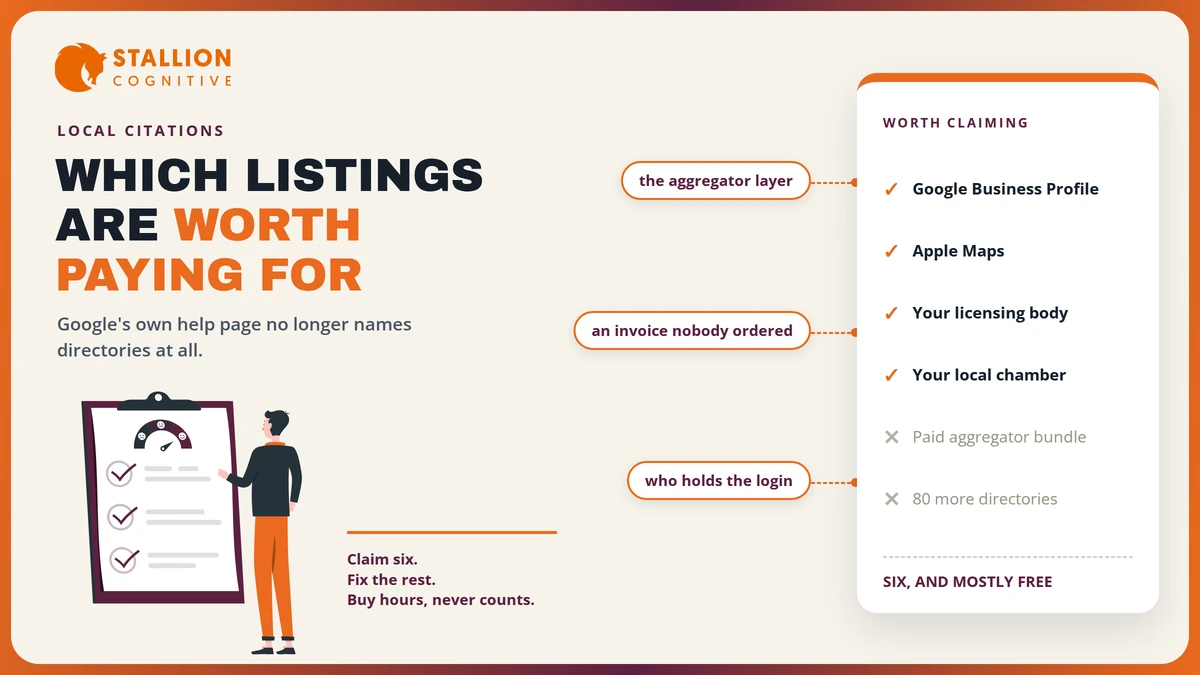
Google's own help page no longer names directories among the things that make a firm prominent in local search.
That line sat there for years and every citation package quoted it back, and it went quietly while the invoices kept coming.
Local citations still earn a firm something. The question worth your time is which ones, and at what price.
Here is what to claim, what to pay for, and what to throw away.
What a Local Citation Is, and What It Is Not
A citation is any public mention of your firm's name, address and phone number on a site you do not own. A chamber page counts. So does a state bar profile, a carrier's agent finder, and the entry your old office park still runs.
Three things fall out of that, and the third is the one vendors skip.
- A citation is a record: Most carry no working link, and the ones that do are marked so they pass nothing.
- You did not make most of them: Firms find their details on sites they have never heard of, because the data moved without them.
- Accuracy is all you control: You cannot make a directory matter. You can make your entry on it right.
Whether the three fields agree across the web is a separate job. Read NAP consistency first if your phone number is still wrong in three places.
Why Has Google Stopped Naming Directories?
Nobody at Google said a word about it. The current page on local ranking explains prominence in two inputs, and directories are not one of them.
"This factor's also based on info like how many websites link to your business and how many reviews you have."
Those two inputs are the whole list, and a directory entry usually supplies neither of them.
Google is more open about where it gets business data, which is a different question from what it ranks. Its page on business information names four sources, and one of them is "Licensed data from third parties".
So the story people tell is half right. Third-party data does reach Google.
What it reaches is the record of what your profile says. It is not the scoring that decides where your profile sits.
Those two things get sold as one thing. They are worth very different money.
Which Listings Are Worth Claiming Yourself
Start with the ones a client might open. For an adviser or an accountant, that list is short enough to finish in an afternoon, and most of it is free.
| Listing | Why it earns the time | Who should do it |
|---|---|---|
| Google Business Profile | The only one that feeds the map pack and the panel | The firm, and nobody else |
| Apple Maps | Every iPhone that asks for directions reads it | The firm, once |
| Bing Places | Pulls most of the record straight from Google | The firm, ten minutes |
| Your licensing body or bar | Clients check credentials here before they call | Whoever holds the licence |
| Your chamber of commerce | A real local link, often the only one a firm has | The partner who pays the dues |
| Industry finders | Carriers, custodians and networks all run one | The relationship manager |
The Apple entry has moved, and a firm that claimed one in 2024 should look again. Apple said in March 2026 that Apple Business Connect is being folded into a new platform, with claimed places carried across. Our post on Apple Maps covers the claim itself.
Everything under that line is optional. A mass-market site with your name in it does no harm, and it is not why anybody finds you.
What Are You Buying From a Citation Service?
You are usually buying a number. The pitch turns up as a count of sites, a price per site, and a promise that all of them will agree, and the count is the part doing the selling, because a firm that has never audited its own listings has no way to judge whether eighty of them beats twelve.
Ask these four before the invoice, in this order.
- Which sites, by name, and can you see the list before you pay?
- Who owns the login on each profile when the contract ends?
- What happens to the entries if you stop paying?
- Which of these sites could a client plausibly search from?
The answers sort vendors fast. A service that hands you a named list and the logins is doing admin work, and you can pay a fair rate for the hours.
A service that will not name the sites is selling the count.
One more test costs nothing. Search your firm name and your phone number and read what is already there, because a good share of what you are about to buy is sitting there unclaimed from a form somebody filled in years ago.
The Aggregator Layer, and Who Still Runs It
The folklore has gone stale and the sales decks have not caught up. The standard pitch names four American data firms that feed listings everywhere else, so we checked each one.
| Company | Status in 2026 | What that means for the pitch |
|---|---|---|
| Data Axle | Running, and selling listings distribution | Real, and you can buy it direct |
| Localeze | Running as TransUnion Digital Business Profile | Real, under a name the deck will not use |
| Factual | Gone as a brand, now a developer data product | No route for a business to submit |
| Acxiom | No listings product on its own site | Treat any promise to submit here as thin air |
Data Axle still describes sending business data to search engines, directories and map apps, and its page was updated in August 2026. So the layer has not vanished so much as halved, and a vendor still selling submission to all four is selling at least one thing it cannot deliver.
Ask which of the two survivors your money reaches. The answer is short, easy to check, and the reason most decks skip past it.
The Invoice That Is Not a Bill
Somewhere in your accounts payable there may be a directory invoice nobody ordered. This is one of the oldest frauds aimed at small firms, and the Federal Trade Commission has been suing over it for years.
Its guidance on small business scams puts the play plainly:
"Scammers try to fool you into paying for nonexistent advertising or a listing in a phony business directory."
It also names the softer opening. A caller asks you to hand over contact details for a free entry, or says the call is only to confirm what they already hold.
A 2014 case against a Florida outfit described bogus invoices sent after calls that asked firms to verify their details, with sums running up to $487.
Four habits stop it, and none of them needs a policy document:
- One person approves this spend: A named partner, and a rule that nobody else pays a directory bill.
- No verbal confirmations: A caller asking you to confirm details is building a record of a contract.
- Match every invoice to a login: If nobody at the firm can sign in, you did not buy anything.
- Keep the fax and the call: These outfits count on you having nothing to show.
What a Regulated Firm Takes On When a Vendor Writes Its Profiles
Handing over the typing does not hand over the duty, and for a broker-dealer it can work the other way. FINRA's Regulatory Notice 17-18 draws a line around content a firm has become mixed up in:
"A firm may have 'adopted' third-party content if the firm indicates that it endorses the content on the third-party site"
The notice describes entanglement as a firm taking part in building content on someone else's site. Paying a vendor to write your profile is close to the textbook case. The notice was written about social media and not directories, so take the specifics to your compliance officer.
The plain version is duller and more use. Whatever a vendor puts out about your firm is something you may be asked to produce later, so keep a shared folder holding the final text of every profile, the site it went to and the date it went live, which costs an hour to set up and answers the question on the day somebody asks it.
Advisers have a parallel duty on the filing side, since the office address, business hours and phone number all sit on Form ADV. A directory that disagrees with a federal filing is an odd thing to leave standing.
Where This Leaves Your Listings Budget
Most firms pay for reach they already have and ignore the six entries a client would open. The work that pays is dull, finite, and mostly free.
- Claim the six: Google, Apple, Bing, your regulator or bar, your chamber, your association.
- Fix what exists first: The old entries carrying your old suite number are the real problem.
- Buy hours, never counts: If you outsource, pay for named sites and take the logins.
- Put reviews and links first: Those are the two inputs Google still names.
- Schedule a quarterly look: Twenty minutes, and the same person each time.
A firm that gets this right stops thinking about citations at all, which is the right end state. To have the whole local picture read in one pass, our local SEO audit walks the same ground, and local link building covers the half that still moves rankings.
Our team does this for advisers, accountants and law firms across the US, and we would sooner cancel your citation contract than sell you a bigger one. Ask us about local SEO if you want somebody to read the list with you.
Frequently Asked Questions
Does an entry we never claimed still show our old phone number?
Unclaimed records keep whatever was last given to them, which is why the old number survives. Claim the record instead of adding another one.
How long before a corrected address spreads across the web?
Expect weeks, and the tail runs longer than anyone will promise. Each site refreshes on its own clock, a few never do, and the quarterly look exists for that reason.
Should our marketing coordinator own this work?
Continuity matters more than seniority here. The failure mode is three people each fixing a different site and nobody holding the master.
Do reviews left elsewhere help us on Google?
Google names reviews as an input without saying whose. The ones on your own profile are the ones you can see, count and answer, so start there and stop worrying about the rest.
What happens when a partner leaves the firm?
Their name lingers on profiles for years after the letterhead changes, so add a listings sweep to your offboarding checklist.