
Somebody can now ask Google Maps whether your firm is any good, and get a paragraph back.
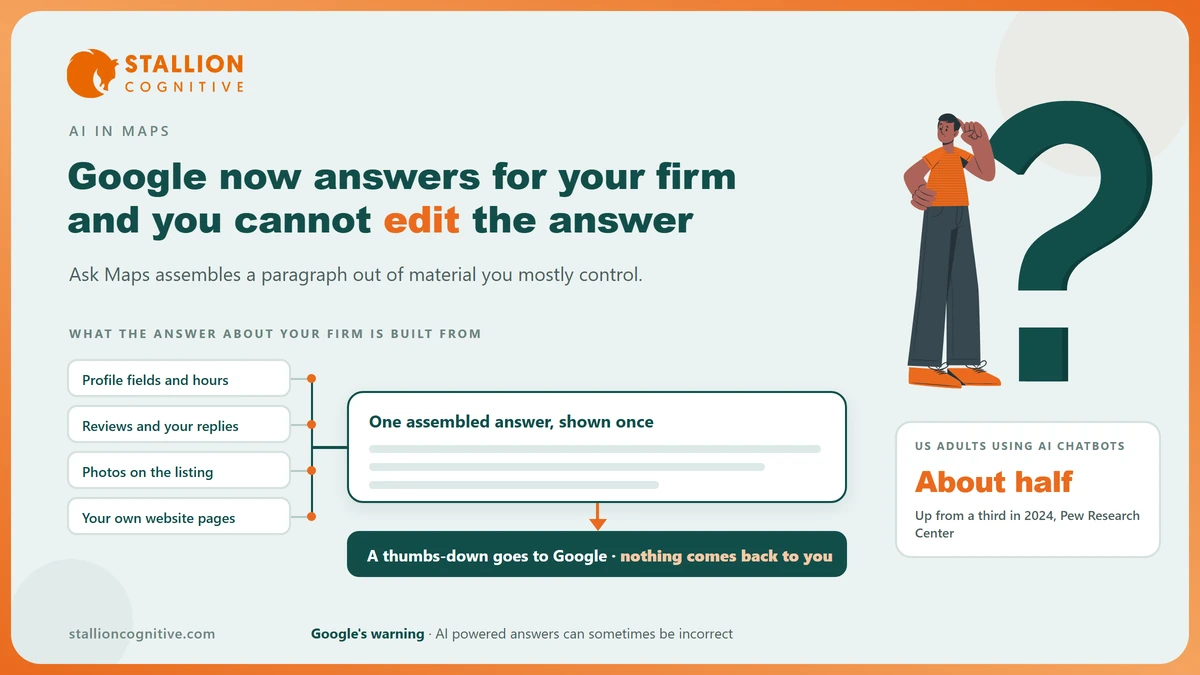
The paragraph is assembled rather than written. It comes from your listing, your reviews and your website, and no partner at the firm signs it off.
Ask Maps on Google is the button doing this, and it has been on phones since March and on desktop since. Nobody at your firm has an edit key.
Start by finding out what it currently says.
What Ask Maps is, and where people meet it
It is a conversation box inside Maps. Google's help page for Ask Maps introduces it in one line, saying "you can get recommendations and answers from Gemini in Google Maps", and describes a tool that "helps you find the best places to go and provides specific details about your destination".
The examples Google gives are consumer errands, questions like where to buy a phone charger or what to do this weekend within a short drive.
Getting to it is simple on both surfaces.
- On a phone: Open the Maps app and tap Ask under the search bar.
- On a computer: Open Maps, click Menu, then Ask Maps, and type the question.
- Follow-ups work: A user can keep asking inside the same conversation.
- It needs WebGL: Google says the technology "is required for Ask Maps to function", so some locked-down office browsers will not show it.
Users can also feed the system while they are in it. Google says people can "share tips, upload photos, or update information about places" from inside an Ask Maps conversation.
That last sentence deserves a second read if you run a regulated practice.
Where the answers about your firm come from
From material you mostly control, which is the good news buried in this. Google's page on how AI uses your data lists what personalises a response, and the list includes "reviews, ratings and photos you posted for places" alongside search history, saved lists and past conversations.
For a business, the practical inputs are the ones sitting on your listing today.
| Input | Who controls it | How often firms check it |
|---|---|---|
| Profile fields, hours and services | Your firm | Rarely, and usually after a complaint |
| Client reviews and your replies | Clients write, you reply | Reviews yes, replies often no |
| Photos on the listing | Mixed, since customers add them too | Almost never |
| Your website pages | Your firm | Only when something breaks |
Three of those four are already part of a normal local search routine. The AI layer changes the stakes rather than the work, because a fact that used to sit in a field a client had to find is now read aloud in a sentence.
Your profile photos and your replying to reviews habits are doing more work than they were a year ago.
Google's own warning about accuracy
Google says the answers can be wrong. The wording is not buried and it is not hedged.
"AI-powered answers can sometimes be incorrect. Be sure to double-check responses."
Google puts the checking duty on the person reading the answer. It also recommends verifying through more than one source and trying differently worded questions for better results.
- The disclaimer is generic: Nothing about it is specific to regulated advice or to your firm.
- Nobody tells you what was said: The answer appears in a private conversation and leaves no record with you.
- Is a wrong answer your problem? In practice a prospect who acted on one will bring it to you as though it were.
- Two people can get two answers: Personalisation means responses vary by history and location.
A prospect comparing three advisory firms in one conversation is a new kind of shortlist, and none of the three will ever know it happened.
Who can correct an answer about your firm?
The person who saw it, and only in one direction. Google's route for a bad answer is a thumbs-down with a reason attached, which the page says helps Google "improve AI-powered features for everyone".
That is feedback, and it is not a correction.
- A user marks the answer unhelpful and picks a reason.
- Google takes the signal into its improvement work.
- The answer that prompted it is not shown to you.
- No route exists for a business to challenge a specific response.
So the lever is upstream. You cannot edit the sentence, and you can change almost everything the sentence is built from, which makes profile accuracy a reputational job now instead of a housekeeping one.
Fix the inputs and wait, because that is the whole toolkit for the moment.
How many people are actually asking?
Enough to matter, and the numbers come from outside Google. Pew Research Center's 2026 survey of AI use reports that "about half of U.S. adults now use AI chatbots, up from a third in 2024". The sample was 5,119 adults, surveyed in February 2026.
A majority now read the AI summaries above ordinary search results too.
| Pew finding, February 2026 | Figure |
|---|---|
| US adults who use AI chatbots | About half, up from a third in 2024 |
| US adults who read AI summaries in search | 60 percent |
| US adults who say they do not read them | 30 percent |
Habit is the thing being measured there.
Somebody who already asks a chatbot for a restaurant recommendation will ask Maps about an accountant without pausing to think of it as a new behaviour, and the jump from a third of adults to half of them in two years says which way that is heading, which is the only forecast worth making here and the reason a quarterly check belongs on somebody's calendar rather than in a plan for next year.
Measurement on your side is still thin. The AI report in Search Console covers AI surfaces in Search and gives you no window into a Maps conversation at all.
Which facts to get right before the AI reads them
Start where a wrong answer would cost you a client. The order below is deliberate, and it puts the fields that carry consequences ahead of the ones that carry polish.
- Hours and closures: A wrong opening time is the most common bad answer and the easiest to prevent.
- Services and specialisms: Vague service fields invite the model to guess what you do.
- Are your fees stated anywhere? If not, an answer will be assembled from whatever it can find, which is a good argument for publishing your fees on your terms.
- Credentials and licensing: Keep them in text on a page a crawler can read, never inside an image.
- Photos of the actual office: Stock imagery gives the system nothing true to describe.
Two habits matter more than any single field. Reply to reviews so your version of a story exists in text, and keep one page per service so a specific question has a specific page to draw from.
Firms that have built toward being cited by AI assistants have already done most of this work.
Does the website still matter if the AI answers first?
More than before, because the answer is built out of somebody's pages. A model with nothing specific to read about your firm produces something general, and general is how a prospect decides you are interchangeable.
- A clear service page gives the answer something exact to quote.
- A vague homepage gives it adjectives and nothing else.
- A page behind a login gives it nothing at all.
- A page it cannot render gives it nothing either.
Trust frameworks make the same point from the other side. The NIST AI risk framework exists to help organisations build trustworthiness into how AI products are used and evaluated, and it is voluntary guidance, so nothing in it obliges Google to give your firm a right of reply.
Publishing well is the one lever you hold. An llms.txt file is not, and neither is a knowledge panel request, though both get sold as though they were.
What to do about an answer you did not write
Ask the question yourself first. Open Maps on a phone, ask what your firm does and who it serves, then ask the same thing about your two nearest competitors and read all three answers side by side.
- Write down what it said: A dated note is the only record of this you will ever hold.
- Fix the field that produced the error: Hours, services and reviews cover most of them.
- Re-ask in a fortnight: Changes take time to work through, so one check proves nothing.
- Put it on somebody's calendar: A quarterly read is enough, and never happens without an owner.
Your profile view numbers will not separate an AI conversation from an ordinary visit, so treat this as reputation work with no dashboard behind it yet.
Our team runs this check for professional firms alongside the listing and content work it depends on. Ask us about an SEO programme if you would rather know what Maps says about your firm before a prospect does.
Frequently Asked Questions
Can we switch this off for our listing?
Businesses get no opt-out. Google offers the feature to users, and the inputs on your listing are the only part of it under your firm's control.
Does asking about our own firm change the answer?
Your own history personalises what you see, so the answer shown to you may differ from the one a stranger gets. Check from a signed-out browser, or borrow a colleague's phone, for a cleaner reading of it.
Is it available outside the US?
The feature launched in the US and India in March 2026 and has since reached well over a hundred countries. Availability keeps changing, so test on the surface your own clients use.
Should we mention it in our client communications?
Telling clients that AI answers about your firm can be inaccurate is reasonable and cheap. Point them at your own website for anything about fees, services or regulatory status, and keep the wording plain.
Will Google tell us if somebody reports a bad answer?
Feedback reaches Google and stops there. Your firm gets no notification, no copy of the answer and no case reference, which leaves a scheduled self-check as the only monitoring on offer to you.