
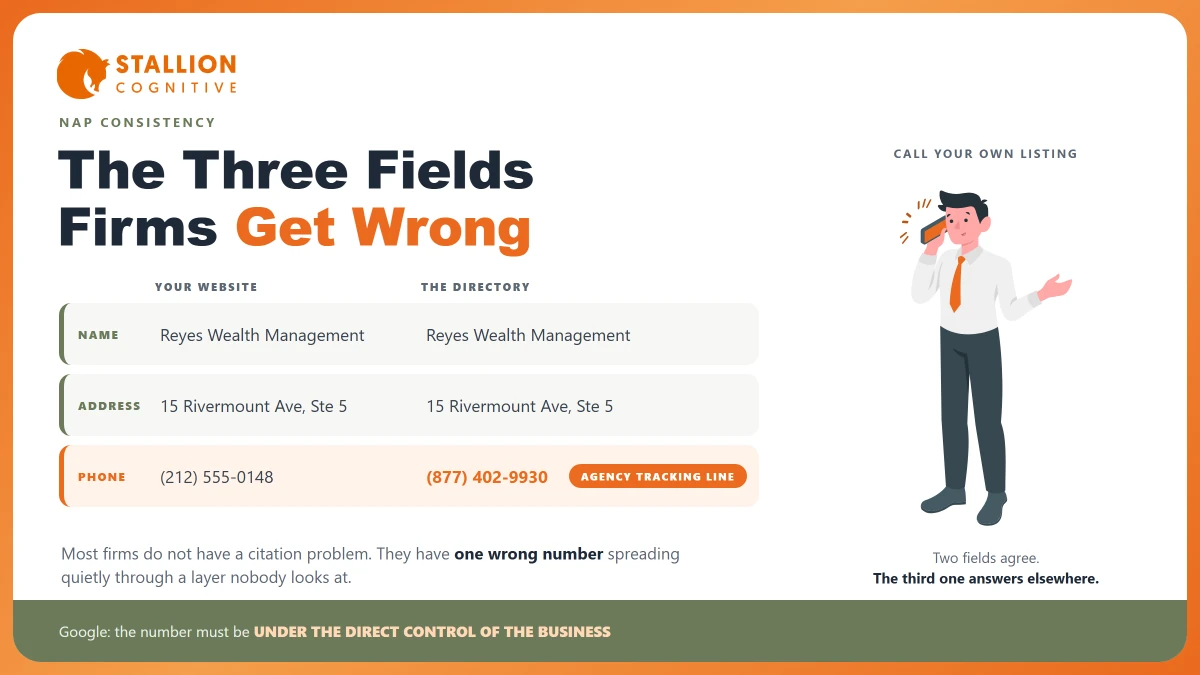
NAP stands for name, address and phone number. NAP consistency means those three read the same way everywhere your firm shows up online.
That is the whole idea, and it is the easy part.
The hard part is that nearly every firm thinks it has this right. Your website carries its own wording. The Business Profile says something close. A directory entry from 2019 says something else. And on three of them, the number rings an agency line rather than your front desk.
So where does it actually break? Below is what each of the three fields demands, what Google's own rules say about them, and why the same fix keeps undoing itself six weeks after someone makes it.
What Breaks First When the Three Fields Drift
Google has to work out how many firms these mentions describe. When the records disagree, the safest reading for a machine is that they are different firms. Your evidence then gets split across those records instead of piling up behind one.
It fails in a familiar order:
- The map result goes first. You still rank for your own name, and you stop showing up for the searches that bring strangers.
- Then the phone stops matching. Clients ring a number nobody watches. No one reports it, because the calls simply never arrive.
- Then a duplicate appears. Shared data builds a second record for the second version of your details. Now two listings compete for one firm.
Google is clear about what it rewards. Its guidance on local ranking says that "Businesses with complete and accurate info are more likely to show up in local search results."
Read the same page for what it does not say. The three factors named are relevance, distance and prominence, and Google sums up prominence as "how well-known a business is," based on "info like how many websites link to your business and how many reviews you have."
Citation volume is not in that definition. Has anyone quoted you a number, fifty listings or eighty, as the price of competing? That figure is somebody's benchmark rather than Google's rule. In our audits, fifteen records that agree beat sixty that argue.
Who Holds the Master Record?
One person, and it should be someone on your payroll. Before you touch a single listing, write the correct version down. Almost every failed cleanup we see began with two people fixing directories from memory, in slightly different ways, in the same month.
The master record names the exact wording for each field:
| Field | What goes in it | The detail firms get wrong |
|---|---|---|
| Name | The registered, real-world name only | Whether "LLC" or "& Associates" is part of it |
| Street | One format, chosen and kept | "Suite 5" against "Ste 5" against "#5" |
| City, state, ZIP | The postal service's version | The ZIP+4 appearing on some records and not others |
| Phone | The main line, one format | Whether it is (518) 201-2870 or 518-201-2870 |
| Website | One canonical version | The https and www combination that actually resolves |
The office manager owns it rather than the agency, because agencies change and the record has to outlive them. Every new listing then gets copied from the document rather than typed fresh by whoever happens to be doing it.
Put the same details in your website footer as plain text. Search engines read text and cannot read an address baked into an image, which is still a common way for a designer to lay out a contact block.
Why Is the Phone Number the Field That Fails?
Because the N and the A get checked, and the P does not. It is where firms break the rules without noticing, and Google has written guidance almost nobody in marketing reads.
Google's guidelines for representing your business ask you to "Provide a phone number that connects to your individual business location" and to "Use a local phone number instead of a central call center helpline number whenever possible." The same page states that "The phone number must be under the direct control of the business."
Common setups that sit badly against that:
- Call tracking numbers. An agency gives each channel its own number to measure where calls come from. Every place that number lands is now a record that disagrees with your real one. The number also sits under the agency's control rather than yours.
- Shared reception at a serviced office. The building's main line does not connect to your own location in the way the rule means.
- A partner's mobile. It reaches a person rather than a business, and it leaves when that person does.
None of these is fatal on its own. Call tracking can be run properly by keeping the real number as the primary one and holding the tracking number on your website with dynamic replacement. Trouble starts when the tracking number leaks into listings, which is what happens when a directory scrapes it off your contact page.
Want the blunt test? Search your firm name, ring the number on each result, and find out where the phone rings.
Is Your Business Name Really Your Business Name?
Google's rule here is narrow, and finance firms break it constantly. The broken version ranks well enough that it looks like it is working.
The rule reads plainly. "Your name should reflect your business's real-world name, as used consistently on your storefront, website, stationery, and as known to customers." Taglines, location words, service words and block capitals are all named as things that do not belong in the field.
So take a firm called Reyes Wealth Management:
- The name: Reyes Wealth Management.
- The keyword version: Reyes Wealth Management | Financial Advisor Ballston Spa NY.
- What it costs you: A rival can file a name edit that Google will accept, and the profile now disagrees with your own stationery by design.
The related trap is the trading name. A practice registered as Reyes & Partners LLC that everyone calls Reyes Financial has to pick one and use it everywhere, including on records it does not control. Directories will not reconcile the two for you.
A wrong name also carries real risk, because this rule is one of the more actively enforced. Winning back a suspended Business Profile takes weeks.
Why Do the Same Fixes Keep Coming Back?
Because you are fixing copies rather than sources. A firm cleans up twelve directories in an afternoon. Four months later the old suite number is back on half of them.
The directories are not restoring the old data. They are being fed it. A layer of data aggregators sits under the sites you can see, licensing business records down to hundreds of smaller directories, apps and in-car maps. Fix a directory and you fix one copy while the source keeps publishing the original to everything else.
That changes the order of the work:
- Your own sources first. Your website, your Google Business Profile, Apple Business Connect, Bing Places, and your Facebook and LinkedIn pages.
- Then the aggregator layer, since that is what rebuilds everything below it.
- Then the directories you can see. Most correct themselves once the layer above them updates.
- Then the industry listings. Regulatory registers, bar directories and adviser lookups often carry better traffic than general directories, and they are worth checking because nobody thinks to.
Apple is its own record and easy to forget. Apple's Business Connect announcement describes a free tool that lets businesses "claim their location place cards and customize the way key information appears" across Apple Maps, Messages, Siri and Wallet, and no one claims that card on your behalf.
Unclaimed listings still count. A record you never made still shows your details to whoever reads it, and the auto-generated pages social platforms build for businesses are a frequent home for a stale address. Two profiles for one office is a related problem with its own fix, covered in duplicate profiles.
What Should You Do When the Office Moves?
Move the profile only once you hold the keys. From the outside, an early address change looks the same as a fake one.
Then work in this order:
- Change the address on its own. Leave the name, phone and categories alone for a fortnight.
- Never open a second profile for the new address. Editing the old one keeps the reviews and the history.
- Update the rest of the web after Google clears it, so the directories back the listing up rather than fighting it.
- Tell the aggregators too. Skip them and they will push the old address back within months.
Expect a dip either way. Distance from the searcher is one of the three factors, so Google has to work out where you now sit relative to every nearby search. That settles over weeks rather than days.
Do clients come to you, or do you go to them? Firms that travel should check whether a service area suits them better than a street address, which is also the route for anyone working from home. If the listing vanishes rather than dips, the checks are in why a listing goes missing.
What to Check Every Quarter
NAP work is upkeep rather than a project. Staff change, agencies change, and the aggregator layer keeps pushing whatever it holds. A short standing check every quarter keeps the record steady.
| The check | What it catches |
|---|---|
| Search the firm name and read the top ten results | Records you did not know existed |
| Call the number on each one | Tracking numbers and dead lines |
| Compare the profile name to the master record | An edit somebody else filed |
| Search the old address, if you have moved | Copies the aggregators regenerated |
| Confirm the website footer still matches | A redesign that dropped the plain-text block |
Fix whatever you find at the source, then write it down, so the next person knows what was already handled.
Listings sit inside a bigger picture. A local SEO audit covers the profile, the technical layer and your reviews in one pass. For firms with more than one office it gets harder, and multi-location local SEO handles the version of this with four master records instead of one.
Start With the Phone Number
Most firms reading this do not have a citation problem. They have one wrong phone number and a name with a city stapled to it, spreading quietly through a layer nobody looks at.
What holds up over time:
- One master record, owned by someone who will still be here next year.
- A phone number you control that rings at the office.
- The registered name, with nothing added to it.
- Sources fixed before copies, or the copies come back.
- A quarterly check that takes about a quarter of an hour.
When did anyone at your firm last ring the number on your own listings? That single check finds the problem more often than any audit tool we could point at, and it costs nothing at all. Our local SEO work starts there, because everything else you build locally sits on records that have to agree first.
Frequently Asked Questions
Does a suite number count as a difference?
Treat it as one. "Suite 5", "Ste 5" and "#5" are three different strings. Google smooths over much of this. The aggregators below it are far less forgiving, so pick a format and keep it.
Does an unclaimed listing still count?
A record you never made still shows your details to anyone who reads it. Claiming it is the only way to control what it says. Auto-built pages on social platforms are the usual culprits.
How long before a correction shows up?
Your own sources update within days. Directories downstream wait for the aggregator above them to push again, and that can run to several weeks, so check a fix at the six-week mark rather than the next morning.
Does a second phone line break it?
An extra line can sit on a Business Profile without pushing the main one aside. Trouble starts when that second number becomes the primary somewhere else. That is how a department line ends up as your public number.
Do social profiles matter as much as directories?
They are read as records like any other, and they rank for firm-name searches, so a stale address on LinkedIn is far more visible than one on an obscure directory. Put them in the quarterly check.