
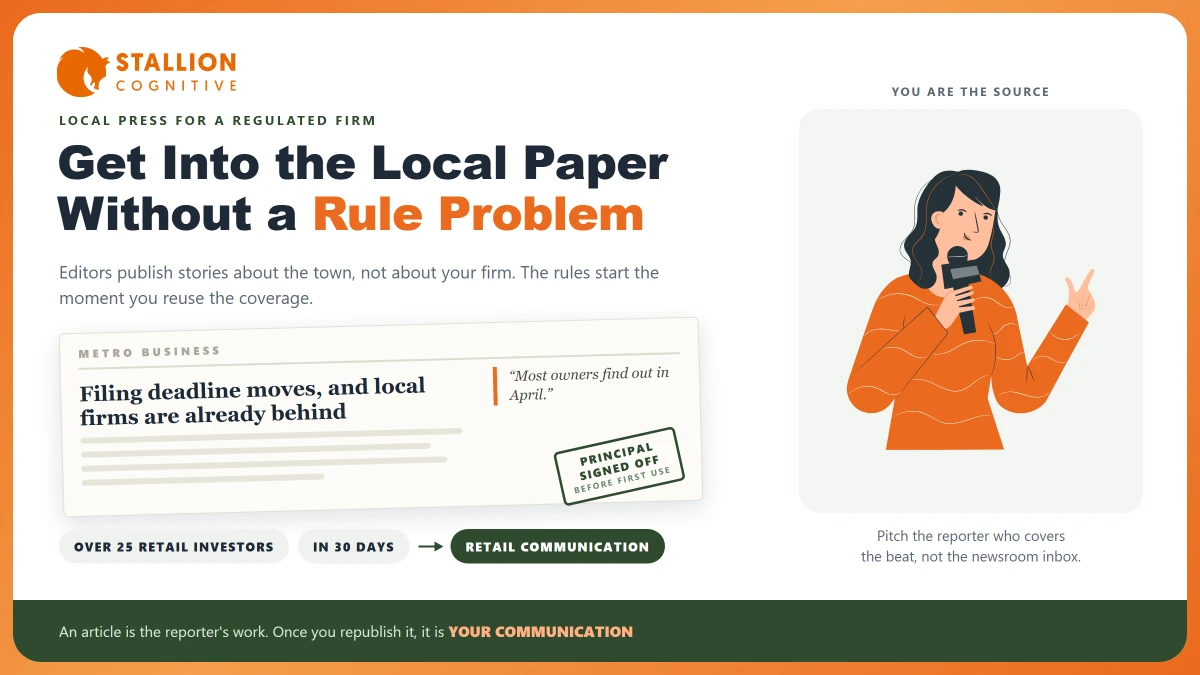
Being quoted in the local paper works differently from an advert. A reader who finds your name in the business section is not being sold to, and they know it, which is why the same words carry more weight there than in a box you paid for.
Getting there is not hard, and it is just different from what most firms try.
The usual try is a press release about the firm, sent to a general newsroom address, describing an event only the firm cares about. It does not run, and the lesson drawn is that local media is shut to firms like yours. Local media is open, and it wants one specific thing. There is also a second snag that nobody writing about this mentions, which is that a regulated firm has rules about what it may say in public and what it may do with the coverage afterwards.
What Is a Local Editor Actually Looking For?
An editor's job is to fill the paper with things people in that town care about. Your firm does not qualify, and what you know about something happening to that town might.
That one difference decides almost everything about the pitch:
| What gets published | What gets turned down |
|---|---|
| An expert explaining a change that hits local readers | A note that your firm has opinions |
| Local numbers nobody else has gathered | National figures anyone can quote |
| A named person willing to talk on a deadline | An offer to be interviewed at some point |
| A local knock-on from a national story | A release about a new hire |
| A row or a decision with two credible sides | A birthday or an anniversary |
The strongest slot for a professional firm is the first row. When a tax rule changes, or a big local employer cuts jobs, or rates move, a reporter needs someone nearby who can say what it means for people in that area. That person is you, and the story is not about your firm at all.
Which is why the pitch that works is rarely the pitch firms want to send.
Who to Pitch, and How Small the Newsroom Really Is
Local newsrooms have shrunk. The paper that once had a business editor may now have one reporter covering business, the council and schools, filing several stories a week.
That shrinkage cuts both ways for you. The reporter is busier than you think, and gladder of a usable source than you think.
- Who files the business stories? Read three issues and write down the bylines. You want the person whose name sits above business, building or local economy pieces.
- Can you reach them directly? Most papers publish staff emails, and many reporters list contact details on their own profiles. A pitch to a named person gets read, while a pitch to a general inbox competes with everything else in it.
- What did they just cover? A reporter who filed on a local plant closing last week is the one who wants a comment on household budgets this week.
- Count the trade press in: A regional business journal, a trade newsletter and a chamber magazine are all easier to enter than the daily paper, and they are read by the exact people you want.
If nobody there covers your subject, the honest answer is that this paper is not your route. Expert-source sites exist for that case, and the ones worth using sit alongside the other routes in local link building tactics.
The Pitch, and How Long It Should Be
Keep it shorter than feels polite, because a reporter decides in seconds.
What they need to see is the story, the reason it hits their readers, and proof you can be quoted well:
- Subject line names the town and the angle: "What the new filing deadline means for Akron small firms" beats anything with your own name in it.
- First sentence carries the story: No paragraph about who you are before they know why you wrote.
- Two sentences of substance: One thing you can explain, and one detail that shows you know it locally.
- One line of credential: Your role, your firm, how long, and any register a reporter can check. This is where a public bio page earns its keep, because a reporter will look you up before quoting you.
- A clear offer with a time on it: Free today, by phone, for fifteen minutes.
Then stop, with no attachments, no media kit and no logo. Follow up once after two or three days, in three lines, and leave it there. A second follow-up is where goodwill goes.
The reporter is not weighing up whether your firm deserves coverage, only whether you will make their afternoon easier.
What May a Regulated Firm Actually Say?
Every page now ranking for this leaves out the part that decides whether coverage helps you or costs you.
An article written by a reporter is the reporter's work. You did not send it out, so it is not your notice. What you say to get into it, and what you do with it after, is a different question.
If you are a FINRA member firm, Rule 2210 counts a retail notice as "any written (including electronic) communication that is distributed or made available to more than 25 retail investors within any 30 calendar-day period." It bars "any false, exaggerated, unwarranted, promissory or misleading statement or claim in any communication," asks that notices be "fair and balanced," and asks a qualified principal to sign off before use, with records kept of the sign-off date, the name and the first use.
If you are an SEC-registered adviser, the marketing rule covers your advertising, and it treats client praise as something that needs its own notes. A client quoted next to you in an article is one thing while it sits on the paper's site. It becomes another thing when you copy it onto yours.
What that means when you are actually talking to a reporter:
- Explain a rule or a mechanism, and never forecast a return.
- Skip big claims about your own firm, because "leading" and "best" are the words that draw attention.
- Do not let a reporter pin a performance figure on you without knowing how you would have to present it.
- Ask to see your quote before it runs. Many local reporters will check a quote for accuracy, and asking costs nothing.
None of this is legal advice, and your compliance officer outranks this article. The same tension runs across marketing for regulated firms and is covered more fully under advertising compliance.
Press Releases, and What They Do for Search
Firms reach for a press release because it feels like the formal way in, and there are things worth knowing before you pay for one:
- A release runs when there is a story in it: A new hire, an office move or an anniversary is not a story to anyone outside the firm, and reporters get dozens a day.
- Paid distribution does not buy the search benefit it is sold as: Google's spam policies name "links with optimized anchor text in articles, guest posts, or press releases distributed on other sites" as link spam.
Google is clear about the fix as well. It says "it's not a violation of our policies to have such links as long as they are qualified with a rel="nofollow" or rel="sponsored" attribute value."
So the release itself is fine. Buying keyword-rich links through one is the problem, and it is a service sold to firms as SEO. It sits with the other patterns in SEO agency red flags.
If you do put one out, ask for a plain link on your firm's name and treat any traffic as the point instead of the rank.
What to Do With the Mention Once You Have It
Most of the value gets captured here, and most of it gets lost here too.
| Use | Worth doing | Rule note |
|---|---|---|
| Link to the article from your news page | Yes | You are sending it out, so it becomes your notice |
| Quote a sentence from it, with credit | Yes | Keep it accurate and fair and balanced |
| Copy the whole article onto your site | No | Copyright sits with the paper |
| Add an "as seen in" logo strip | With care | Logos usually need permission, and one mention can imply more |
| Repost a client's quote from the article | Check first | This may count as client praise under your rules |
| Send it to clients in a newsletter | Yes | Counts toward your notice thresholds and sign-off |
The week it runs, tell the reporter it was useful and offer to be free again, because a source who is easy to reach gets called back. The mention counts even where there is no link on it, which is the mechanism behind unlinked brand mentions and part of why press works differently now.
What Coverage Is Worth, and What It Is Not
One run in the local paper does not fill your calendar. What it does is give you something to point at, and something for a buyer to find when they check you out.
The effect builds slowly, and it shows up in more than one place:
- Recall: A firm quoted three or four times a year in papers its clients read becomes the firm those clients think of first.
- Off-page weight: The same mentions feed the wider off-page SEO picture whether a link is attached or not.
- Proof: A prospect who already found you reads a byline and stops worrying.
What it will not do is stand in for the rest of your visibility. If nobody can find you when they search for what you do, press coverage just sends people to a site that was already failing to convert them.
Start with one reporter and one story that is about your town and not about you. Get it right, keep the quote clean, and be easy to reach the next time something happens in that town that your clients will ask you about.
We build and optimise websites for financial and professional firms, including the pages a reporter and a buyer both check before deciding you are credible. If you want a view of how your firm reads to someone checking you out, contact our team.
Frequently Asked Questions
Should we hire a PR firm for local coverage?
For one town with two or three papers, a partner sending four good pitches a year usually beats a retainer. PR help earns its cost when you are entering several markets or aiming at national trade press.
How often can we pitch the same reporter?
When you have something truly useful, which for most firms is a few times a year. Pitching monthly trains a reporter to stop opening your email.
Does the article need to link to our website?
A link helps, and coverage without one still works as a mention and as proof. Ask politely once, then leave the choice to the reporter.
What if the reporter gets our quote wrong?
Contact them quickly, point at the error itself, and ask for a correction. Most papers will fix a factual mistake, and a wrong figure pinned on a regulated firm is worth chasing properly.
Can we pay for a profile in a business journal?
You can, and that is advertising and not coverage. Say so where you use it, keep any link marked as sponsored, and expect readers to treat it as an advert.