
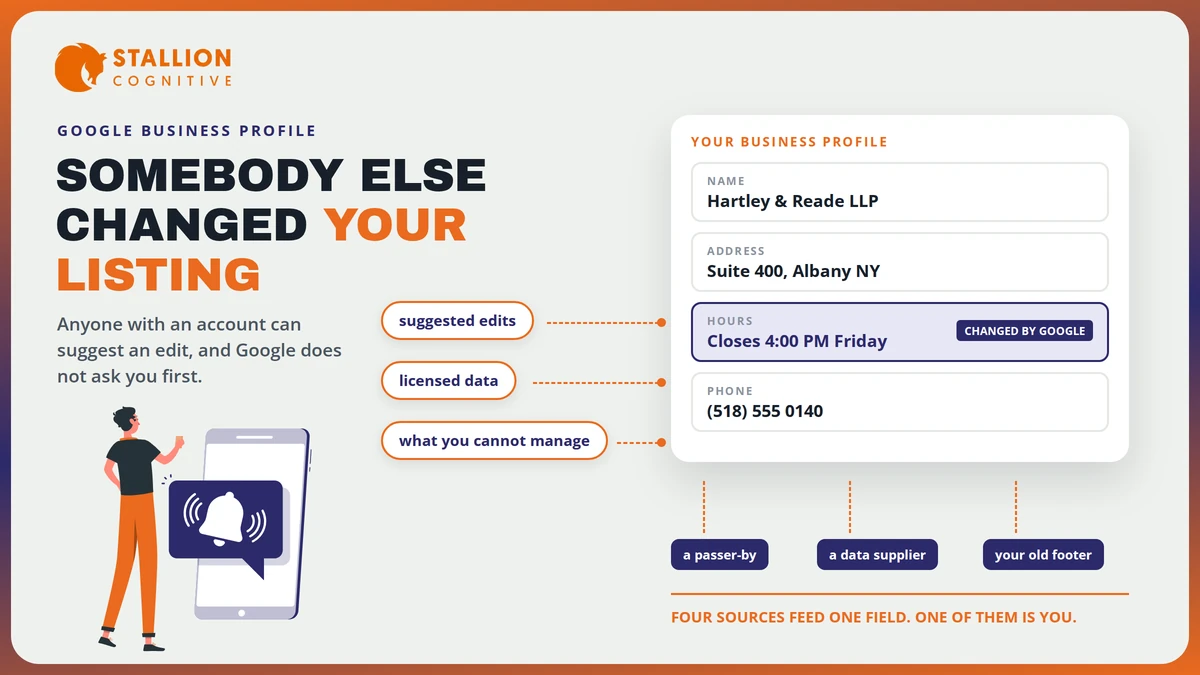
Somebody changed your firm's details on Google and it was probably not anybody at your firm.
The profile looks fine at a glance. Then a client mentions the phone number rang out, or the hours say you close at four on a Friday you have never closed early.
Nothing was hacked. Google takes business data from several places, and your own account is one of them.
Here is where the wrong detail came from and how to put it back.
Four Places the Wrong Detail Could Have Come From
Google is open about this, and the list is shorter than most owners expect. Its page on Google updates says so plainly:
"Google gathers info from different sources, like user reports and licensed content."
Four of them account for almost everything we get asked to fix.
| Source | What it looks like in practice | How much control you have |
|---|---|---|
| Crawled web content | An old address still sitting on your own site | Total, once you find the page |
| Licensed third-party data | A suite number from a data supplier | None directly |
| User contributions | A stranger corrected your hours | Limited, and reversible |
| Google's own signals | Popular times, a closure inferred from activity | None |
Read the third row twice.
It surprises people, and it sits behind most of the calls we take.
Your own site is worth checking before anything else. A stale footer, an old contact page or a set of NAP consistency problems will keep feeding the wrong answer back in, no matter how many times you fix the profile.
Who Else Can Change Your Listing?
Anyone with a Google account. The Maps help page on editing business information does not ask whether the person owns the place:
"You can provide feedback that helps Google Maps decide whether to change a place's information."
The fields open to them are the ones that matter most to a firm. Name, category, location, hours, phone number, website, and whether the place has shut.
- Google reviews every suggested edit before it goes live, and it does not ask you first.
- People who edit a lot carry more weight, since the Local Guides program rewards volume.
- A wrong edit can sit for months, because nobody at the firm is watching the profile daily.
- Competitors are not the usual cause, and the usual cause is a client trying to be helpful.
That last point matters when you decide how hard to push back. Most bad edits come from somebody standing at a locked door on a Friday afternoon, guessing at the hours, and doing what the app invited them to do, which is worth remembering before anybody drafts an angry message to Google about sabotage.
What a Google Update Looks Like on Your Profile
Google labels its own changes and the label is easy to miss. Fields it changed show in blue, and fields you own show in black or white, so one pass down the profile tells you who touched what.
The same help page carries a line that belongs in your notes:
"You can't manage all Google updates through your Business Profile."
A small share of what appears about your firm therefore sits outside your account.
Fighting for control of all of it wastes a week.
- Watch the blue fields: They tell you where the data came from without you having to guess.
- Fix the source, then the field: A licensed record that still says Suite 200 will come back.
- Screenshot before you edit: You will want the date if the same change happens twice.
How Do You Correct It, in the Right Order?
Work outward from the thing you control. Fixing the profile first and the sources second is the reason so many firms end up correcting the same field three times in a year.
- Correct your own website, including the footer, the contact page and any location page.
- Sign in to the profile and set the name, address, hours, phone number and website.
- Check the primary category still describes the work you actually sell.
- Fix the same fields on the other listings a client might open.
- Note the date, and look again in two weeks.
Google reviews owner edits too. Nothing goes live the second you press save, so give it a few days before you decide the change has failed.
If the listing has vanished rather than gone wrong, this is the wrong route. A profile that is missing from Maps or sitting behind a duplicate profile needs a different fix, and correcting fields on the wrong record wastes two weeks.
Why a Correction Comes Back Rejected
Rejections stop being a mystery once you read the rule behind them. Most trace to a name or an address that breaks a published guideline, and firms in shared offices trip the same three every time.
| What you tried | The rule behind the rejection | What works instead |
|---|---|---|
| Adding a service to the name | The name must match real-world signage | Use the legal name and put services in the services list |
| A mailbox or virtual suite | The address must be a real staffed location | Hide the address and set a service area |
| A partner's home listed too | One profile per staffed location | Keep one record for the office |
| Changing the address outright | An address change triggers verification again | Expect a postcard or a video call |
| Reception desk phone number | The number should reach your business | Use a line your own staff answer |
An address change is the costly one. Google asks you to verify the firm again and the pin can wobble for a week or two, so batch it with every other change you had planned and reverify the listing once.
Repeated failed attempts draw attention of the wrong kind, and a suspended profile costs far more than the wrong suite number ever did.
The Field That Costs a Regulated Firm the Most
For an investment adviser the address, the office hours and the phone number are more than marketing. All three are collected on Form ADV, in the part covering the main office and place of business, which you can read on the SEC's own form.
So a wrong address on Google puts a search result at odds with a federal filing. Nobody is fined for that alone.
It is still an awkward thing to explain in a year when somebody is already asking questions, and it is the kind of small mismatch that turns a routine review into a longer one.
State-registered firms are moving the same way. NASAA updated its advertising rules in May 2026 to line up with the federal version, and most states take up the model in time.
- Tie the fields to your filing: Whoever updates Form ADV should own the Google fields too.
- Log the date of every change: A dated screenshot answers a question nobody can answer from memory.
- Do it in the same week as the move: The filing and the profile should change together.
When It Says Permanently Closed and You Are Open
A wrong closure arrives without warning and it costs real money. The profile drops out of the local results while the label stands, and the cause is usually a suggested edit or a long quiet spell during a refit.
The fix runs through your own hours rather than a support ticket.
- Open the profile and go to the hours section.
- Set the business back to open with its main hours.
- Confirm the hours are current, including holidays and half days.
- Watch for a second closure, which means the source has not gone away.
One warning is worth repeating. If the closure was applied as part of a move or a name change, reopening the old record is the wrong move and Google says to add the business at the new location instead.
Sudden closures also tend to follow gaps in your opening hours, so a profile with holiday hours filled in for the year gives people less to correct.
What to Check Each Quarter, and Who Should Do It
Twenty minutes, four times a year, by the same person.
The failure is never the checking. It is that three people each looked once and nobody looked twice.
- Read the profile as a stranger: Open it signed out and on a phone.
- Compare it to the filing: Address, hours, phone number, in that order.
- Check the blue fields: Anything Google changed since last quarter is a clue.
- Look at the other listings: Apple, Bing, your regulator, your chamber.
- Write the date down: Four dated notes a year make any dispute short.
Wrong details are cheap to fix and expensive to ignore, and the firms that never think about them are the ones that put twenty minutes in the calendar. Our team keeps profiles accurate for advisers, accountants and law firms across the US, so ask us about local SEO if you would rather this sat on somebody else's desk.
Frequently Asked Questions
Can a competitor edit what people see about us?
Anybody with an account can suggest a change, competitors included. Sustained interference is worth reporting, and the far more common cause is a client who guessed at your Friday closing time.
How long until an edit appears for clients?
Google publishes no figure and describes the wait only as some time. Treat a few days as normal and look again before you escalate anything.
Does fixing our website update the map pin?
Crawled pages are one input among four, so a site correction helps the record without moving the pin on its own. Change both.
Should the office manager hold the login?
Ownership should sit with a partner and daily access with the office manager. Two people is the right number, since one leaves and nobody can get in.
What happens when two people edit the same field?
The last saved value wins, which is how a corrected phone number reverts a week later. Agree who owns the profile before you agree what it should say.