
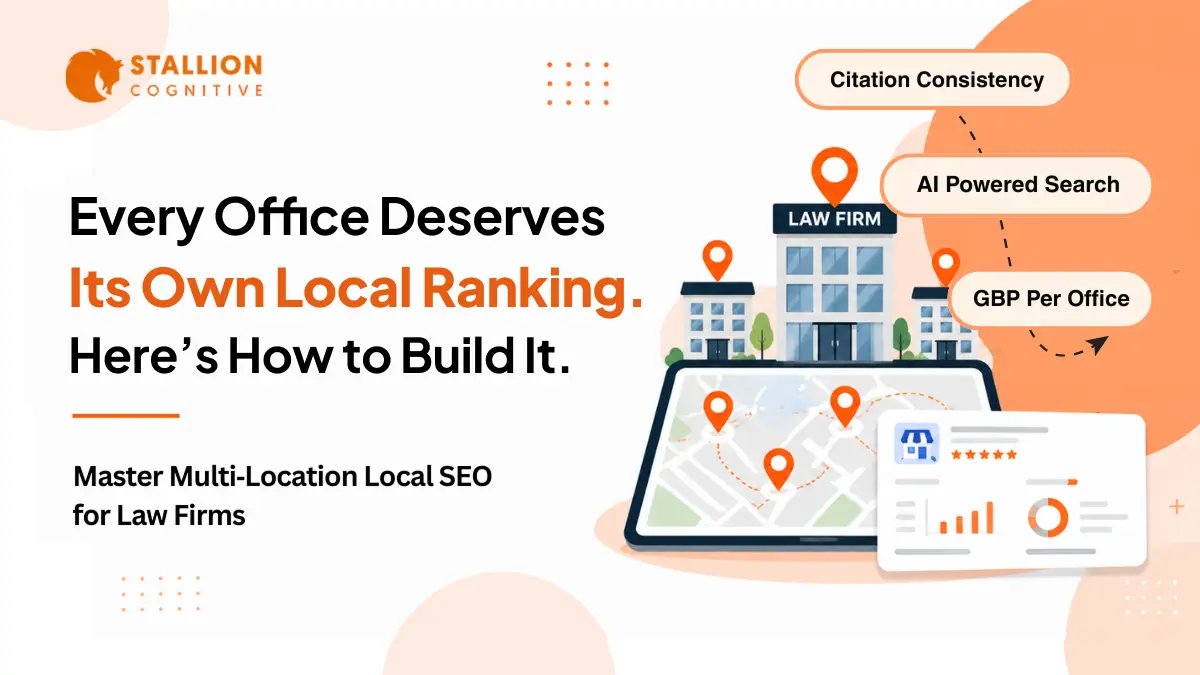
A managing partner opens a second office 90 miles away. Six months later, that office doesn't show up in the local 3-pack for a single keyword. Worse, the original office's rankings have started slipping too. How does expanding a firm's footprint actually shrink its online visibility?
It happens because most firms treat multi location local SEO like a copy-paste job. What works for one office doesn't automatically scale to three. And getting it wrong costs real cases, every single week.
What Makes Multi-Location SEO Different from Single-Office Optimization?
Multi-location local SEO for law firm introduces a unique set of variables at every office: a distinct competitive set, different local directories, a fresh review profile starting at zero, and geographic search behavior that varies city to city. A single-location approach simply can't account for all of that.
Here's where most multi-office law practices go wrong:
- Copy-pasting GBP descriptions across all offices word-for-word
- Building location pages where only the city name changes
- Tracking reviews at the brand level instead of per-office
- Inconsistent NAP formatting ("Suite 200" on the website, "Ste. 200" on Avvo)
- Flat site architecture that buries location pages three or four clicks deep
- No per-location content strategy, so every page reads identically to Google
Each error compounds. Together, they signal to Google that the firm isn't genuinely established in those markets. Rankings reflect that judgment fast, sometimes within weeks.
The same principles that apply to local SEO compliance for financial advisors hold true for law firms: every location needs its own optimization path from day one.
How Should Each Office's Google Business Profile Be Configured?
Every physical office needs its own verified Google Business Profile. No shortcuts. Google's Business Profile Help documentation confirms that each physical location must be independently created, verified, and maintained within the same account.
Here's what a properly built GBP for each law firm office looks like:
| GBP Element | Best Practice | Common Mistake |
| Business Name | Exact legal name matching signage | Keyword-stuffed names like "Smith Law, Best PI Lawyer Dallas" |
| Primary Category | Same across all offices (e.g., "Personal Injury Attorney") | Mismatched categories between locations |
| Address & Phone | Unique local number, verified street address | Shared call center number for all offices |
| Description | 100% unique copy referencing the city, neighborhoods, and attorneys at that office | Copy-pasted firm boilerplate |
| Photos | Real images of that specific office and staff | Stock photos or headquarters shots reused everywhere |
| Hours | Accurate per-location, including holidays | Generic "9-5 Mon-Fri" pasted across all listings |
In our practice, we have seen that the description field is where most firms get lazy. A GBP description that mentions the local courthouse, the lead attorney's name, and the neighborhoods served sends a completely different signal than a generic "serving clients across Texas" blurb. That specificity is what separates firms that rank from firms that hope to.
For firms managing 10 or more offices, Google's bulk verification process saves significant time. Smaller firms should verify each profile individually to ensure nothing gets missed.
What Site Architecture Supports Multiple Law Office Locations?
The website structure will make or break a multi-location effort. Build it wrong, and Google can't figure out which location serves which market. Build it right, and each office earns its own organic equity.
A recommended URL structure:
- yourdomain.com/locations/
- yourdomain.com/locations/dallas/
- yourdomain.com/locations/dallas/personal-injury/
What belongs on each location page:
- Unique H1 tag with city and practice area
- Embedded Google Map for that specific office
- Local attorney bios (people who actually sit in that office, not firm-wide partners)
- Office-specific testimonials or case results
- Contact info matching the GBP listing exactly
- LocalBusiness schema markup unique to that address
Every location page should live within two clicks of the homepage and carry a self-referencing canonical tag (pointing to itself, not to a parent page).
The biggest trap?
Building location pages as near-identical templates where only the city name swaps out. Google's Helpful Content system flags these as scaled content produced for search engines only instead of people. Reference local courts by name. Mention jurisdiction-specific procedures. Include details only someone genuinely present in that market would know.
Firms scaling across many cities can apply programmatic SEO frameworks for franchise-style expansion to create location page templates while keeping each page's content unique and locally relevant.
How to Build Location-Specific Content That Actually Ranks
Generic "areas served" pages were thin content in 2023. In 2026, they will be invisible. Content that is working now has to prove genuine local presence. It has to provide the kind of detail only someone embedded in that community would know.
Here is a practical breakdown of what strong location content looks like:
- Local legal guides: "What to Expect After a DUI Arrest in Harris County" with jurisdiction-specific timelines, court addresses and procedural details
- Attorney spotlight posts: Profiles of lawyers at each office, mentioning bar association memberships, local community involvement and case specialties
- Community-focused updates: Coverage of local court procedural changes, county ordinance updates or municipal legal trends
- Per-location FAQ pages: Answering questions specific to that region's courts, judges and legal processes
- Local case result summaries: Anonymized outcomes from that office's practice areas and has to show real expertise
Take a personal injury firm with offices in Dallas and Houston. The Dallas page should reference Dallas County court timelines and the Frank Crowley Courts Building. The Houston page should address Harris County processes and the Harris County Civil Courthouse. Swapping city names in a template does not build topical authority. Writing about what actually happens in each courthouse does.
A similar content approach works across professional services: market-specific knowledge beats generic advice in local SEO for accountants just as it does for law firms.
The Per-Location Review Strategy Most Firms Skip
We have observed that, a mistake nearly every multi-location firm makes, is celebrating a firm-wide review count while ignoring that the newest office has three reviews, two of them mediocre. Google evaluates reviews per listing, not per brand.
The data backs up why that distinction is so important. According to BrightLocal's 2024 Local Consumer Review Survey, 91% of consumers say local branch reviews shape their overall perception of a multi-location brand. That same research found 88% of consumers would choose a business that responds to all its reviews, while only 47% would consider one that doesn't respond at all.
An effective per-location review strategy has four components:
- Dedicated review links that send clients to the correct GBP listing for their office (not the headquarters)
- Office-specific follow-up sequences triggered via email or SMS after consultations
- Response protocols requiring every review to get a reply within 48 hours
- Monthly per-location audits tracking:
| Metric | What It Reveals |
| Review count per office | Social proof strength at each location |
| Average star rating per location | Quality perception in each market |
| Review velocity (new reviews/month) | Momentum and active engagement |
| Response rate | Trust signal to both Google and prospects |
Think of each office's review profile as a separate asset that needs its own attention. A firm with 5 offices and 50 reviews each will outperform a firm with one office at 250 reviews and 4 offices sitting at 10. Every time.
Citation Consistency and Legal Directory Optimization at Scale
NAP (Name, Address, Phone) consistency across directories remains a foundational local ranking factor. For one office, it's simple. For five or twelve offices, it's a full-time project if done manually.
According to Search Engine Land's reporting on multi-location SEO, businesses with multiple offices commonly face duplicate listings, inconsistent NAP data, and category mismatches, all of which limit visibility across Google Maps and the Local Pack.
Every office location needs its own listing across three tiers of directories:
- Legal-specific: Avvo, FindLaw, Justia, Lawyers.com, Super Lawyers
- General business: Yelp, BBB, Yellow Pages, Bing Places
- Local/regional: Chamber of Commerce sites, city-specific business directories
The format must be identical everywhere. "Suite 200" on the website and "Ste. 200" on a directory listing creates exactly the kind of data inconsistency that erodes trust signals. Consistent NAP syndication across all platforms becomes especially important when managing listings for multiple offices simultaneously.
Run citation audits monthly using tools like BrightLocal or Whitespark. Old listings get corrupted by third-party aggregators, staff changes introduce errors, and new directories appear constantly. Monthly audits catch drift before it becomes a ranking problem.
Technical SEO Checklist for Multi-Office Law Practices
Technical execution is where 80% of multi-location firms lose ground. The content and profiles might be solid, but the underlying site infrastructure falls apart under the weight of multiple locations.
Here's what the technical foundation should include:
- LocalBusiness schema (or LegalService schema) on every location page with unique properties: name, address, telephone, geo coordinates, opening hours, areaServed
- Self-referencing canonical tags on each location page
- Dedicated locations XML sitemap submitted via Google Search Console
- Lazy loading for embedded Google Maps and staff photos to prevent page speed bloat
- Hreflang tags on location pages in bilingual markets (Miami, El Paso, etc.)
- Contextual internal links connecting each location page to its related practice area pages and vice versa
- Mobile-first optimization ensuring all location pages load under 3 seconds on mobile devices
- Structured data validation via Google's Rich Results Test for every location page
Don't nest all locations under a single Organization schema. Each office needs its own LocalBusiness entity in the structured data.
Keeping mobile-friendly standards across every location page is non-negotiable, since most local searches happen on phones. A fast, well-structured mobile page will outrank a slow, bloated one even when the content quality is comparable.
Firms that want a deeper look at what actually moves the needle should study the factors behind local search rankings and how proximity, prominence, and relevance work differently in a multi-location context.
Preparing Multi-Location Content for AI-Powered Search
AI Overviews are showing up in local search results at a rate that demands a real response. According to Local Falcon's 2025 research, AI Overviews are appearing in a growing share of local queries.
That means a significant percentage of potential clients searching for "personal injury lawyer near me" are seeing AI-generated summaries before they ever reach organic listings or the local 3-pack. For firms with multiple offices, this creates both a challenge and a genuine opportunity. However, there is a new term Generative Engine Optimization (GEO), that helps local services get cited by ChatGPT, Perplexity, Gemini, and Google AI Overviews when users search for nearby providers.
To position multi-location law firm content for AI extraction:
- Write direct-answer paragraphs (40-60 words) at the top of each major section so AI can pull them as citation blocks
- Use entity-rich language: name specific courts, statutes, bar associations, and geographic landmarks per location
- Create per-location FAQ content using the exact phrasing people type into ChatGPT or Perplexity ("Who is the best DUI lawyer in [city]?")
- Publish original analysis rather than rephrased generic legal content
AI systems tend to favor content with definite language, high entity density, and simple writing structures. That's exactly the kind of content multi-location firms should produce for each market.
The interplay between GEO, AEO, and traditional SEO matters more here because each office page targets a distinct geographic entity, giving AI systems clear relevance signals when deciding which content to cite.
For voice-driven queries like "find me a divorce lawyer in Austin," local voice search optimization for law firms at the per-location level captures traffic that competitors miss entirely.
Tracking Performance Across Locations: What to Measure
You can't fix what you can't see. Firm-wide averages mask problems at individual offices. Every location needs its own performance dashboard, tracked monthly at minimum.
Track these KPIs per location:
| Metric | The Impact |
| Local pack ranking by keyword | 3-pack visibility for target practice areas in that specific market |
| GBP impressions and actions | How often the listing appears and what users do after seeing it |
| Website clicks from GBP | Quality traffic flow from the local listing to the location page |
| Review count and average rating | Social proof and trust signal strength per office |
| Citation accuracy score | NAP inconsistencies caught before they erode rankings |
| Local organic rankings | Traditional SEO performance for each location page |
| AI Overview mentions | Whether the office appears in Google's AI-generated answers |
Tools like Local Falcon provide grid-based rank tracking that shows where each office ranks across a geographic area, not just a single pin on the map. Picking the right local SEO tools for multi-location tracking can save hours of manual reporting every month, especially once a firm crosses the five-office mark.
How Multi-Location Law Firms Should Think About All of This
The firms that win at multi location local SEO share three traits. They treat every office as its own local SEO project with dedicated resources. They invest in genuine, location-specific content that reflects real community knowledge. And they measure performance at the individual location level, catching problems at the newest office before those problems spread.
A Google official presenting at Secrets of Local Search noted that 46% of all search queries carry local intent. For a law firm with offices in five cities, that's five separate opportunities to capture high-intent clients during their most urgent moments.
Start with the GBP setup. Move to site architecture and location pages. Layer in review strategy and citation management. Skip any step, and competitors will gladly take those cases. Stallion Cognitive builds the technical infrastructure and local content required to rank in every market. Get in touch with us to turn your expanding footprint into actual caseloads.
FAQs
Can a law firm use a virtual office address for a Google Business Profile?
No, google requires a physical space where staff meets clients during normal hours. P.O. boxes and virtual offices violate these rules. Using them risks a complete suspension, wiping your listing from Maps and local search.
Should each law firm location post separately on Google Business Profile?
Yes, copying identical content across multiple offices looks spammy. Create unique posts for every listing. Share branch-specific updates like local sponsorships, attorney recognitions, and legal advice relevant to that exact city.
What happens to SEO rankings if a law firm closes one of its locations?
Ghost locations hurt brand trust and confuse searchers. To protect your rankings, mark the profile "Permanently Closed." Then, delete the old location page, set up a 301 redirect to the nearest open office, and update your directory citations.
How long before a new law office location starts ranking locally?
Expect your new office to hit local results 60 to 90 days after verifying your GBP and building citations. Highly competitive fields like personal injury can take six months. Getting positive reviews and publishing quality content speeds up this timeline.
Do Google's local ranking algorithms treat YMYL legal content differently?
Yes, legal services face strict Your Money or Your Life quality standards. Lawyer credentials, bar admissions, case results, and real client reviews hold significantly more ranking power here than they do for regular local businesses.