
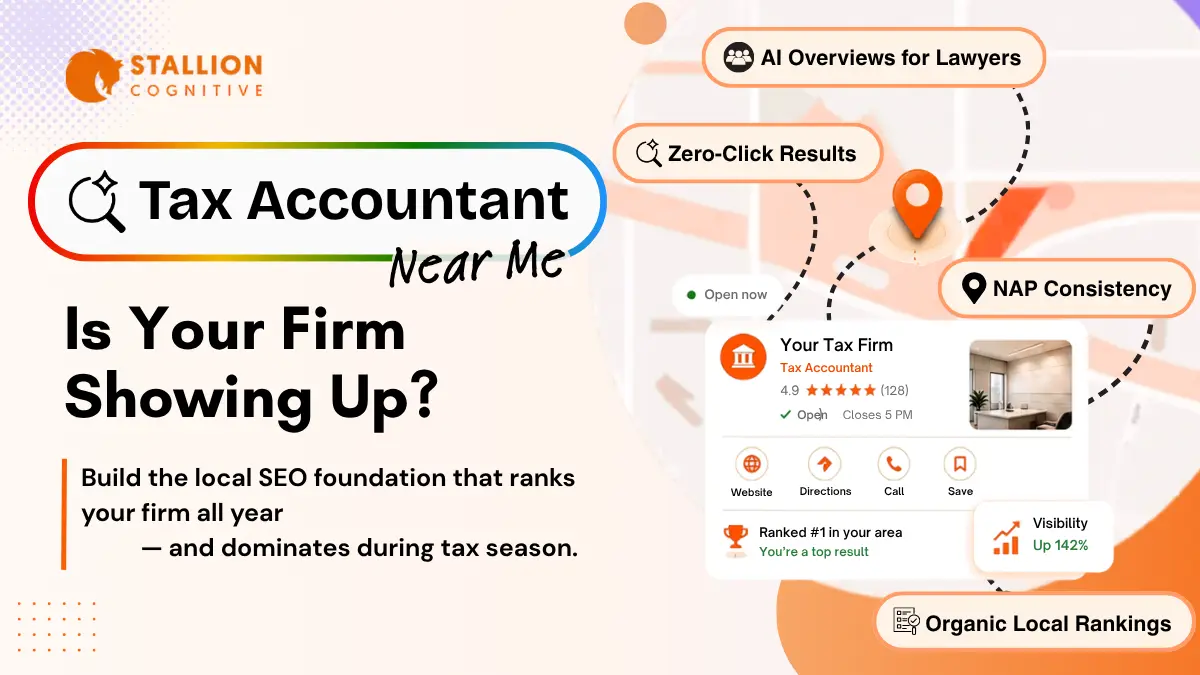
By the time most accounting firms think about their Google presence, tax season is already here. The firms ranking at the top of local search in January and February didn't optimize then. They built those positions in October and November, before demand peaked.
That's how local SEO for accountants works. Rankings you hold in April are the product of decisions made months earlier. A CPA practice that builds its Google Business Profile, collects reviews, and publishes location-specific content in the fall walks into tax season with a structural advantage. One that waits until clients are already searching gets started on a race that's effectively over.
Accounting firm SEO at the local level has five core components: your Google Business Profile, NAP consistency across directories, review velocity, website structure, and seasonal content. Each sends a distinct signal to Google's algorithm, and together they determine whether your firm shows up in the three results that capture most of the clicks or in the positions that capture almost none.
Why Local SEO for Accountants Pays Off More Than Most Marketing Channels
Local SEO for accountants delivers something paid advertising can't: a position that holds and compounds. Every review collected, every citation built, and every piece of local content indexed contributes to a base that grows month over month. When the budget behind a paid campaign stops, those rankings disappear. Organic local rankings stay and continue building.
The Gap Most Accounting Firms Don't Know Exists
According to Ahrefs local SEO data, 46% of all Google searches carry local intent. For professional services queries like "CPA near me" or "tax accountant for small business in [city]," almost all of that intent flows directly to Google Maps and the local 3-pack. Those three positions capture the majority of clicks, and during peak tax season searches the firms outside them are effectively invisible.
Most accounting firms don't know this because referrals keep coming. That referral stream works until a competitor who did the SEO groundwork starts taking calls that should have gone to them.
Signs your accounting firm has a local SEO problem:
- You appear below position 3 for "[your service] near me" in your own city
- Your Google Business Profile hasn't been updated in 60+ days
- Competitors with fewer years in practice outrank you in Google Maps
- You get referrals regularly but almost no inbound inquiries from online searches
Measure the Gap Before You Close It
Before anything else, pull a local ranking factor analysis to see exactly where your firm stands against the competitors currently holding 3-pack positions in your market. You can't close a gap you haven't measured.
How to Build the Foundation Google Uses to Rank Accountants
Accounting firm SEO at the local level relies on three signals: relevance (how specifically your profile matches the query), distance (your proximity to the searcher), and prominence (how established your firm looks across the web). Distance dominates at roughly 66% of ranking weight, followed by reviews at 10.9% and domain authority at 5%, per SearchAtlas's ranking factor data.
Your Google Business Profile Is Your Ranking Engine
The GBP is the single most impactful element in local search. Most accounting firms claim theirs and then leave it incomplete. An incomplete profile rarely appears in the 3-pack.
GBP fields that directly affect local rankings:
- Primary category: "Tax Preparation Service" outperforms the generic "Accountant" for tax-focused searches. Audit it quarterly. Google changed category availability roughly 40 times in 2025.
- Secondary categories: Add CPA, Bookkeeper, Payroll Service, Tax Consultant. Each one expands the pool of queries your profile can appear for.
- Services tab: List every service individually with a short description that includes keywords and location language.
- Posts: Two to three per week minimum: filing deadline reminders, client questions answered, service spotlights. Profile posting is a direct activity signal to Google's local algorithm.
- Photos: Office, team, credentials. Update quarterly. Mobile users account for 71% of GBP interactions and are 2.4 times more likely to call directly from a profile than visit the website.
Per Google's local business guidelines, profile completeness and consistent activity directly influence local ranking performance.
NAP Consistency and Citations
NAP is Name, Address, and Phone number. Google cross-references these across every directory where your firm appears. Any inconsistency (a suite number formatted differently on Yelp vs. Google, a former address still live on BBB) creates conflicting signals that suppress local rankings.
Priority directories for accounting firms:
- Google Business Profile, Apple Business Connect, Bing Places (Tier 1, set these up first)
- Yelp, Facebook Business, Better Business Bureau
- CPAdirectory.com, AICPA member directory, state CPA society listing
- Local chamber of commerce, regional business associations
Industry-specific directories like CPAdirectory.com carry topical relevance that general directories can't match. Run a citation audit quarterly using Moz Local or Semrush Listing Management to catch and fix inconsistencies before they compound.
How Reviews Function as Both a Ranking Signal and a Trust Signal
Reviews affect local rankings through volume, recency, and rating, but recency carries the most weight. A firm generating five new reviews per month may consistently outranks one with three times the total count but nothing new in the past year. Review velocity signals to Google that yours is an active, operating business with regular client engagement.
Build a Review Request System That Runs Automatically
A consistent review system is more effective than any one-time campaign. Three touchpoints that work for accounting firms:
- Post-engagement email: Sent 7 to 10 days after tax filing confirmation. One short sentence and a direct review link. No need to ask for a specific rating.
- Email signature link: Passive collection on every outgoing message. Generates steady inbound reviews without any extra effort.
- In-office QR code: Printed at reception or included in client folders. Takes clients directly to the review form with no search required.
Potential clients compare review recency as much as overall rating. A consistent monthly rate of three to five new reviews, maintained over 12 months, builds more ranking authority than a one-time burst of 30 followed by months of silence.
Respond to every review within 48 hours. Google uses review response activity as a prominence signal, and potential clients read how you handle negative feedback as closely as they read the reviews themselves.
The Tax Season Review Window
April and early May are the highest-yield months for review generation at accounting firms. Clients who just completed their filings are satisfied, the experience is fresh, and the relationship is at its highest point.
A single follow-up email sent 10 days after the April filing deadline, acknowledging the completed return and including the review link, consistently produces the best review conversion rate of any campaign an accounting firm can run. The velocity built in April and May directly strengthens your 3-pack positions going into the following tax season.
What Does Your Accounting Website Need to Compete Locally?
Your accounting website needs to give Google three clear signals: what you do, who you serve, and where you're located. Those signals come from structured service pages, location-specific content, and technical elements like schema markup. A website missing these works against your local rankings regardless of how well your GBP performs.
Service Pages and Location Pages Done Right
One generic "Services" page cannot rank for individual services. Each service and each location you serve needs its own dedicated page.
What each accounting service page should include:
- H1 naming the service and city: "Tax Preparation for LLCs in Denver, CO"
- 400 to 600 words of service-specific content, written for that specific service and location rather than a template with a city name swapped in
- An FAQ section answering the 3 most common questions clients ask about this service
- A clear call to action with phone number or booking link in the body
- LocalBusiness and Service schema markup
Location pages follow the same logic. "CPA for Small Businesses in Denver" and "CPA Services in Boulder" are two different pages, each with meaningfully distinct content. 40% of U.S. accounting practices operate from multiple offices. Multi-location firms without properly distinct location pages see measurably lower organic lead conversion.
Schema Markup and Technical Signals
Schema markup is structured data that tells Google specific facts about your business in machine-readable format. Most accounting websites have no schema at all. Deploying it correctly produces a measurable lift in both local search and AI Overview appearances.
Three schema types every accounting firm website needs:
- LocalBusiness (AccountingService subtype): On your homepage and location pages. Includes name, address, phone, hours, and service area.
- Service schema: On each individual service page. Describes the specific service offered and links it to your LocalBusiness entity.
- FAQPage schema: On any page with FAQ content. Gets pulled into Google's AI Overviews and rich results directly.
Page speed is a ranking signal too. A WordPress accounting site with unoptimized plugins and uncompressed images can score below 50 on Google's PageSpeed Insights. Audit Core Web Vitals through Google Search Console and fix the highest-impact issues first: image compression, third-party script reduction, and server response time. The Local SEO audit for accountants covers both on-page and technical signals in a structured order.
Tax Preparation Marketing: Why Tax Season Rewards the Prepared
Tax preparation marketing works on a delay. Content published in January competes for rankings in an already-crowded window and often doesn't gain traction until after April 15th. Content published in October or November indexes and ages before search volume peaks. The difference in ranking outcomes between a firm that starts early and one that starts late is significant.
The Pre-Season Content Calendar
Every accounting firm running local SEO should have the following live and indexed before November 1st:
- Location-specific service pages: "Tax Preparation for LLCs in [City]," "S-Corp Tax Filing Help in [City]"
- FAQ-format blog posts: "What does a CPA charge for small business tax prep?" and "When do I need an accountant instead of tax software?"
- Audience-specific seasonal content: "Tax Planning Guide for Freelancers," "Real Estate Investor Tax Strategies for 2026"
GBP posts referencing upcoming filing deadlines should run weekly from October onward. Profile activity during the pre-season window contributes to the engagement signals Google weighs when the spike hits. 40% of local queries now trigger Google's AI Overviews, and those AI answers pull from your GBP, structured content, and reviews. Understanding AI Overviews and local search is part of making this pre-season content calendar work.
Three Keyword Intent Categories That Spike November to April
Tax season search volume splits across three distinct intent types. Each targets a different stage of the client decision process and belongs in different content formats.
| Keyword Type | Example Searches | Where They Belong |
| Transactional | "CPA for LLC taxes," "tax accountant near me," "IRS audit help [city]" | Service pages, GBP service listings |
| Informational | "How much does a CPA charge," "do I need a CPA or tax software," "what to bring to a tax appointment" | Blog posts, FAQ pages |
| Deadline-based | "Tax extension deadline 2026," "quarterly tax due dates," "when to file S-Corp taxes" | Seasonal blog content |
Transactional pages convert immediately. Informational content builds trust during the research phase. Deadline content compounds annually. The post you publish this October generates traffic every filing season without being rebuilt.
The Year-Round CPA Marketing Strategy That Keeps Rankings Active
The accounting firms dominating local search during any given tax season built those positions across all four quarters of the prior year. Year-round CPA marketing strategies focus on keeping Google's key ranking signals active on a consistent cadence: GBP posts, review collection, content publishing, and citation maintenance.
Off-Season Content That Brings Leads Year-Round
Outside of tax season, three content categories consistently attract qualified accounting leads:
- Business formation and startup accounting: "How to choose a CPA when starting an LLC," "accountant for new S-Corp." Attracts founders who need both formation guidance and ongoing bookkeeping from day one.
- Bookkeeping and financial management: "QuickBooks setup for restaurants," "monthly bookkeeping checklist for small businesses." Draws clients who want a long-term accounting relationship rather than a single annual return.
- Advisory and planning: "Tax strategy for high-income consultants," "cost segregation for rental property owners." Targets higher-value clients with complex needs and the strongest likelihood of becoming retained advisory relationships.
Each category targets a different buyer at a different stage of their business lifecycle. Together they keep your website generating organic traffic in every month of the year.
A Quarterly Roadmap That Prevents Post-Tax-Season Drift
- Q1 (January to March): Tax season execution. GBP posts 3x weekly. All service pages indexed and current. Active review collection from every completed engagement.
- Q2 (April to June): Post-season infrastructure. Publish business formation and bookkeeping content. Run the April review campaign. Audit citations and update GBP categories.
- Q3 (July to September): Authority building. Publish advisory and planning content. Build local links through chamber contributions. Draft and schedule all pre-season content for Q4.
- Q4 (October to December): Pre-season setup. All tax season content live by November 1st. Refresh service pages with current-year filing references. Run October and November review campaigns.
The GEO and AEO signals that determine how your firm appears in AI-generated answers build directly on top of everything in this roadmap. Q3 is the right window to implement FAQ-rich content and schema before the peak-season window opens. For the full picture on how GEO works for local services, that layer is worth understanding before Q4 setup begins.
The Consistent Firm Wins
Local SEO for accountants is a 12-month commitment. The firms holding 3-pack positions during peak searches earned them through consistent, deliberate work across all four quarters: reviews collected steadily, GBP updated weekly, content indexed months before demand arrives.
The firms missing from those positions treated local SEO as something to address when things slow down. By the time they start, the gap is wide and the season is already in motion.
Start where the impact is fastest. If your GBP has gaps or hasn't been updated in months, fix that first. If your reviews are stale, build the request system and run it through your next three client completions before doing anything else. Every month of consistent signals is a month your competitors have to close.
Want a full competitive audit showing exactly where your firm stands in your local market? Our local SEO services start with that audit and a prioritized action plan built around your specific gaps.
FAQs
How long does it take for accounting firm local SEO to show results?
GBP optimization produces visible ranking movement within 30 to 60 days. Citation cleanup shows reliable improvement within 60 to 90 days. Location page rankings develop over 3 to 6 months. The compounding effect of consistent review velocity, content publishing, and GBP activity becomes most visible at the 6-month mark.
Can an accounting firm rank in multiple cities without a second office?
An accounting firm with one office can rank in surrounding cities by building dedicated location pages for each city served and setting a service area in the GBP. Each location page needs a unique title tag and city-specific content. Service area settings signal geographic reach without needing a second address.
Does specializing in a niche improve local SEO for CPA firms?
A firm positioning as "CPA for e-commerce businesses" or "accountant for restaurant owners" in a specific city faces less direct competition for those searches and converts inquiries at higher rates. Niche-specific service pages and GBP descriptions naming the target client type help Google match the firm to high-intent queries.
How do Local Services Ads compare to organic local SEO for accounting firms?
Local Services Ads appear above the organic 3-pack on a pay-per-lead model and stop the moment the budget stops. Organic local SEO builds a position that compounds over time. The most effective tax season approach combines both: organic rankings as the foundation, Local Services Ads as amplification during peak demand.
When should an accounting firm start local SEO to see results by tax season?
September or October is optimal. GBP optimization, citation cleanup, and content work take 60 to 90 days to show meaningful ranking improvement. A firm starting in September consistently sees better first-season results than one starting in January. Firms that start in January are typically building for the following year.