
We might quote one owner a $4,500 site and another a $22,000 build in the same week, and both prices are fair. That is the whole trouble with this question.
The honest range really is that wide, so most articles shrug and throw "$500 to $75,000" at you as if that settles anything.
We build these sites for a living and publish our prices, so this is the version we would give a friend. A business website costs $4,000 to $15,000 when an agency builds it. Less if you do it yourself. More the moment you start selling online.
The rest of this shows you where your number actually lands, and where owners quietly hand over money they never needed to spend.
What Does a Business Website Actually Cost?
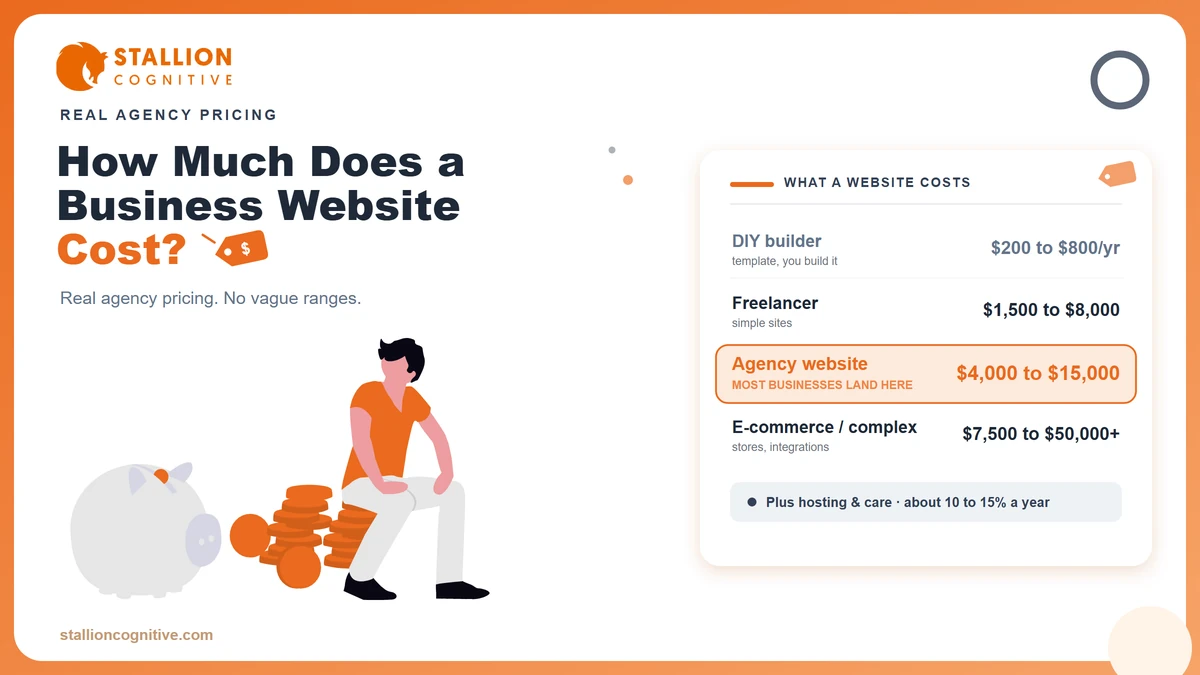
An agency-built business website runs $4,000 to $15,000 in 2026. Do it yourself with a builder and you are looking at $200 to $800 a year. Bring in a freelancer and it tends to land around $1,500 to $8,000. Add a store, a booking system, or client logins and you sail past $7,500 fast, sometimes well past $50,000.
Here is how the four routes stack up.
| Who builds it | Typical cost | Best for |
|---|---|---|
| DIY website builder | $200 to $800 / year | Testing an idea on a tight budget |
| Freelancer | $1,500 to $8,000 | Simple sites with clear direction |
| Agency (business site) | $4,000 to $15,000 | Sites that need to bring in leads |
| Agency (e-commerce or complex) | $7,500 to $50,000+ | Online stores, booking, integrations |
Those ranges match the wider market. HubSpot pegs the average small business site at $1,000 to $7,000, with agency work running past $15,000 as the job grows.
Find your row and hang onto it.
The thing nobody warns you about is how much the number still swings inside a single row, often more than the gap between rows. We have quoted two five-page sites a month apart where one came in at $4,000 and the other at $11,000. Same page count. Wildly different build underneath.
What Makes the Price Go Up or Down?
Ask us why one quote doubles another and it almost always traces back to the same six choices. Add more of any one and the number climbs.
- Page count: A five-page site is a different animal from a twenty-page one, because every page is more design, more writing, and more that can break.
- Custom or template: A recycled theme is cheap, and it usually shows. A design built around your brand costs more and works harder for it.
- What the site has to do: A contact form is nothing. Online booking, client logins, and payment processing are each a small project of their own.
- Who writes it: Hand over your own copy and photos and the price drops. Ask the team to create all of it and it climbs.
- SEO from day one: A site built to rank, with clean code and real on-page work, is worth more than a pretty page nobody ever finds.
- Selling online: Product pages, carts, checkout, tax, and shipping pile up fast, and this is where budgets jump the most and cheap builders quietly fall apart.
None of that is the website itself. You are paying for a stack of decisions, and design is the one owners tend to overspend on while starving the SEO that would have made the whole thing pay off.
So write the brief before you shop the quote. A vague brief gets priced for the worst case every single time.
Should You Go DIY, Freelancer, or Agency?
It comes down to one question. How much does the website actually need to earn? If the answer is nothing yet, a builder is fine for now. If the answer is real money, the cheap route gets expensive in a hurry.
One quick gut check sorts most people.
- Losing the site tomorrow would cost you nothing: DIY is fine, and there is no shame in it.
- You know exactly what you want and it stays simple: A freelancer gets you there for less.
- The site is meant to bring in clients: An agency almost always pays for itself, and this is the choice people underspend on.
DIY website builders
Wix, Squarespace, and templated WordPress hand you the keys for the price of a monthly subscription. You do the work, and the result tends to look like the template it started from, because that is what it is.
That trade is fair while you are still testing whether the idea has legs. Owners who build a website with AI ship pages in a weekend, then a few months later wonder why nothing ranks and nobody fills in the form.
Freelancers
A good freelancer sits in the middle, often $1,500 to $8,000, and gives you something semi-custom without the agency overhead.
The trade-off is real, though. One person means one skill set, one calendar, and one thing that can go quiet on you for two weeks. Freelancers shine when you can hand over clear direction and you will not need much support once the site is live.
Agencies
An agency costs more because you are renting a team rather than a person. Strategy, design, development, copy, and SEO under one roof, all aimed at a site that brings in work.
For an established business the math usually lands in your favor, since stronger website conversion rate work squeezes more booked calls out of the traffic you already have. Put a cheap build on a site your revenue leans on and it becomes the priciest line on this whole page.
The Costs That Never Make It Into the Quote
The build is the sticker price. A website keeps costing money after launch, every year, whether you plan for it or not. Skip this part and the site slowly rots. Plugins break, the host lapses, rankings slide, and one day you notice the contact form has been dead for a month.
Four things belong in the yearly budget.
- Domain name: Ten to twenty dollars a year, worth setting to auto-renew so it never gets lost in an inbox.
- Hosting: Roughly $100 to $600 a year for a small business site, climbing as traffic grows.
- Maintenance and security: Updates, backups, and monitoring. This is the line owners love to cut, and it is the one that bites hardest.
- SEO and content: The ongoing work that keeps traffic coming, since rankings fade the moment you stop feeding them.
HubSpot puts the yearly running cost at roughly 10 to 15 percent of the build. Hosting on its own is a whole industry, with the U.S. web hosting market projected to reach $73.71 billion in 2025 per Statista, which should tell you this line is normal and not some upsell we dreamed up.
We fold all of it into flat website care plans, so the yearly number is on the table before you sign, well ahead of the week something breaks. A site you cannot afford to keep up ages fast, and it ages ugly.
What Should a Small Business Actually Spend?
Most small and mid-sized businesses get everything they need between $4,000 and $8,000. That buys custom design, real SEO groundwork, and a build that turns visitors into enquiries instead of just sitting there looking nice. Go much cheaper and you usually get a tidy template that converts almost nobody.
The trap is easy to miss. A $1,500 site feels like a steal right up until it has brought in nothing for a year. Then you pay a second time to rebuild it, and you also eat every lead the weak version let slip out the back.
Think of the site as a salesperson who works every hour of every day and never asks for a raise. One extra client a month changes the whole calculation. A homepage built to drive sales or a tight landing page design can cover the entire project out of one good campaign.
A sensible small business budget covers four things.
- Custom design: Built around your brand and your buyer, never a stock theme half your competitors are also running.
- Speed and mobile: Most of your visitors show up on a phone, so a fast, thumb-friendly build is not optional.
- On-page SEO: So people can find the site the week it launches instead of a year later.
- Room to grow: A structure that lets you add pages and features later without paying for a rebuild.
So what would two new clients a month be worth to your business? Budget against that figure rather than the invoice in front of you. And once the site earns reliably, ease off. Past a certain point you are buying scale you will not touch for years.
How to Read a Website Quote Without Getting Burned
A good quote reads like a plan. A bad one reads like a single number with the details hidden, so the scope can creep later and drag the price up with it. Before you sign anything, make it spell out the pages, the design, the content, the SEO, and what happens after launch.
Run any quote through this list before you agree to it.
- Pages: How many, and what each one is for, written down instead of assumed.
- Custom or template: Stated in plain words, so nobody is guessing later.
- Content: Who writes the copy and preps the images, you or them.
- SEO: Whether on-page work is in the price or waiting as a surprise line item next quarter.
- Mobile and speed: A mobile-friendly build and fast load times as standard, never an add-on you pay extra for.
- Timeline: Kickoff to launch, with milestones you can hold them to.
- After launch: Who owns the site, who supports it, and what updates cost.
One big number with no breakdown is a red flag dressed up as convenience. Ask for the itemized version and watch how they react, because any team that has done this a hundred times will walk you through every line without flinching.
Ready to Budget Your Website?
You are not guessing anymore. You know the ranges, you know what pushes your number up, and you can tell an honest quote from a padded one at a glance.
The only thing left is a real figure for your project. Tell us what the business needs and we will scope it line by line, so the price matches the work and nothing hides in the footnotes. Our web design services build in the SEO and speed that get a site earning in its first few weeks instead of its first year.
So what is the right website worth to your business this year? Start the conversation and we will put a real number on it.
Frequently Asked Questions
Do web designers charge a one-time fee or a monthly retainer?
Usually a one-time project fee for the build, then an optional monthly fee for hosting, care, and support. A few bundle everything into one monthly plan. Ask which model you are signing before you sign, so the running cost never blindsides you.
Do I own the website and content after the project ends?
With a reputable agency, all of it is yours, the domain, the hosting login, the files, and the content. Get it in writing anyway. Some budget shops lock you to their platform, and then leaving turns into its own expensive project.
Can you redesign an existing site for less than building new?
Often, when the bones and the content are worth saving. When the foundation is shaky, a rebuild usually beats patching something you will replace within the year regardless. A quick audit tells you which camp you fall into.
How soon can a new website start paying for itself?
Depends on your margins and how well it converts. A lead-focused site for an established business often earns its cost back inside the first several months. The quicker it turns a visitor into an enquiry, the quicker it pays.
Does a bigger budget guarantee a better website?
A bigger budget buys scale and custom work, though it promises nothing by itself. A sharp team on a middling budget will outbuild a fat budget with no strategy behind it. Point the money at clear goals and it works far harder.