
Maybe you saw the demo. Type a sentence, get a working website by lunch. Looks easy enough, until you start asking what happens after the launch screenshot.
Quick truth. AI can build you a working website in 2026. Real layouts, real copy, real mobile responsiveness, all live in under five minutes. The piece nobody covers on the demo is what comes after launch, which is whether a site that loads is the same as a site that books meetings, ranks on Google, or earns trust from a stranger about to hand over their retirement portfolio.
Half the calls we field this year start the same way. An accountant or a financial planner built something with AI in February, the leads dried up by April, and now they're trying to figure out what broke. What follows is the agency take on using AI without burning a year of growth doing it.
What AI Can Actually Do Right Now
Let's start with what's real. AI builders this year actually pull off the demo. Five minutes, one prompt, and out comes a full responsive site, mobile-ready, on-page SEO already wired in, even the imagery picked for each section. For a brochure that has to be online by Tuesday, you can ship it Monday afternoon and nobody on Google will know the difference.
And these aren't the template-pickers we used to mock either. The new builders reason their way through structure, copy, design, and assets in one continuous pass. They've eaten a few million well-performing web pages for breakfast, which is why the first draft already looks like something a freelancer would have charged you $3K for.
Speed that almost feels like cheating
Used to be that a basic small business site ate 8 to 12 hours of dev time and ran anywhere from $7,000 to $70,000 in real money, per GoodFirms' 2025 cost survey. AI builders cut that down to 30 seconds and a free trial. No wonder 67% of business owners now lean toward AI over hiring a developer from scratch.
For a founder who's been putting off launching because freelance quotes felt insane, that single shift changes the whole calculation.
What AI actually handles well
Where the current generation pulls its weight:
- Layout: Functional grids, hero sections, navigation that works on the first pass.
- Copy: Serviceable headlines you'd refine, not rewrite from scratch.
- Mobile responsiveness: Passes mobile-first crawling checks without you lifting a finger.
- On-page SEO: Title tags, meta descriptions, alt text scaffolding, sitemap. All in place.
- Imagery. Decent stock pairing or AI-generated visuals matched to each section, which used to take a designer half a day.
Where the speed actually helps
This is no-brainer territory. A founder building an MVP, the side project nobody'll look at twice, a campaign microsite that retires next quarter, or an advisor who's been delaying his website for two years and finally needs something credible online by Friday. For situations like those, the right move is to use AI, get the thing live, and stop overthinking it.
Speed is only half the win, though, and the bigger half is whether the site holds up once real traffic, real scrutiny, and Google's algorithms enter the picture. That's where AI builders start to crack.
Where AI Website Builders Still Fall Short
This is where the demo magic wears off. AI builders consistently break on the four things that decide whether a website earns you money: brand distinctiveness, technical performance, real SEO depth, and Google's trust. The "looks fine" tier is exactly where most small business sites die slow deaths.
Roughly in order of how badly each one will hurt you:
| Crack | What breaks | Cost to your business |
|---|---|---|
| Sameness | Every AI site looks like every other one | Conversion rate drops 30-60% vs. a differentiated site |
| Performance | Lighthouse scores in the 45-60 range | Rankings, Core Web Vitals, bounce rates |
| Shallow SEO | Mechanics handled, strategy ignored | Page-2 ceiling for anything competitive |
| Weak E-E-A-T | No real author signals or expertise | Invisible in YMYL niches and AI Overviews |
The sameness problem
Try a quick test. Pull up three AI-built sites from three random industries (a consultancy, a dental practice, a local coffee roaster), then try to guess which is which from the layout alone. We've done this with clients more times than we can count, and almost nobody gets all three right.
Most AI builders pull from the same training data and the same modern design conventions, which is why output gravitates toward identical spacing, hero structures, and CTA placements. For a financial advisor selling trust, or an accountant selling credibility, that visual sameness is a quiet tax on your conversion rate. The copy follows the same pattern, because every AI-generated headline reads like the same writer wrote it.
Performance that quietly tanks your rankings
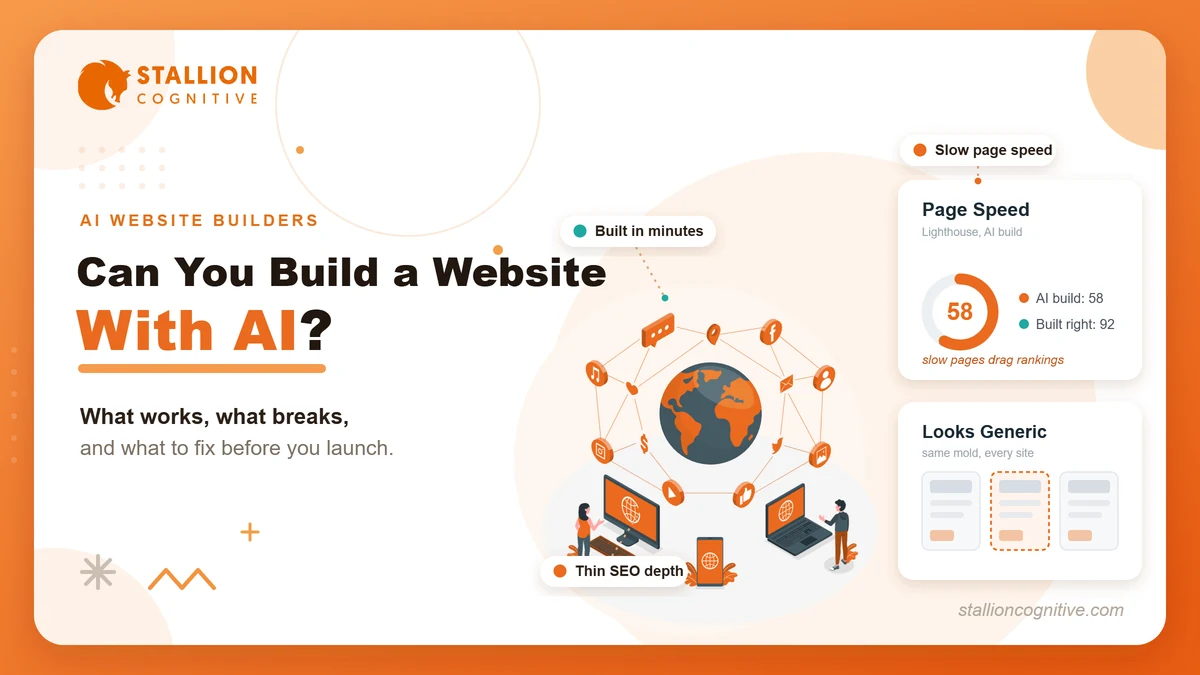
The gap is bigger than the pricing pages let on. Drag-and-drop AI builders typically land Lighthouse scores in the 45 to 60 range, while custom-built sites usually sit between 88 and 95. That 30-to-40 point spread doesn't just sit there looking ugly on a report card. It shows up in Core Web Vitals, search rankings, bounce rates, and whether Google ever ranks you for anything competitive.
JavaScript-heavy builders add a second problem on top of that. Googlebot's first crawl often hits a near-empty page because the content needs JavaScript to render before it appears, and we've watched founders publish 20-plus blog posts that never showed up in any search result, all because of how the page actually renders for a search engine at the source-code level.
SEO mechanics vs SEO that actually wins traffic
The bit the demos skip entirely is where you'd hope they'd lean in. AI nails the 10% of SEO that's mechanics, which is the easy stuff. Where it whiffs is the 90% that actually moves rankings:
- Keyword strategy. Picking terms you can actually rank for, not the ones with the biggest volume that you'll never crack.
- Content depth. Pages that answer the question properly, rather than recycle the top three results.
- Topical authority. Built through strategic internal linking, pillar-cluster structures, and patient publishing.
- Schema and entity markup. The structured data that gets you into rich results and AI citations.
None of that is in any AI builder's wheelhouse. It still needs a human who's done this for a living.
| "Shipping a website in five minutes is now a solved problem. Shipping one that ranks is still a 12-month one." |
The trust problem nobody talks about
Google's E-E-A-T framework (Experience, Expertise, Authoritativeness, Trustworthiness) is the single biggest non-technical ranking signal for any YMYL site. That's finance, accounting, legal, health, insurance, and any niche where bad information can actually hurt the reader.
AI copy with no author credentials, no original client data, no founder voice, and no real-world examples? Doesn't clear that bar. Your site exists, technically, but Google doesn't trust it enough to put it in front of actual humans. The gap matters way more now that AI Overviews appear in 47% of search queries and the citations pulled into those overviews come from sites that demonstrate real expertise, not from sites that just look polished on the surface.
Pull both options up side by side and the trade-offs get clearer.
AI vs Human-Built Sites: How Do They Actually Compare?
AI gives you speed, a cheap launch, and easy iteration. Human builds give you conversion rate, an SEO ceiling that actually exists, brand uniqueness, and a site you fully own. Which side you should be on depends entirely on what you're optimizing for, and most business owners pick the wrong variable on the first decision.
Side-by-side, no spin
| Factor | AI-Built Site | Human-Built Site |
|---|---|---|
| Time to launch | 30 min to 1 day | 4 to 12 weeks |
| Upfront cost | $0 to $50/month | $7,000 to $70,000+ |
| Lighthouse score (avg) | 45 to 60 | 88 to 95 |
| Brand differentiation | Low | High |
| SEO ceiling | Basic on-page only | Full technical + strategic |
| Conversion optimization | Generic CTAs | Tested, audience-specific |
| Code ownership | Locked to platform | Fully yours |
| E-E-A-T readiness | Weak by default | Built in |
| Best for | MVPs, landing pages | Revenue-driving business sites |
The row everyone misses
Look at the conversion optimization row again. A site pulling 1,000 monthly visitors at a 1% conversion rate gets you 10 qualified leads. The same traffic on a properly optimized site running 4% gets you forty. Four times the business off the exact same traffic, which is enough to cover the cost of a professional build inside a single quarter for most service firms.
So when is each approach the right move?
When Should You Build a Website With AI?
Use AI when speed and cost outweigh performance, ranking, or originality. Skip it the moment your site has to be your primary revenue channel, the moment you sit inside a YMYL niche, or whenever you need a design that hasn't already been cloned by 10,000 other AI users this quarter.
Build with AI if...
- You need a credible landing page online by Friday to test a new idea.
- The site exists mostly to display information, not generate qualified leads at scale.
- Budget is zero, and the only alternative is no website at all.
- You're building a one-off microsite for an ad campaign or a product launch.
Bring in a strategist if...
- The site is your primary lead channel. Period.
- You sell to people in finance, accounting, health, legal, insurance, or any YMYL category where trust does the heavy lifting.
- You compete in a market where five or six other firms already rank for your money keywords.
- You need real integrations, like a CRM, a booking platform, or any JavaScript app where SEO has to keep working.
The trap most owners fall into
Word of caution. Most owners overestimate how much of their website is a brochure and underestimate how much of it has to sell. If one new client is worth $5,000 or more to your business, the AI route isn't really saving you money. It's deferring revenue while a generic-looking competitor pockets the calls you should be getting.
Still going with AI? Below is how to use it without paying for it later.
How to Build a Website With AI Without Getting Burned
If you're going AI, the smart play is to treat the output as version zero, not the launch version. Push it through a structured review before publishing, and your site won't carry the same baseline weaknesses every other AI-built site does this year.
The process we use with clients
Below is the seven-step workflow we run when a client wants AI speed without the cleanup bill:
- Write a real positioning brief: Tell the AI who the audience is, what the one most important action is, and what you want a visitor to feel inside the first three seconds. Skip this and you'll get the same generic site everyone else has.
- Generate three versions, not one: Three prompts, three platforms (Hostinger Horizons, Wix AI, Framer AI all behave differently), three different framings of the same brief. Compare side by side before you commit.
- Line-edit the copy: Strip out any sentence that could plausibly appear on a competitor's website, and replace fluff claims with real numbers, named processes, and specific client outcomes.
- Do your own SEO pass: AI handles meta tags and basic schema, while you handle keyword strategy, content depth, and the kind of GEO-ready content that actually earns mentions in AI Overviews.
- Test Lighthouse before you launch: Anything below 80 means the builder is hurting you, so either switch platforms or get a developer to clean up the rendering pipeline.
- Layer in real expertise: Author bios with actual credentials, original screenshots from your work, named case studies, and a founder voice that doesn't sound like ChatGPT. Almost nobody does this, which is exactly why it's the easiest win on the page.
- Plan content for the next six months: AI gets you live, but rankings come from what you publish after, and AI cannot fake the depth that takes.
The step everyone skips
Step six is the one that decides whether your site ever surfaces in an AI Overview, ranks for a competitive keyword, or earns the inbound calls that actually grow the business. Skipping it leaves you with a website that loads fast and goes nowhere. Taking the time to do it properly leaves you with one that keeps earning calls five years out.
Conclusion
So here's where we land. AI can absolutely get a website on the internet for you in five minutes. The part it cannot do is make a stranger trust you, click your CTA, or remember your name a week later. Those jobs still belong to a human in 2026, and frankly they're worth more than ever right now, because every other competitor's AI site is starting to look exactly like the one next to it.
If your website is supposed to be the front door to your business, and you'd rather it open for the right people, what would it take to stop settling for "fine"? See how our team builds websites that earn in 2026.
Frequently Asked Questions
Are AI-built websites bad for SEO?
Weaker than they look, more than outright bad. Meta tags, sitemap, mobile responsiveness, all fine on the technical side. The slippage is on strategy, which is where AI sites quietly lose ground to anyone running real keyword research and putting actual experts behind the content.
How long does an AI-built website last before it needs a rebuild?
Twelve to eighteen months for most clients. The wall hits when integrations get complex, the content library outgrows what AI can structure, or your SEO needs get serious. Plan the rebuild before it turns into an emergency, with AI as the starter and a professional build as the follow-up.
Can AI write content that ranks in Google in 2026?
Rarely for anything competitive these days. The helpful content updates and AI Overviews have pushed Google toward pages with demonstrated expertise, original research, and a human voice. AI is fine for scaffolding, but the depth that earns rankings still needs a real subject matter expert behind it.
Hostinger Horizons, Wix AI, or Framer AI, which one is the best?
Depends on your stack and your bar. Hostinger Horizons is easiest if you've never built a site before. Framer AI gives you the cleanest design output. Wix AI handles ecommerce better than the other two. For anything where ranking matters, the platform you pick matters far less than what you do during the six months after launch.
Should a financial advisor or accountant use an AI website builder?
Risky as your primary site. Finance and accounting sit dead center in Google's YMYL category, the one where E-E-A-T weighs heaviest. An AI site without author credentials, original client stories, and verifiable proof points won't earn rankings or trust in those markets. Use AI for campaign landing pages, and bring in a strategist for the main site.