
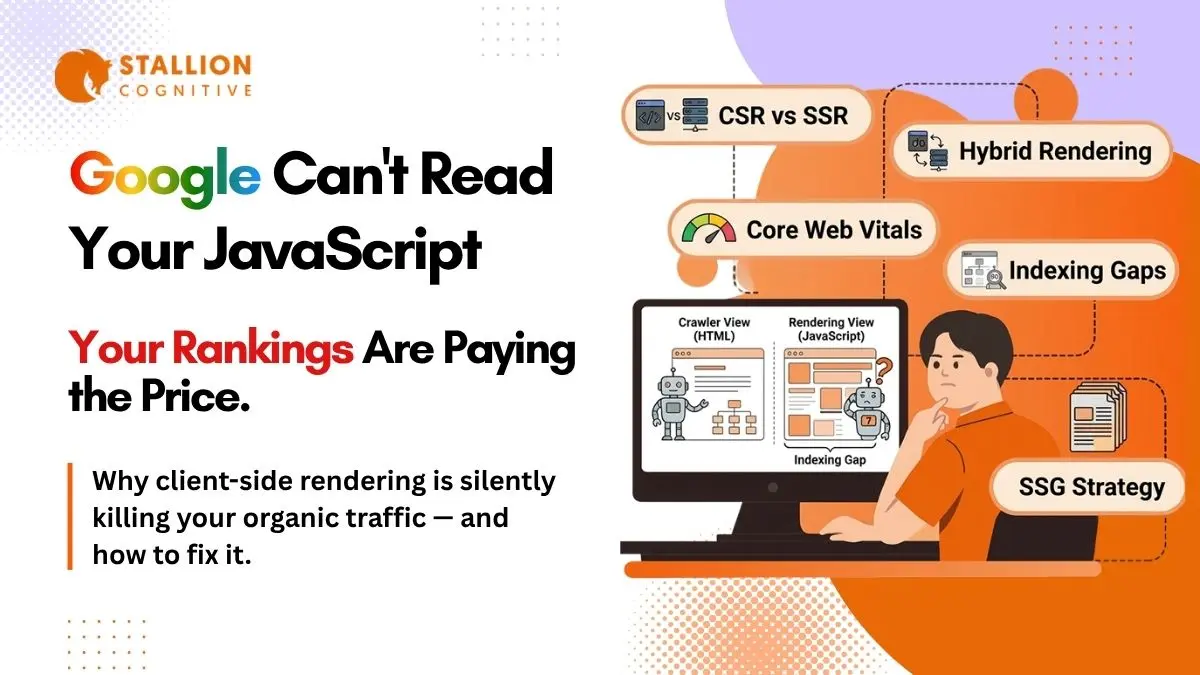
You spent six months building a React app your whole team is proud of. The animations are smooth, the UX is tight, and the code is clean. Three months after launch, you open Google Search Console and the impressions graph looks like a flatline.
We have worked with founders who hit this exact wall more times than we can count. Good codebase, solid content, and still nothing moves. Almost every time, client side rendering is quietly destroying search visibility while everyone is busy shipping features.
But there is something frustrating. Google has gotten better at rendering JavaScript, and teams use that fact to talk themselves out of fixing the problem. But better rendering doesn't mean instant, guaranteed indexing. And beyond Google, AI crawlers like GPTBot and ClaudeBot don't execute JavaScript at all, so your CSR pages are completely invisible to the systems now deciding what answers users get. That's the real problem, and that's what this blog breaks down.
What Client-Side Rendering Actually Does to Your Site
CSR turns your page into an empty HTML shell on the first server response. Google has to queue it for JavaScript rendering, sometimes waiting days before indexing any content. AI crawlers skip that queue and see nothing. No amount of great writing fixes an architecture that hides your content from the systems that need to read it. For the full technical picture of how Google's Web Rendering Service handles this, see our JavaScript SEO guide.
Client-side rendering forces every crawler to wait through a multi-step JavaScript execution process before your actual content exists on the page. That wait is the source of every indexing, ranking, and visibility problem covered in this piece, and no amount of content quality fixes a rendering problem.
When Googlebot lands on a CSR page, the server hands it <div id="root"></div> and a stack of script tags. Your headlines, product descriptions, internal links, and structured data are nowhere in that initial response. Here's the exact sequence that plays out before any of your content becomes readable:
- Bot requests the page: Server returns an empty container with script tag references. Nothing to read, nothing to rank.
- Bundles download: Every JavaScript file transfers over the network before a single line can execute. On a heavy React app, this burns real time.
- Parse and execute: The crawling environment runs your code. This is the most compute-intensive step and exactly why Google rations how often it does this per site.
- Content surfaces: Only after all three steps above complete do your headlines, links, and schema exist in any crawlable form.
- Page enters the render queue: Google schedules a deferred rendering job rather than indexing immediately. Sometimes that job runs in hours. Sometimes it takes weeks.
Think of it like a budget. Google has a finite pool of computational resources to spend crawling your site. If it has to download a large JavaScript bundle, parse it, and execute it just to find out what your H1 says, it may spend that budget elsewhere and come back later. While your page sits in that queue, a competitor running Next.js gets indexed almost immediately because their server already built the full HTML before any bot arrived.
What AI Crawlers Actually See on a CSR Site
Googlebot at least attempts to render JavaScript, even if it defers the job. GPTBot, ClaudeBot, and most other AI crawlers don't execute JavaScript at all. They read only the raw HTML the server returns on that first request. For a CSR site, that's an empty shell, which means those systems have nothing to extract, nothing to cite, and nothing to surface in AI-generated answers.
Recently, AI-generated answers drive meaningful referral traffic for informational and commercial queries. Teams that have invested months in content creation are seeing that content go completely unread by the systems serving it to users, purely because of how the page renders. Fixing rendering strategy fixes both problems at once.
The Two-Wave Indexing Problem Nobody Talks About
Google runs two passes on JavaScript-heavy sites, and the gap between those passes is where CSR sites lose consistent ground. First pass happens immediately. Googlebot requests the page, gets whatever the server returns, and moves on. For a CSR site, that's an empty shell. The second pass, where JavaScript actually runs and real content appears, happens whenever the render queue catches up.
For time-sensitive content, that lag stings. Your competitor on SSR gets indexed in minutes and builds early ranking signals while your page waits in line.
And it compounds fast:
- New URLs enter the same queue and wait before Google reads any content
- Content updates need a full render cycle before the change registers with Google
- Internal links inside JavaScript navigation get discovered later, slowing how authority moves across the site
- Schema changes take longer to show up in rich results when structured data is injected client-side
Across hundreds of pages, that's a permanent crawling lag baked directly into the foundation. It's a core reason why sites with stronger local SEO competitor analysis habits often catch technically simpler sites ranking above more polished ones. Fast, consistent indexing is an architectural advantage that on-page work alone can't overcome.
According to Ahrefs, JavaScript rendering problems remain one of the top three technical reasons sites underperform in organic search.
8 CSR Problems Draining Your Organic Traffic
Running all eight of these simultaneously is genuinely common on CSR sites. Each one looks manageable alone, but together they build a site that's structurally behind before the content quality conversation even starts. Teams that don't spot this pattern spend years wondering why well-written content never ranks the way it should.
- Indexing delays: New content waits in the render queue while time-sensitive ranking windows close around it.
- Core Web Vitals failures: LCP can't fire until JavaScript finishes running, and INP, which replaced FID and now carries full ranking weight, suffers badly on bundle-heavy pages.
- Broken social previews: LinkedIn and Slack often pull the empty HTML shell instead of actual Open Graph content when tags are injected client-side.
- Link equity gaps: Crawlers that don't fully execute JavaScript miss navigation menus, cutting off the internal link flow that moves authority across the site.
- Unreliable analytics: Single-page apps routinely misreport pageviews because route changes don't trigger traditional page load events, so decisions get made on broken data.
- Mobile bounce rates: Lower-end Android devices choke on heavy JavaScript bundles and leave before the content loads, and these devices represent a significant slice of global traffic.
- Crawl budget drain: Google burns extra resources rendering each page, visits fewer URLs per crawl session, and fresh content surfaces more slowly across the whole site.
- AI crawler invisibility: GPTBot, ClaudeBot, and Perplexity's crawler don't execute JavaScript. If your content only exists after client-side rendering, those systems see nothing and your site gets zero visibility in AI-generated answers.
That eighth point is the one that changed the stakes. Every other item on this list existed two years ago. AI crawler invisibility is new, it's growing in impact, and it hits CSR sites harder than any other rendering approach.
Why Rich Results Deserve Special Attention Here
Rich results move click-through rates in ways that compound over time. FAQ snippets, product cards, and review stars all depend on schema being readable at crawl time. When JSON-LD is injected client-side, Google reads it inconsistently, and losing those rich result placements to a competitor whose schema is server-rendered is an entirely avoidable outcome.
CSR vs SSR: Where the Real Performance Gap Lives
Server-side rendering changes what every crawler receives on that very first request. Your server builds complete HTML with content, meta tags, and structured data already included, then ships it ready to read. Googlebot arrives and the full page is already there. AI crawlers arrive and the full page is already there. Indexing and citation both happen immediately.
Core Web Vitals data from the Chrome User Experience Report consistently shows SSR and SSG implementations outperforming pure CSR on every metric that affects rankings. LCP improvements alone frequently land at two or more seconds, and that's the exact margin between passing and failing Google's performance thresholds.
When SSR Should Be Your Default
Any site where organic search drives revenue should start with SSR as the baseline. Blogs, marketing pages, e-commerce category and product pages, documentation hubs — all depend on fast, reliable indexing and AI crawler readability. Teams already using technical SEO auditing tools get far more out of that investment when the rendering layer works with them rather than against them.
When CSR Is Actually the Right Answer
Internal dashboards, SaaS product interfaces behind authentication, and admin panels don't need to appear in search results. Google can't crawl past a login wall, and neither can AI agents. CSR makes complete sense when search and AI visibility aren't part of what a page is supposed to do.
| Rendering Type | First Paint | SEO Crawlability | AI Crawler Visibility | Best For |
| Client-Side (CSR) | Slow | Poor | None | Authenticated apps |
| Server-Side (SSR) | Fast | Excellent | Full | Marketing, e-commerce |
| Static (SSG) | Fastest | Excellent | Full | Blogs, docs, landing pages |
Static Site Generation: When You Want Speed Above Everything
SSG builds every page at deploy time and serves plain HTML from a CDN. There's no server processing when a request comes in, which is why these pages load so fast and why both crawlers and AI agents get exactly what they need on the very first visit, without any JavaScript execution step between the request and the response.
A few frameworks worth knowing before picking an approach:
- Astro ships zero JavaScript by default and only hydrates the components you specifically flag as interactive, making it the cleanest choice for content-heavy sites
- Eleventy and Hugo suit teams that don't need a JavaScript framework and want minimal build complexity
- Next.js with Incremental Static Regeneration rebuilds individual pages on demand after deployment, solving the painful slow-rebuild problem for high-volume content operations
ISR has become the preferred architecture for e-commerce because it balances the indexing speed of static generation with the content freshness that product and inventory pages need. Build time is still the trade-off on very large sites, but ISR makes it manageable in most real-world cases.
Hybrid Rendering: How Production Sites Are Actually Solving This
Most production sites don't fit neatly into one rendering category. Forcing every page to use the same approach creates exactly the kind of mismatches that cost rankings and AI visibility simultaneously. Hybrid rendering applies different strategies to different page types inside the same codebase, matching the approach to what each specific route needs to accomplish.
Marketing pages need maximum SEO signal, so static is the obvious call. Product pages need live inventory data and still need to rank, so SSR with caching hits the right balance. The user dashboard sits behind authentication and needs app-like performance, so CSR fits perfectly there. One codebase, three strategies, each chosen because it matches what that specific page is built to do.
Next.js calls this per-route rendering, and it's a central reason the framework has absorbed so much of the React ecosystem. Nuxt 4 offers the same flexibility for Vue teams. The mental shift worth making is away from "which rendering approach wins" and toward "what does this specific route actually need."
How Universal Rendering Connects Both Worlds
Universal rendering runs the same JavaScript on both the server and the client. The server generates complete HTML so crawlers and AI agents read a full page on the first request, and then the browser activates that HTML to make everything interactive. Users see content right away and get the full app experience as the page comes alive around them.
For teams running programmatic SEO at scale, this matters even more because rendering decisions made at the template level immediately propagate across every page that template generates. At scale, that's thousands of pages affected by a single architectural choice, which makes getting it right upfront far cheaper than fixing it after launch.
Pre-Rendering: A Legitimate Fix When Migration Isn't Realistic Yet
Pre-rendering services like Prerender.io detect bot user agents and serve them a fully-rendered HTML snapshot while real users continue getting the original CSR experience. It's a patch, but patches serve a real purpose when the alternative is another quarter of declining organic traffic.
We've used this approach with clients who couldn't fund a six-month rebuild but couldn't absorb more losses either. It stops the bleeding while the real fix gets scoped and budgeted properly. A few honest trade-offs come with it:
- Snapshot freshness matters more than most teams expect. A meaningful gap between what bots see and what users see raises cloaking concerns with Google
- Running two versions of the same site adds infrastructure overhead that grows heavier as the site scales
- Real-user Core Web Vitals scores don't improve, since pre-rendering only helps crawlers
- Most AI crawlers still won't see your content through pre-rendering unless the service specifically supports non-Google bot agents
Use it as a bridge to something built on a proper foundation. Teams tracking how AI Overviews affect local search are already seeing why a long-term CSR workaround gets more expensive to maintain over time, not less.
How We Think About Rendering at Stallion Cognitive
Rendering decisions are business decisions before they're engineering ones. The question that drives the right answer is always simpler than the framework debate: where does your revenue come from, and which rendering approach protects it?
Our process follows a clear sequence:
- Full crawl audit: Map what Googlebot currently reads across every URL on your site using Screaming Frog or a comparable crawler
- AI crawler check: Test which pages are readable by GPTBot, ClaudeBot, and Perplexity's crawler without JavaScript execution
- Intent classification: Sort pages by intent, such as informational, transactional, or app-like, to match rendering approach to page purpose
- Route-level recommendations: Match each page type to the right strategy based on what that page is built to accomplish, not what the rest of the site uses
- Migration roadmap: Prioritise the pages driving the most organic value and sequence the work so traffic comes back fastest
- Post-migration monitoring: Track indexing rates, Core Web Vitals scores, and ranking shifts in the weeks after deployment
Sometimes the answer is a full migration to Next.js. Sometimes it's pre-rendering as a bridge while a rebuild gets planned. Sometimes the marketing site goes static and the product app stays untouched because changing it costs more than it gains.
Teams that understand GEO, AEO, and SEO together are already building rendering infrastructure that earns traffic from both traditional rankings and AI-generated answers. That's increasingly where high-intent users are being reached, and it starts with what the server returns on the very first request.
Design choices are heading the same way as AI changes what users expect from an interface. See our take on how AI is rewriting UI/UX design for where that's going.
Is Your Rendering Strategy Working For You or Against You?
Every day your site runs on the wrong rendering architecture is another day it loses ground in search or hands AI visibility to a competitor whose server already returns complete HTML. If you're not certain which side of that you're on right now, that conversation is worth having before another quarter slips by. Talk to our team and we'll audit your setup, show you what Googlebot and AI crawlers are actually reading, and put together a path that changes your numbers.
Frequently Asked Questions
Does rendering strategy affect how much you pay per click in Google Ads?
Google's ad crawlers face the same JavaScript constraints as Googlebot. A server-rendered landing page delivers content on the first hit, loads faster, and earns a better Quality Score over time. Over months of consistent ad spend, that cleaner page experience pulls cost-per-click down in a way that compounds significantly.
If my site holds good rankings today, is migrating away from CSR still worth it?
Holding rankings on CSR today means the cracks haven't surfaced yet. Google's crawling standards have been tightening, INP now carries full ranking weight, and AI crawlers don't render JavaScript at all. Fixing the architecture while rankings are stable costs a fraction of what a full recovery project costs after traffic has already dropped.
Can CSR cause duplicate content problems in Search Console?
Client-side routing sometimes produces multiple URL variations for the same page because JavaScript handles navigation differently from server-side routing. Without canonical tags set at the server level, Google can quietly index several versions, splitting ranking signals across URLs that should all point to one destination.
Do third-party scripts like chat widgets behave differently on CSR versus SSR sites?
On SSR and SSG sites, third-party scripts load after the server-rendered HTML is already delivered, so crawlers read your content cleanly without interference. On CSR sites, those scripts join the JavaScript execution race, compete for processing time, slow the rendering process down, and occasionally affect how the page gets parsed by crawlers.
Does mixing rendering strategies across subdomains create any SEO risk?
Different rendering approaches across subdomains are generally fine on their own. The problem surfaces when the same content lives across subdomains under different rendering methods with no canonical structure pointing Google to the right version. That setup splits authority across URLs that should be consolidated, and it tends to get messier the longer it sits unaddressed.