
Most team pages say the same thing. Forty years of combined experience, a commitment to service, and a photo taken against a grey wall in 2019.
None of it tells a prospect whether the person can handle their situation.
A bio page is one of the few pages on a firm's site that a buyer reads closely before they call. It is also the page most likely to carry a claim your compliance officer never approved. So what belongs on it, and what has to stay off?
What Does a Bio Page Have to Do?
It has two readers and they want different things. The prospect wants to know whether you have done this before, for someone like them. Google wants to know who stands behind the page and whether that person is fit to write it.
Both readers are looking for the same raw material. Specifics.
Here is the gap in practice. A prospect deciding on a $12,000 engagement is not weighing "dedicated professional with a passion for client service" against anything. They are trying to work out if you handle trusts, whether you have dealt with a business sale, and how long you have been doing it.
- Vague: "Extensive experience serving high-net-worth families."
- Useful: "Works with families going through a business sale, usually between $2m and $15m. Fourteen years, the last nine at this firm."
The second version costs nothing more to write. It also survives the compliance read, because everything in it can be checked.
What Does Google Actually Ask For?
Google is unusually direct about this. Its guidance on helpful content sets out a self-assessment built around who made the content, how, and why, and the first of those is a question about your bylines.
The wording is worth reading closely, because it asks for more than a name:
Do bylines lead to further information about the author or authors involved, giving background about them and the areas they write about?
The same page states that "We strongly encourage adding accurate authorship information, such as bylines to content where readers might expect it," and asks whether "it is self-evident to your visitors who authored your content."
Read that as a spec rather than a nudge:
- A name is not a byline. The name has to lead somewhere.
- The destination has to carry background, meaning who the person is and what they work on.
- "The areas they write about" matters for a firm where three partners cover different services.
None of this is a ranking button. It gives Google's systems a person to attach the page to, and gives a reader a claim to check. Our work on website authority covers the wider signal set this sits inside.
What a Regulated Firm May Not Claim
Now the constraint. Google wants your credentials forward and visible. If your firm is regulated, a separate rulebook governs how you state them, and it is stricter than most marketing teams expect.
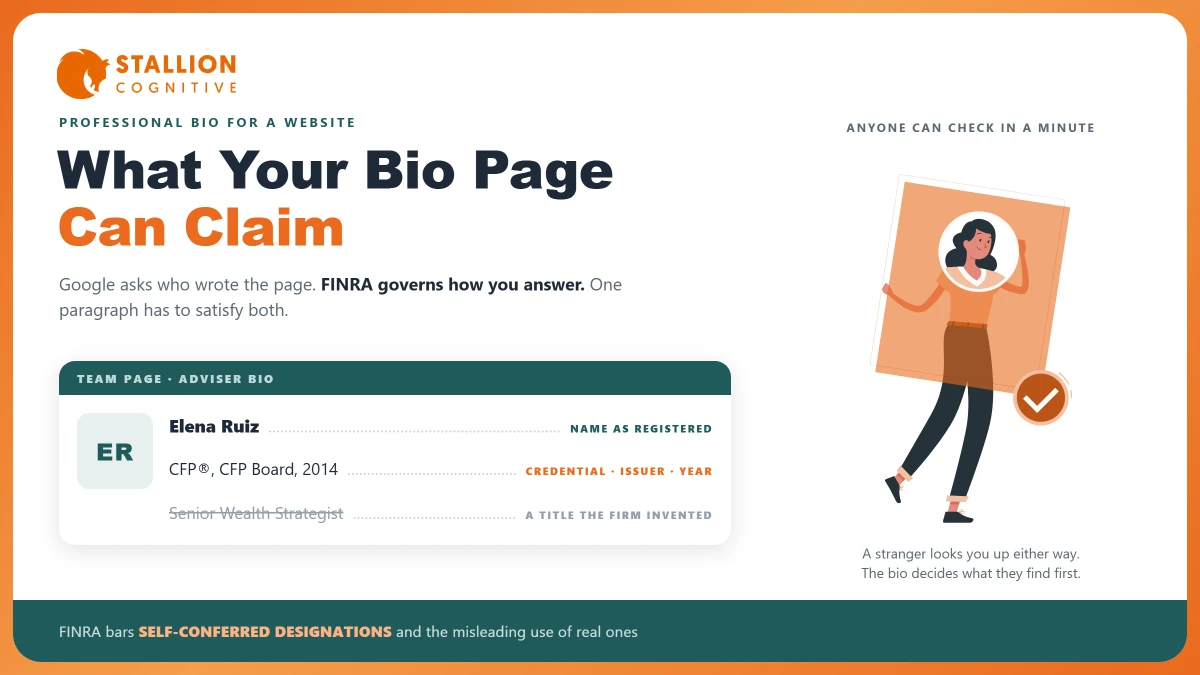
FINRA's notice on professional designations prohibits "making false, exaggerated, unwarranted or misleading statements or claims in communications with the public." It names the specific failure directly, barring firms from "referencing nonexistent or self-conferred degrees or designations or referencing legitimate degrees or designations in a misleading manner."
The second half of that clause catches more firms than the first. Almost no one invents a credential. Plenty of bios imply one.
What that rules out in practice:
- Coined titles. "Senior Wealth Strategist" reads like a credential and is a job title your firm made up.
- Expired credentials. A lapsed one written in the present tense is a real credential used in a misleading way.
- Borrowed authority. "Trained at" or "studied with" a body that never certified you.
- Implied specialism. Wording that hints at expertise with older clients falls under FINRA's separate senior-designation guidance.
- Degree inflation. Coursework described in words that sound like a qualification.
There is a process requirement too, and it surprises people. FINRA Rule 2210 treats these as communications, so at a broker-dealer the wording needs approval "prior to use and in writing by a registered principal." Writing the bio is not the last step before it goes live.
Firms under the SEC's marketing rule face a related set of limits, which we cover in the adviser compliance guide. None of this is legal advice, and your compliance team reads your own registrations, so get the wording cleared once and then reuse it.
Where Prospects Check You Before They Call
Financial and legal firms have one thing most trades do not. A public database where a stranger can verify what your bio says, in about forty seconds, from the same phone they are reading it on.
That changes the maths. A vague bio is not only weak, it invites a search that you no longer control.
| What the bio claims | Who issues it | Where a prospect checks |
|---|---|---|
| Registered representative | FINRA | BrokerCheck |
| Investment adviser | SEC or a state regulator | Adviser public disclosure records |
| CFP certification | CFP Board | The Board's public verification page |
| CPA licence | State board of accountancy | That state's licence lookup |
| Bar admission | State bar | The state bar's member directory |
The instruction is short. Whatever your bio says, make it match the record, use the same name that appears in the register, and state the year rather than a rounded "over a decade" that the record will contradict.
Firms usually pass this check. Where they come unstuck is a bio that says less than the register does, which reads as though they are holding back. You can point straight at the record. BrokerCheck is public, so a line inviting the reader to look you up costs nothing and settles the question. Reviews are public evidence of the same kind, which is why asking clients for reviews belongs in the same conversation.
What Goes in the Bio, and in What Order
Lead with the work rather than the biography. The reader is not curious about you yet. They become curious once they can see you have solved their problem before.
| Order | Element | What it does | Common mistake |
|---|---|---|---|
| 1 | Who they work with | Lets the reader self-select in one line | Listing every service the firm offers |
| 2 | The problem they handle | Names the situation the reader is in | Abstract language about goals and futures |
| 3 | Credentials, named exactly | Gives the claim something to stand on | Initials with no explanation |
| 4 | Years, stated as a number | Anchors the experience claim | "Over a decade" |
| 5 | Where they sit in the firm | Tells the reader who they would deal with | Titles nobody outside the firm understands |
| 6 | One human detail | Makes the person memorable | Three paragraphs about marathons |
One human detail helps, and it belongs at the end of the bio where it cannot crowd out the substance.
Length settles itself once the order is right. Roughly 150 to 250 words covers it, and a bio running past 400 has usually drifted into autobiography.
Write it in the third person. It reads as the firm speaking rather than the individual, which is also what your compliance file expects.
One Team Page, or a Page for Each Person?
Give each person their own URL, and keep the team page as the index that links to them. A single page listing eight partners cannot rank for any of their names, and a name is exactly what a referred prospect types.
The split does several jobs at once:
- It gives the byline somewhere to go. Google asked for a destination with background, and a scroll position on a shared page is a weak one.
- It catches name searches. Someone given your partner's name over lunch will search that name that evening.
- It contains the compliance job. One page per person means one approved wording per person to review when a credential changes.
Keep the team page anyway, and the rules for a good about page apply to it. It answers how big the firm is and who a client would actually deal with, which is a different question from who Anna Reyes is.
Does your site pass the simplest version of this test? Search your own partner's name and see whether your site or a directory answers first.
Do Your Blog Posts Need a Byline?
Where a reader would expect one, yes. Google's wording is conditional and it does the work here, asking whether pages "carry a byline, where one might be expected." A reader expects a named author on an article about tax treatment. Nobody expects one on a pricing page.
That gives you a workable rule:
- Byline it: Anything giving guidance, an opinion, or a reading of a rule.
- Leave it: Service descriptions, location pages, the contact page.
- Never fake it: An invented author with a stock photo is the version that does real damage.
The byline links to the bio page you just built, which is where the whole thing joins up. If AI helped produce the draft, Google separately asks whether that is "self-evident to visitors," and we worked through what that means for a regulated firm in our piece on AI content and Google.
Read Your Own Bios Against This
A bio page is the cheapest trust asset a professional firm owns, and most firms fill it with adjectives that no reader can check and no regulator would approve.
The version that earns its place on the site:
- Specific about the work, so a reader can place themselves in it.
- Exact about credentials, naming the issuer and the year.
- Matched to the public record, because the reader is checking it anyway.
- Approved once, in writing, then reused.
- On its own URL, with the blog bylines pointing at it.
Read your own partner bios against that list. It is the cheapest hour in any SEO programme you are paying for. Most firms find two claims they cannot evidence and one designation that lapsed. Our SEO work starts with the pages a buyer already reads, because a team page that earns trust is worth more than a blog post that earns a visit.
Frequently Asked Questions
Should a bio include a photo?
A real one helps, and a stock image does measurable harm the moment someone reverse-searches it. Use the same photo across the site, the profile and any directory listing so the person stays recognisable.
What happens to the page when someone leaves?
Take the bio down and redirect it to the team page. Leaving it live misrepresents who works at the firm, and any regulated wording on it is still your communication.
Do junior staff need bios?
Anyone a client will speak to earns one. A paralegal or an associate who handles the day-to-day is often the person a prospect most wants to see, and a firm showing only partners looks smaller than it is.
Can one bio serve several offices?
The bio belongs to the person rather than the office. Where someone really does cover two sites, say so in the text instead of copying the page, because two near-identical pages compete with each other for the same name.
Who signs off the wording?
At a broker-dealer, a registered principal, in writing, before publication. At other firms it varies, so the practical answer is to agree one reviewer and route every bio change through them rather than deciding case by case.