
A restaurant asks for a review while the card machine is still warm. A firm nine months into a client's succession plan has no such moment, and advice written for the restaurant does not survive the trip.
So how do you ask clients for Google reviews when the relationship is formal, the work is confidential, and there is no counter to lean across? You build the ask into the work instead of waiting to feel brave.
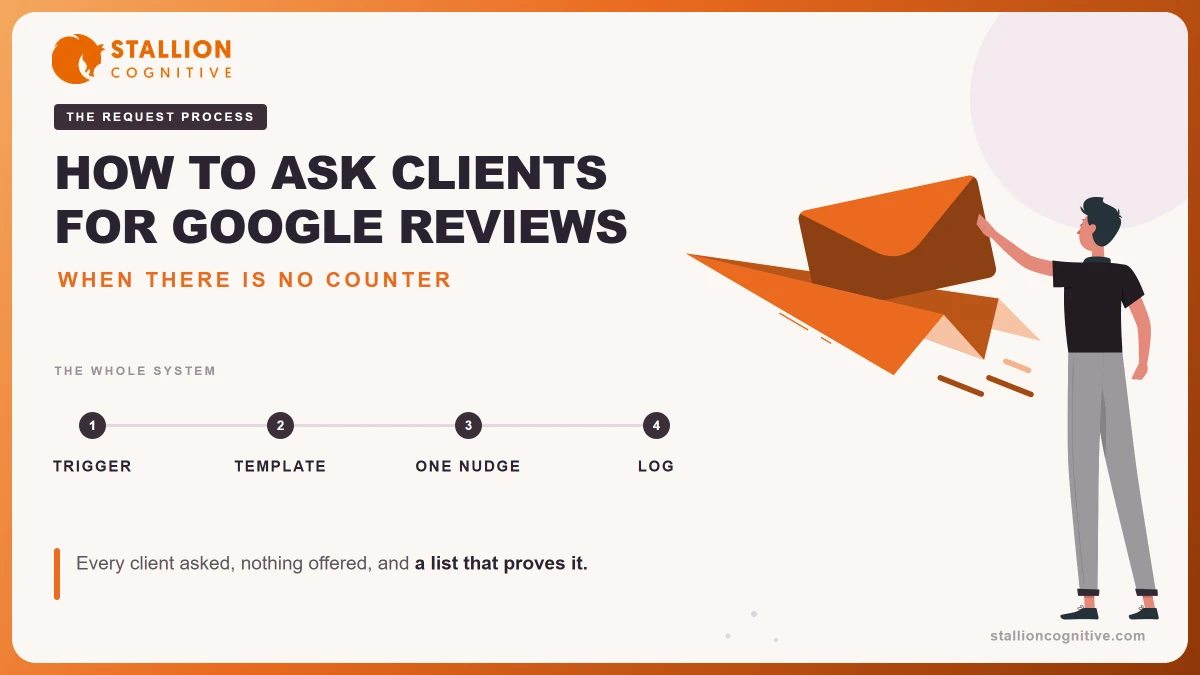
What follows is the whole system. The trigger, the wording, the cadence, the record, and the four rules that quietly shape every one of those choices.
Why Doesn't the Casual Ask Work in a Professional Firm?
Because the casual ask leans on a moment your firm does not have. A transaction ends, the client is pleased, someone says a line at the till. Professional work ends in a filing, a completion statement or a quiet email, and none of those feels like the right place to ask a favour.
Three things set a firm apart, and each one changes the design:
- No point of sale: There is no counter, no receipt and no natural pause where a request feels normal.
- A long engagement: By the time the work closes, the moment the client felt most helped was months ago.
- A formal relationship: Partners worry that asking reads as needy, so the ask gets postponed until it never happens.
The result is a firm doing excellent work with four reviews, sitting below a rival with sixty. Reviews are one of the inputs behind Map Pack ranking, so the gap costs you search traffic as well as trust.
Does any of that sound like your firm? The fix is to stop treating the ask as a social act and start treating it as a step in the job, the same way you treat sending an invoice.
How Do You Ask Clients for Google Reviews?
You send a short written request with a direct link. Google settles the mechanics in its own guidance on getting reviews, which tells businesses that "To leave reviews, you can ask customers to visit a Google link or scan a QR code." The link comes from your profile and takes the client straight to the review box.
Get the profile right before the first send. A request pointed at an unverified listing goes nowhere, so verify your Business Profile first, and check for a duplicate Business Profile that would split your reviews across two records.
The message thanks the client, says why you are asking, gives the link, and makes it easy to ignore:
Thank you for your patience through the completion. Reviews are the main way other business owners find us, so if you have two minutes we would be grateful for one. The link goes straight to the form. If now is a bad time, please ignore this.
That template works because of what it leaves out. No star count, no suggested wording, no mention of what a good review would say. The single most common mistake in a review request is telling the client what to mention, which Google names outright as conduct to avoid.
Who signs it also matters. A request from the partner who did the work gets answered far more often than one from a marketing address the client has never seen.
When Should You Ask, and How Often?
Ask on a fixed event that happens in every engagement, and ask once more if nothing arrives. Advice written for service trades says send within 24 to 48 hours of the appointment, and a firm with no appointments needs another anchor. Pick the moment the client can see what they got.
| Firm type | The trigger to use | Why it works |
|---|---|---|
| Accounting practice | The return is filed and confirmed | Relief is the strongest feeling the client will have all year |
| Law firm | Completion or settlement confirmed | The outcome is known, so the client can describe it |
| Financial advisory | The first annual review meeting closes | Early enough to be fresh, late enough to have substance |
| Consulting | The final deliverable is signed off | The work is done and the value is visible |
| Any firm | A client refers someone unprompted | They have already recommended you out loud |
Two sends is the whole cadence. The first goes out on the trigger, and a single nudge follows about ten days later if nothing has appeared. A third message reads as pressure, and pressure is where firms start bending the other rules.
Seasonal practices need the trigger written down more than anyone. In accounting, local SEO for accountants peaks in the exact weeks the team has least capacity, so a request that waits for someone to remember it will simply not go out.
Steady beats sudden. Forty reviews landing in one week at a firm that took two years to earn ten draws attention, because Google watches for unusual patterns.
What Can You Never Offer or Filter?
Two habits break the rules, and both are common enough to be sold as features. Offering anything of value in exchange for a review is the first. Deciding in advance which clients get asked is the second.
Google's prohibited and restricted content policy covers both. A firm may not "Offer incentives ... in exchange for posting any review", and may not "selectively solicit positive reviews from customers" or discourage the negative ones.
What that rules out in practice:
- Any reward at all: A coffee voucher, a fee credit, a prize draw entry or a donation in the client's name are all payment in the sense the policy means.
- Review gating: The funnel that asks a scoring question first, routes high scorers to Google and low scorers to a private form, is banned by the plainest reading of the clause.
- Partner discretion: Choosing which clients "are the right ones to ask" is gating done by hand rather than by software.
- Scripted content: Asking a client to mention a service or a named adviser shapes the review, whatever the intent.
All four trace back to the same two clauses.
The federal rule reaches the same conduct with more teeth. The Federal Trade Commission's rule on consumer reviews treats payment as a breach when it is tied "expressly or by implication" to a review with a given slant.
Google's usual answer is quiet. It strips the review and works the rating out again, so a firm can lose a dozen before anyone spots the total moved. Run the pattern at scale and the profile itself draws a closer look, and anyone who has been through a Business Profile suspension will tell you it costs weeks rather than stars.
Who Inside Your Firm Must Not Leave a Review?
Anyone on the payroll, and the list runs wider than most firms assume. The instinct at a firm sitting on three reviews is to ask the team, and it is the one shortcut that carries a federal penalty rather than a takedown.
Google treats it as a conflict of interest. The policy names "current or former employment" along with contracts, consulting ties, and other work or personal links. A former employee counts, and so does a contractor you pay.
Under 16 CFR 465.5, an officer or manager who writes a review about their own firm commits an unfair or deceptive act unless the review carries "a clear and conspicuous disclosure" of their "material relationship to the business." The rule reaches further down the staff list than the job titles suggest:
- Officers and managers: Partners, directors and anyone carrying a management title.
- Employees: Including part-time staff and people who left recently.
- Agents: The marketing agency writing on your behalf sits in this group.
- Family and close ties: Google's clause catches these even where the federal rule might not.
It also reaches the firm that spreads the review around afterwards. Publish a staff quote on your own site without that disclosure and the breach lands on the firm, whoever wrote the words.
Who on that list has left you a review? A firm with five reviews and four from the payroll has a credibility problem sitting underneath the legal one.
What Changes When Your Firm Is Regulated?
One thing changes, and it is a gap rather than an extra step. You can be required to attach a disclosure to a client testimonial. Google gives you nowhere to attach it.
Advisers, accountants and law firms all work under rules that can treat a client's public praise as a message the firm answers for. Where the review sits on your own website the fix is simple, because you own the page and can put the wording beside the quote. The SEC Marketing Rule sets out what that wording has to say and how prominent it needs to be.
Google offers nothing like it. You cannot edit a client's words, you cannot add a line underneath them, and you cannot pull the review down because it lacks something your regulator wants.
So how do regulated firms run this? They lean on the system rather than on judgement calls:
- Ask without steering: An unprompted review is easier to defend than one you shaped, which is the same reason the template above says nothing about content.
- Ask everyone, every time: A dated list showing every client was asked settles the selective-asking question a year later.
- Leave Google reviews on Google: The moment a quote appears on your own page, your own disclosure rules apply to it.
- Clear the process once rather than each send: FINRA review compliance duties differ by registration, so get the template and the trigger approved and then run them unchanged.
None of this is legal advice. Compliance teams read these rules differently by firm, so design the process first and have someone qualified check it before a single request goes out.
The Record That Proves Your Process Ran
Keep a log from the first send. A review acquisition workflow that cannot show who was asked also cannot prove it asked everyone, and that proof is the whole defence against a selective-asking question.
| What you record | What it answers later |
|---|---|
| Client name and date sent | Whether the request followed a rule or a preference |
| Channel used | Whether anyone was approached in person on the premises |
| Template version | Whether some clients received a different ask |
| Nudge sent | Whether one nudge quietly became a campaign |
| Exclusions and the reason | Whether a client was skipped for a reason you can defend |
A spreadsheet does this job perfectly well.
Firms running client review campaigns at any scale ask whether a compliance-friendly review request can be automated. It can, and the software has to send to everyone, which is the setting that tends to get switched off. Check that box before you trust the automation.
Review the log once a quarter against your completed engagements. A local SEO audit picks up the profile side in the same pass, since a request process and the profile it points at fail together.
Where This Leaves Your Firm
Firms that stay stuck on four reviews are rarely doing anything wrong. They are waiting for a natural moment that a professional engagement never produces, and a review generation strategy built on memory will lose to one built on a trigger every time.
The system fits on one page:
- One trigger: A fixed event in every engagement, written down.
- One template: The same words for everyone, saying nothing about content.
- Two sends: The request, then a single nudge, then silence.
- One log: Proof every client was asked.
Which of those four does your firm already have? Most have none of them, which is why the first month of doing this properly usually produces more reviews than the previous two years. Our local SEO work starts with the profile and the request process, because reviews decide what the rest of your visibility is worth.
Frequently Asked Questions
What if a client says they do not have a Google account?
Google requires one, and its guidance states that customers "must be signed into a Google Account to leave a review." Most clients already have one through Gmail or an Android phone. Where they truly do not, thank them and move on.
Can we put a QR code for reviews in the reception area?
Google names the QR code as a sanctioned way to ask, so a code on a card the client takes away is fine. The difficulty starts when a staff member stands there while they use it, since pressing someone on the premises is conduct to avoid.
Can we reply to a review and ask the client to add more detail?
Replying is encouraged and Google wants firms doing it. Asking for a change to the wording drifts toward requesting specific content, and offering anything for a revision is banned outright. Thank them and leave the text alone.
Do older Google reviews lose their value?
Recency carries weight with readers even where a rating stays flat, and a profile whose newest review is three years old reads as a firm that stopped. Steady arrivals matter more than a single burst that then goes quiet.
Does using a different review platform change what we can do?
Platform rules vary, and the federal rule follows you wherever the review ends up. Rewards and selective asking stay banned on any site. Switching platforms changes your audience rather than your duties.