
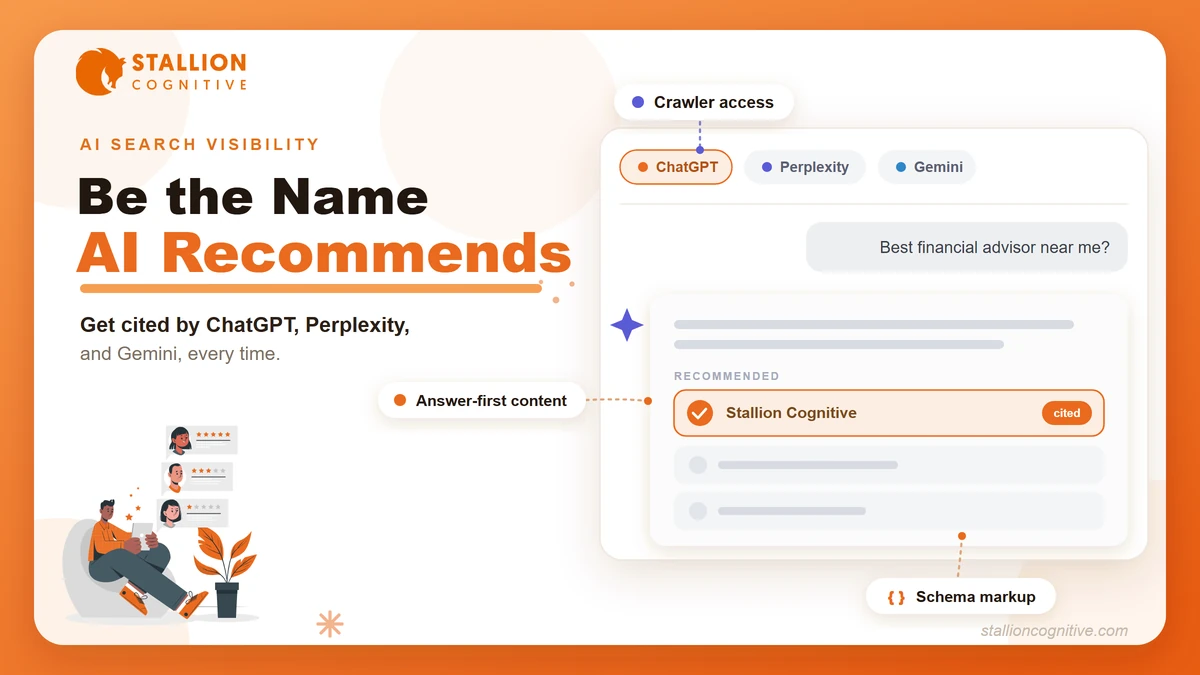
Right now, someone is asking ChatGPT for the best option in your field.
It picks three businesses and names them.
Your competitor made the list, and you didn't.
That quiet exchange is the new search result. It decides who gets the call before anyone clicks a thing.
So the real question for your business has shifted. It used to be how do I rank. Now it's how do I get cited by ChatGPT, Perplexity, and Gemini.
Good news? This runs on signals you can control. We've watched them work across client pages at Stallion Cognitive, and the winners are rarely the biggest names.
Let's start with what getting cited actually means.
What does getting cited by AI actually mean?
It means an AI engine names your business, quotes your page, or links to you inside its answer.
That sounds like ranking, but it behaves nothing like it.
A page can sit at position one on Google and still get skipped. These engines pick sources on clarity, on trust, and on how cleanly they can lift a single line. Rank barely comes into it.
The old prize was a blue link someone might click. The new one is a mention inside the answer, often with no click at all.
And you're rarely the only name in the room. Pew Research found that 88% of Google's AI summaries pull from three or more sources.
So the target has moved. You want a seat in that small group the answer trusts.
| Old goal (SEO) | New goal (AEO and GEO) |
|---|---|
| Rank a blue link | Get named inside the AI answer |
| Earn the click | Earn the mention, click optional |
| Judged by position | Judged by clarity, trust, and how easily a page can be quoted |
That table is the whole idea behind generative engine optimization.
Once you see search this way, one question follows. If ranking and getting cited have split apart, which one is worth your time?
Why getting cited now beats chasing rank
The short answer is that the click is drying up.
When Google shows an AI summary, people click a normal result just 8% of the time, Pew Research found. Without a summary, it's 15%.
That's the zero-click search everyone kept warning about, and it has arrived. The link you worked for gets seen less the moment an AI answer sits on top of it.
Even the number one result feels it. Ahrefs measured its click-through rate falling about 34.5% on informational queries once an AI Overview shows up.
The next part stings a little.
Ranking high no longer buys you a place in the answer. Plenty of top pages get passed over, while a page from further down gets quoted because it answered more cleanly.
So "just rank number one" has stopped being the whole game.
Classic SEO still earns its keep, since engines often pull from pages that already rank, which is why SEO is far from dead in 2026. It just isn't the finish line.
Getting into the answer starts before the writing, though. It starts with whether the engines can read you.
Let the right AI crawlers reach your site
Before any engine can cite you, its crawler has to reach your pages.
Each tool sends its own bot. And plenty of sites block them by accident, usually through a security plugin's defaults.
So your first move costs two minutes. Open yoursite.com/robots.txt and see who you're letting in.
| Engine | Crawler to allow |
|---|---|
| ChatGPT | GPTBot, OAI-SearchBot |
| Perplexity | PerplexityBot |
| Google AI (Gemini, AI Overviews) | Google-Extended |
| Claude | ClaudeBot |
Cleared that? Two smaller wins are worth grabbing.
- Get on Bing: ChatGPT leans on Bing's index for web answers, so a verified Bing Webmaster Tools account with your sitemap submitted helps more than you'd think.
- Serve real HTML: Crawlers read your page source. If your content only loads after JavaScript runs, the bot can hit a blank page and leave.
Google keeps a full list of its crawlers if you want to see what each one does.
Owners forget one thing. Every bot you block is also citation traffic you turn away.
So the smart line is simple. Welcome the engines you want recommending you, and shut out the scrapers that only take.
Letting them in is the easy half. The harder half is giving them something clean enough to quote.
Structure your pages so AI can lift the answer
Lead with the answer in the first two lines of a section. Then explain.
Engines pull the cleanest, most self-contained line they can find. A page that gets to the point beats one that warms up for three paragraphs, every time.
See the difference for yourself.
"Choosing an accountant is a big decision for any growing business" gives an AI nothing to use.
"A small business should look for an accountant with industry experience, fixed pricing, and proactive tax advice" hands it a line it can quote word for word.
Three habits make this second nature.
- Write headings the way people ask them: Real questions, in the words someone would actually type.
- Put a number behind your claims: A Princeton-led GEO study found that adding statistics and citing sources can lift a page's visibility in AI answers by up to 40%. A concrete figure gives the engine something to repeat.
- Add FAQ blocks and schema: A little structured data in JSON-LD tells the engine what your page is and which part answers what.
None of this replaces your usual SEO. It stacks on top, so the effort compounds.
Some pages take to this better than others. It's worth knowing which, before you plan your next one.
What kind of content gets cited most?
The pages that win settle a question fast.
Definitions, honest comparisons, step-by-step how-tos, and pages with original data get quoted far more than a sales page or a thin "about us."
Think about why.
A definition gives a one-line answer an engine can lift whole. A comparison helps it weigh options for someone still deciding. A numbered how-to matches how people ask an AI to walk them through something.
And original data, the kind nobody else has published, is the most quotable thing you can own.
The thread is the same across all of them. Each one answers a real question head-on. It's the same instinct that used to win a featured snippet, now aimed at AI answers.
If your reader gets the point from the first two lines, the AI will too.
Build the authority AI engines trust
Clear writing gets you read. Trust gets you chosen.
Engines lean toward businesses with a consistent identity, real reviews, and mentions on sites they already rely on. The steadier your footprint across the web, the safer an engine feels naming you.
Try a quick gut check.
If an AI only knew your business from what other sites say about it, would it get the story right?
Four things move that picture.
- Keep your details identical everywhere: Same name, address, phone, and description on your site, your Google Business Profile, and every directory. Mismatches leave an engine guessing which version is true.
- Earn reviews and reply to them: Volume and freshness feed local search and AI trust alike. A wall of recent ones reads as a safe pick.
- Get mentioned where AI already reads: Industry publications, solid directories, and active communities all carry weight. One mention on a trusted site can beat another page on your own.
- Claim your profiles: A complete Google Business Profile feeds your knowledge panel and helps an engine connect who you are, what you do, and where.
This is the slow part. It's also the part most competitors skip, which is exactly why it's your opening.
While they wait for a magic tag to fix everything, you can become the most consistent and best-reviewed name in your corner of the market.
Trust travels across every engine. How each one weighs it, though, differs just enough to matter.
Do ChatGPT, Perplexity, and Gemini want the same thing?
Mostly yes, though three differences are worth tuning for.
Nail the fundamentals first. That means crawl access, clear answers, and real authority.
Then lean into whichever engine sends you the most traffic.
| Engine | Leans hardest on |
|---|---|
| ChatGPT | Bing index, authoritative long-form pages |
| Perplexity | Fresh content, primary and original sources |
| Gemini | Clean schema and Google signals |
ChatGPT
ChatGPT pulls most of its web answers through Bing, so Bing is the dial you can turn. Set up Bing Webmaster Tools and submit your sitemap there too. It also tags the citation links it sends, which makes that traffic easier to spot later.
Perplexity
Perplexity has a taste for freshness and first-hand material. Original research and lived expertise beat thin rewrites of someone else's work. Run a survey or audit your own client results, then lead with those numbers.
Gemini
Gemini reads structured data closely, and a clean schema gives it the confidence to use your page. The same holds for Google's AI Mode, the fuller conversational search it now folds Gemini into. Its answers also reshape what shows up for nearby searches, which is the whole story behind how AI Overviews are changing local search for any business with an address.
Tuning each one helps. But none of it means much until you can see what the citations bring back.
How do you know if it's actually working?
You measure it.
It comes down to two things. The first is how often you get named in AI answers. The second is what that traffic does once it lands.
Here's the catch. A lot of AI referral traffic hides in your "Direct" bucket unless you tell your analytics to split it out.
Tracking AI traffic in GA4 pulls those visits into the open, so you can see which came from ChatGPT, Perplexity, or Gemini, and what they did next.
- Track your mentions: Ask the engines what your customers ask, and note whether you appear and how you're described.
- Follow the referrals: Watch for visits from chatgpt.com, perplexity.ai, and gemini in your reports.
- Measure what happens next: See whether those visitors convert. Arriving is cheap. Converting is the point.
Once you can see it, the work gets easier to steer. You feed the pages already earning citations, fix the ones getting skipped, and a few lucky mentions turn into a steady stream.
Your get-cited checklist
Run this before you publish anything you want an AI to quote.
Each line maps to a signal these engines reward. Skip them, and strong writing still goes uncited.
- The main answer sits inside the first 150 words.
- Every section opens with a direct answer, then the detail.
- Headings read like real questions people ask.
- At least one claim carries a specific number and a named source.
- FAQ and Article schema are in place.
- Your name, address, and phone match everywhere they appear.
- The page links to your pillar and a couple of related posts.
- GPTBot, PerplexityBot, and Google-Extended are allowed in robots.txt.
- The page loads fast and serves real HTML a bot can read without running JavaScript.
Run it once and most of it becomes a habit. Even better, it compounds. Every clean page makes the next one easier to cite.
Start with one page this week
The businesses showing up in AI answers right now aren't the household names.
They're the ones who made a single page worth quoting and a business worth trusting. Then they watched the numbers and did it again.
You can start the same way this week, with one page.
So here's a question worth sitting with.
If your strongest page answered the exact thing your buyers are asking AI today, how much would that change who picks up the phone?
Want help getting there? Stallion's SEO and AI visibility work can get your pages into the answer. Pick the page that earns you the most, and let's make it the one an AI recommends.
Frequently Asked Questions
How long until AI starts citing a new page?
New, well-structured pages can earn first citations within a few days to a couple of weeks, especially on a site that already carries authority. Broad, steady visibility across engines usually takes a few months of consistent work.
Does an llms.txt file help?
An llms.txt file can point AI crawlers toward your key content, though it stays a minor signal today rather than a deciding one. Treat it as a small bonus once crawlability, page structure, and authority are handled.
Can a small business compete with big brands in AI answers?
Smaller businesses earn AI citations often, especially for specific, local, or niche questions where a focused page answers better than a broad corporate one. Relevance and clarity tend to beat raw size in these moments.
Will optimizing for AI hurt my Google rankings?
Optimizing for AI and for Google pull in the same direction. Clear answers, clean structure, and real authority help both. Few tactics improve one while hurting the other, so the effort compounds across both channels.
Do I need special tools to start?
Free checks cover the basics. Read your robots.txt, tighten your page structure, and test real questions inside each AI engine. Paid AI-visibility tools earn their place once you scale, though they stay optional early on.