
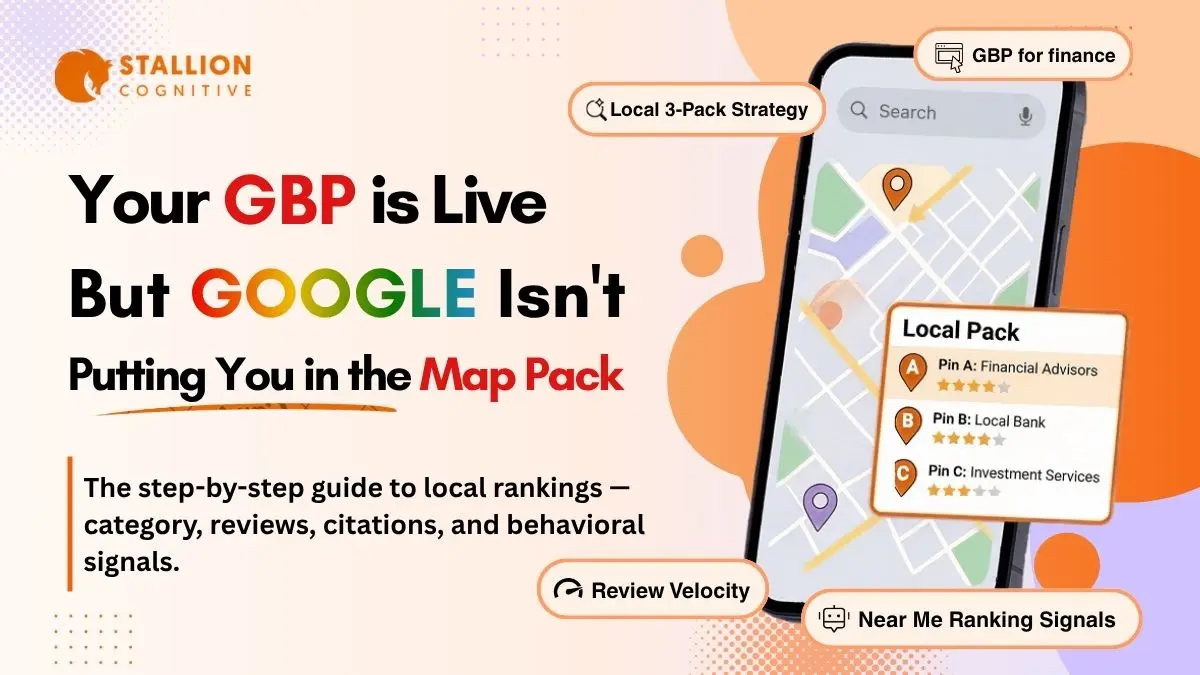
Your potential client just typed "financial advisor near me" into Google. Before a single website loads, Google returns three businesses at the very top. Photos, ratings, hours, phone numbers, all visible before anyone clicks a link. That's the Map Pack, and those three spots collect the majority of local search clicks.
Ranking in the map pack is a process. This guide walks through it step by step, from how Google's algorithm scores local businesses to the specific signals financial service firms can move.
How Google Decides Who Gets Into the Map Pack
Google evaluates every local business against three signals: relevance, proximity, and prominence. Two of them respond to optimization. Proximity, the third signal, is largely fixed by your location. Relevance and prominence are where your Google Business Profile does its work.
Google's local ranking formula weighs each signal differently. According to Whitespark's 2026 Local Search Ranking Factors survey, here is how ranking weight breaks down across Map Pack signals:
| Signal Category | Approx. Weight | What It Covers |
| Google Business Profile | 32% | Category, completeness, posts, photos, Q&A |
| Reviews | 20% | Volume, recency, star rating, response rate |
| On-page website signals | 15% | Local keywords, service pages, mobile experience |
| Behavioral signals | 9% | Clicks, calls, direction requests, dwell time |
| Local backlinks | 8% | Quality links from local and relevant sources |
| Citations and NAP | 6% | Business name, address, phone consistency |
Your GBP and review profile together account for more than half of measurable Map Pack ranking weight. That's what shapes the step order in this guide.
Why Proximity Isn't as Limiting as It Looks
- Proximity matters, but it's not only about where your phone is located
- Google factors in the location specified in the search query itself
- For service-area firms, defining a coverage region inside GBP shapes which local searches you're eligible for
- Optimizing proximity is about configuration: your service area, not your office coordinates
Step 1: Claim, Verify, and Get the Category Right
Before anything else can work, your GBP must be claimed and verified. Once it is, the single most consequential decision in the entire optimization process isn't your photos, your description, or your services list. It's your primary category.
Your Primary Category Is the Gatekeeper
Whitespark's 2026 survey identifies the primary GBP category as the top local ranking factor, ahead of reviews and profile completeness. Google uses it to determine which searches your listing is eligible to appear in.
A tax accounting firm listed under "Financial Planner" doesn't rank lower for "accountant near me" queries in its city. It doesn't appear for them at all, regardless of how strong everything else looks.
How to choose the right primary category:
- Identify the service your best clients hired you for
- Search that service in your city and note what the top-3 Map Pack results are categorized as
- Choose the most specific category that accurately matches your core offering
Secondary categories expand your reach without diluting the primary signal. A firm handling both tax preparation and estate planning might structure it like this:
- Primary: Tax Preparation Service
- Secondary: Financial Planner (if genuinely offered)
- Secondary: Bookkeeper (if relevant to your work)
Add only categories that honestly apply. Irrelevant secondary categories create suspension risk.
Step 2: Build a Profile That Does More Than Just Exist
A fully completed GBP signals legitimacy to Google and gives potential clients enough to make a contact decision before they've clicked through to your website. Listings that rank but fail to convert are almost always incomplete.
Start with the fields Google evaluates for basic trust:
- Business name: Accurate, no keyword stuffing; Google flags it and suspensions follow
- Phone and address: Must match your website and every directory exactly
- Website link: Working, pointing to the right page
- Hours: Current, including holiday closures and seasonal adjustments
- Services: List each specific service as a separate entry (indexed and searchable)
The Two Fields Most Financial Firms Leave Blank
Services section: A firm that breaks its work into individual entries, including retirement planning, tax planning, college savings consultation, and wealth management reviews, surfaces for far more specific searches than one with a single broad category. It's free additional reach most businesses don't use.
Photos: According to Google's own published data, profiles with photos receive:
- 42% more direction requests than profiles without them
- 35% more website clicks than profiles without them
Beyond click volume, Google's Vision AI scans photo content to understand what a business actually does. A firm uploading professional office and team shots sends a relevance signal through imagery that stock photos cannot replicate.
Add new photos regularly. Photo activity signals an actively managed listing.
Step 3: Build Reviews Around Velocity, Not Volume
Reviews account for roughly 20% of Map Pack ranking weight. The metric that separates businesses in competitive markets isn't total review count. It's velocity, meaning how consistently new reviews arrive. Recency tells Google the business is active and trusted today, not just historically.
A firm with 30 reviews spread over three years is regularly outranked by competitors that collected 20 reviews steadily over the past six months. A stale review base signals a business that has either stopped delivering well or stopped asking.
BrightLocal's annual local consumer research shows businesses responding to the majority of their reviews see measurable improvements in both rankings and client conversion. Response rate tells Google the listing is attended to.
What a Healthy Review Profile Looks Like
- Rating target: 4.5 or higher. A perfect 5.0 with no negative feedback often triggers Google's credibility filters
- Review count: At minimum 20 recent reviews; recency matters more than the total
- Response rate: Respond to every review, good and bad, within 48 hours
Building a system that keeps velocity consistent:
- After each successful engagement, send a short follow-up with a direct link to your GBP review page
- Keep it to one click with no searching required, because any friction kills follow-through
- Respond to every review within 48 hours; the response is a behavioral signal and a trust signal simultaneously
Your review profile builds the prominence signal. Your website builds the authority layer beneath it.
Step 4: Your Website Doesn't Just Convert. It Signals.
On-page website signals account for roughly 15% of Map Pack ranking weight. Your website isn't a separate track from local SEO. It's the authority layer that validates and amplifies everything your GBP does.
The most important alignment check is NAP consistency. Your business name, phone number, and address must match your GBP exactly across your website. Any mismatch creates a data conflict Google has to resolve, and that uncertainty costs ranking.
Local Landing Pages and Why Website Quality Affects Rankings
For financial firms covering a metro area, purpose-built local landing pages are among the highest-return investments in local SEO.
What a high-performing local landing page includes:
- Service-area specific content (not a generic copy of your main service page)
- Your verified address and phone number
- An embedded Google Map
- Testimonials or case results from clients in that area
Website quality creates a second ranking pressure. A searcher who finds your Map Pack listing and lands on a site not optimized for mobile or that loads slowly is gone within seconds. Short sessions feed behavioral signals that work against your Map Pack position.
If your website isn't converting the local traffic your profile generates, the gap between your ranking and your results stays wide regardless of what else you optimize.
Financial advisors navigating compliance constraints around local content will find guidance on local SEO for financial advisors for building authority within those limits.
Step 5: Citations Tell Google Your Profile Data Is Real
Your GBP states your business name, address, and phone number. Citations are how Google validates those claims across the wider web. Consistent data across directories builds confidence in your profile. Inconsistencies create conflicts the algorithm has to resolve, and unresolved conflicts suppress rankings.
Audit your listings across the directories that carry the most weight for financial businesses:
- Google Business Profile (primary source)
- Bing Places for Business
- Apple Maps
- Yelp
- Facebook Business
- Your regional Chamber of Commerce and professional association listings
Anywhere your phone number, suite number, or business name appears differently from your GBP, fix it.
Where the Strongest Local Links Come From
Citations set the foundation. Local backlinks build authority above it.
A single link from a respected regional newspaper, a local business journal, or a recognized professional association carries more local ranking weight than dozens of generic directory submissions. Quality and local relevance outweigh volume.
Practical paths for financial firms:
- Being quoted as a subject-matter expert in a local financial news story
- Sponsoring a community event that earns a genuine web listing
- Active membership in a recognized regional professional association
Understanding what's behind your competitors' local rankings gives you a concrete target rather than a vague strategy.
Step 6: GBP Posts and Behavioral Signals
Google's official guidance on improving local rankings outlines what actually moves your position. It covers profile completeness, review quality, keyword relevance, and prominence signals. Posting frequency is not in that list. Posts serve an indirect engagement purpose, not a direct ranking one.
What posting does accomplish is meaningful but narrower than most guides suggest. A profile with regular updates looks active and managed to both visitors and Google's crawl. Active-looking profiles earn more clicks. Clicks feed the behavioral signals that do influence rankings, even though posting itself doesn't trigger them.
The case for consistent posting is real. Just know what you're posting for.
Behavioral Signals Google Actually Tracks
Behavioral signals account for roughly 9% of Map Pack ranking weight according to Whitespark's 2026 survey, and that share has been rising. The signals in this category include:
- Clicks on your profile from search results
- Phone calls made directly from Google
- Direction requests
- Photo views and time spent engaging with your listing
- Whether your business is open at the time of the search
That last one surprises most businesses. Businesses open when a search happens rank better than closed competitors for that same query. It's a dynamic signal Google applies in real time, not an averaged metric.
Google's guidance on improving local rankings returns to the same point consistently: complete, current, and actively managed profiles outperform neglected ones regardless of any individual tactic.
How to Use Posts Effectively
Post at minimum once per week. Service updates, seasonal reminders, event participation, and relevant financial content all qualify. The topic matters less than the consistent signal that someone is actively running the business.
The Map Pack Belongs to Businesses Where the Whole System Works
Getting into the Map Pack means maintaining several signals in parallel, not excelling at one in isolation.
What each layer does:
- Category: determines which searches can find you
- Profile completeness and photos: determines what those searchers see
- Reviews: signals to Google whether you're active and trusted
- Website and citations: reinforces and validates the data beneath both
- Behavioral signals: confirms real client engagement in real time
The financial businesses sitting outside the Map Pack aren't usually failing at complex strategy. They have the wrong primary category, or their last new review arrived four months ago, or their website lists a different phone number than their GBP. Those are solvable problems, and most can be corrected in weeks.
If you want to know exactly where your local profile stands, start with a conversation about your local search visibility. The gaps are almost always more specific than expected, and so is the path from them.
Frequently Asked Questions
How long does Map Pack ranking take after a GBP optimization?
Early movement in local pack visibility usually appears within four to eight weeks of completing a thorough GBP optimization. Meaningful, sustained improvement builds over three to six months as review velocity compounds, behavioral signals accumulate, and citation consistency settles across major directories.
Can a service-area financial firm rank in the Map Pack without a physical storefront?
Service-area businesses that define a coverage region and hide their address can appear in the Map Pack. Google evaluates them against the defined service area rather than a fixed address. Visibility tends to be strongest near the center of the defined region and more competitive toward the outer edges.
Does working on Map Pack signals also improve organic search rankings?
Signals that strengthen Map Pack performance, including a complete GBP, consistent NAP data, website authority, and locally relevant content, also reinforce organic local visibility. Local landing pages built for Map Pack targeting carry over directly to organic local queries. The two strategies overlap considerably.
What triggers a Google Business Profile suspension?
Keyword-stuffed business names, primary categories that misrepresent the actual business, and virtual office addresses without genuine staffing are the most common triggers. Bulk edits to core profile fields in a short window also flag for review. Gradual changes and consistently accurate information are the most reliable protection.
How do I track where my business actually ranks across the Map Pack area?
Map Pack positions shift based on the searcher's exact location, so a single rank check gives an incomplete picture. Tools like BrightLocal's Local Rank Tracker and LocalFalcon generate a grid view of your visibility at different geographic points across your service area, showing precisely where you appear and where you don't.