
An agency can put your firm's name on a website you have heard of.
The price runs to four figures. Someone else writes it, and it goes out under a partner's byline with a link home.
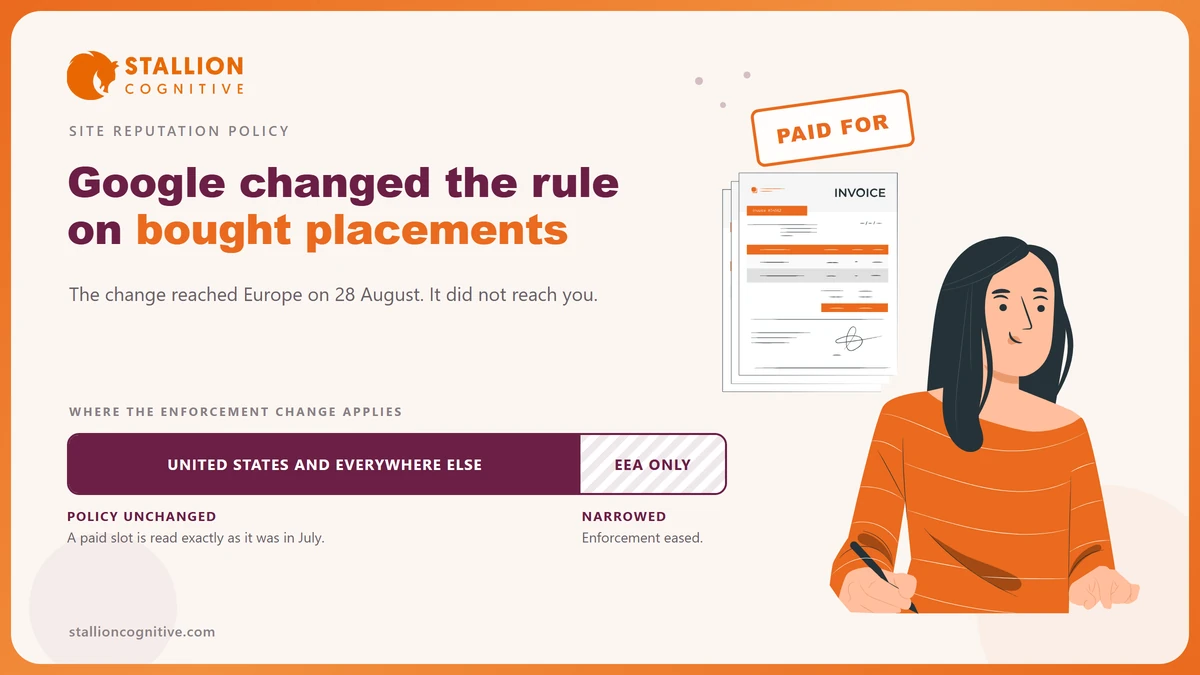
Google wrote a policy for that deal two years ago, and it changed that policy on 28 August 2026. Is guest posting worth it now? The answer turns on why the host said yes.
The change is real, though most US firms will never feel it.
What the offer in your inbox actually is
One word covers deals that have almost nothing in common. What separates them is who chose to publish the piece, and that choice is the whole of Google's interest in them.
- The bought slot: A vendor sells you space on a site they already have access to. Nobody edits it, and the fee buys the page.
- The shared article: One article, written once, placed on many sites under many names. Your version is not unique to the host.
- The contributor network: The host runs an open sign-up. Publishing is close to automatic, and the byline is the product.
- The commissioned piece: An editor asks your partner for help on a story they are already writing. No money moves.
Only the last one starts with an editor.
The first three start with a price list, which is the signal Google's policy is built to read.
Owners rarely see this split, because every version of the offer arrives dressed as the fourth one, complete with a byline and the name of a friendly editor. The pitch says "we can get you featured", and the invoice says something plainer.
What Google's site reputation policy covers
The policy is written around motive.
It asks why the host published the page, and it does not care whether the writing is good.
The site reputation policy applies where third-party content is published on a host site mainly because of that host's already-established ranking signals, which it has earned primarily from its first-party content.
Google is direct about what it is aiming at. Its own summary of the tactic says the goal is "for the content to rank better than it could otherwise on its own."
Having third-party content at all is fine.
Google says the trouble starts only when a page goes up on a host "mainly because of that host site's already-established ranking signals". It names freelancers and white-label services among the people it has in mind.
| The arrangement | Why the host published it | Inside the policy? |
|---|---|---|
| A vendor sells you a slot with no editing | Because the page will rank | Yes |
| One article distributed across many host sites | Because the page will rank | Yes |
| An open contributor programme with automatic publication | Because volume earns revenue | Usually |
| An editor commissions your partner for a story | Because the expertise improves the story | No |
| Your own article on your own site | Because it is your site | No |
The examples Google publishes are blunt. One is a school site carrying paid reviews of payday loans, sent to other sites as well. Another is a health site running a cheap ad page about casinos, dropped in with no tie to the site around it.
Read the middle column before you read the price. A firm that cannot say why an editor wanted the piece is buying the first row.
What changed on 28 August, and where it does not apply
Google updated the policy on 28 August 2026, and the update was about where it gets enforced. Its documentation changelog gives the reason as "We've adjusted our enforcement approach within the European Economic Area (EEA)." The policy page carries the same note.
For a firm in the United States, that is a change with no effect.
The rule did not get softer. It got softer somewhere you do not operate.
Two things follow, and they pull in opposite directions. A US practice reading headlines about a relaxed policy is reading about a European carve-out. A firm with a European office now has two levels of risk in two markets for one tactic, which is a hard thing to run a single budget against.
The policy itself is two years old, and Google has enforced it by hand for most of that time. Nothing in the August update makes a bought slot a better idea in Chicago than it was in July.
Who pays when a placement gets caught?
The host site takes the action. Your firm takes the loss. Those are two different events, and the gap between them is why this tactic keeps selling long after it stopped working.
| Party | What happens | What it costs them |
|---|---|---|
| The host site | Receives the manual action against the affected content | Ranking on the section that earned the fee |
| Your firm | Keeps the article and loses what it was bought for | The fee, and the time spent approving copy |
| The link | Stays live, stops counting | The reason you paid |
| The vendor | Sells the next slot on the next host | Nothing |
Nobody tells your firm, because your site was never the one acted against.
The page stays up. Traffic to it was always tiny, since almost nobody reads a contributor post. What goes missing cannot be seen, so the vendor sells the same slot on the same site for months.
The invoice was paid in month one.
That gap is worth naming when someone shows you a report full of placements. A live URL is not proof that a link still does anything, and the reporting habits worth checking are the same ones that show up in other SEO agency red flags.
The disclosure rule that has nothing to do with search
Paid placement raises a second question that no ranking policy answers.
When a firm pays for content that looks like editorial, US ad law says the reader is owed a word about it.
The Federal Trade Commission's native advertising guidance is written for this exact format, and it puts the duty on the buyer. Its wording is that "advertisers are responsible for ensuring that native ads are identifiable as advertising before consumers arrive at the main advertising page."
Its endorsement guidance closes the obvious escape route in one line.
Your company is ultimately responsible for what others do on your behalf.
Three points fall out of that for a regulated firm.
- A disclosure has to be easy to see where the reader meets the claim, and burying it at the foot of the page defeats the point.
- The firm that paid cannot hand the duty to the publisher by contract.
- An article your firm paid for and signed off is a message about your firm, which is a heading most compliance manuals already carry.
Your compliance officer will have a view here well before your marketing team does. Ask for the disclosure wording before you approve the copy, because it is far harder to change after the piece goes live.
Is there a version of this that works?
Yes, and it is the version that was never for sale. An editor, a reporter or a panel chair decides your partner is worth quoting, and the mention follows that decision instead of coming before it.
The route is slower and it produces less volume, which is why it is rarely pitched.
- Local and trade press: A reporter needs a named source who returns calls, and local press coverage is far more reachable than a national title.
- Bodies you already belong to: Chambers, trade groups and the people who licence you all publish member work, and those pages are part of normal local link building.
- Your own site: A firm that publishes well on its own domain builds something nobody else can switch off, which is the case behind topic clusters.
- Being findable by name: Using the same firm name everywhere is what off-page brand building is for, and it works on search engines and AI answers alike.
There is a second reason to look local, and it runs against the instinct that a national title is the bigger prize. Pew Research Center surveyed 5,195 US adults in September 2025 and found that 56% trusted information from national news organisations, against 70% for local ones.
Your prospect trusts the county business journal more than the national brand your vendor is selling.
None of that arrives as an invoice, and none of it rests on a policy staying still. A firm quoted in its regional paper, because it was the obvious firm to ask, keeps that mention through every future update.
Five questions to put to whoever is selling it
A vendor who can answer all five is describing something real, and most stop at the third.
- Who at the host site reads a piece before it goes up, and what have they turned down?
- Is this article being offered to anyone else, in any form?
- What is the fee for, in writing, if the piece is editorial?
- Where will the disclosure sit, and who drafts it?
- What happens to our money if the host takes a manual action?
An editorial decision has no invoice attached to it, so a fee and an editor rarely turn up in the same deal.
Keep the answers. If the same vendor comes back in six months with a different host site, the file tells you whether anything they promised last time survived.
Where that leaves the offer in your inbox
Guest posting was a tactic before it was a product, and the product is what Google named. The August change tightened nothing for a US firm and loosened nothing either, so this month's answer is last month's answer.
- Sort the offer first: Find out whether an editor or a price list decided it would run.
- Price the whole thing: Add the disclosure work and the compliance review to the fee before you compare it against anything.
- Spend the same money on your own domain: Nobody can enforce a policy against you for publishing on your own site.
A partner quoted by name in a title that wanted the quote is worth more than a dozen bought bylines, and it lives through the next update as well. If you would rather build that from your own pages, our SEO team starts with what your firm can prove and works outward.
Frequently Asked Questions
Does removing an old paid article help?
Taking down old placements rarely produces a ranking gain on its own, since the value was never counted in the first place. Removal matters far more where the piece says something a compliance review would now reject outright.
Our vendor says the links are nofollow. Is that safer?
A nofollow tag tells Google not to pass ranking value, which removes the reason the slot was sold while leaving the advertising question exactly where it was.
How long does a manual action last?
Until the host fixes the content and files a reconsideration request Google accepts. Your firm has no standing there and cannot file for them.
What about paying for a press release?
Wire services put one page on many sites at once, which is the pattern the policy describes. Treat the reach as news value and expect nothing from it in search.
Should we stop writing for other titles entirely?
Writing for a title that asked you is normal professional work and always has been. The test is whether the invitation came before the invoice.