
Your page still ranks. The clicks, though, keep thinning out, and a rival site isn't the one stealing them. They're vanishing into an AI answer that summarizes your work, satisfies the reader, and never sends a single visitor your way. That's the gap AI search visibility tools were built to expose. Ignoring it has started to cost real money.
Below, we line up the platforms worth paying for in 2026 and show what each one really measures. You'll see where the enterprise heavyweights earn their price and where a lean tracker does the same job for a fraction of it. Then we'll cover the part most teams skip, turning that data into citations.
Start with why this snuck up on so many sharp marketers.
Why Ranking First Stopped Guaranteeing the Click
Ranking number one used to mean the visit was yours. These days it guarantees nothing. Google's AI Overviews and chat tools like ChatGPT settle the question right on the results page, so most readers never scroll down to your link. Pew Research found only 1% of visits to pages with an AI summary produced a click on a cited source.
Where your clicks quietly disappear
The shift is structural, and Google built it on purpose. Semrush studied more than 10 million keywords and found AI Overviews leveled off near 16% of all queries through late 2025, after a mid-year spike that touched nearly a quarter of searches.
For how-to and informational topics, that share climbs higher still. The answer now arrives before your link ever gets a chance.
Here's the deal. When an engine answers and skips your name, you lose the visit and the credit in one move. Your dashboard keeps flashing a healthy ranking while booked work quietly dries up.
Three forces collided at once:
- Answers jumped above the links, and AI Overviews now own the top of the page while organic results sink below the fold.
- Chatbots quietly replaced the search box for a real slice of buyers.
- Citations turned stingy. An engine might read five sources, name only two, and leave yours off the list entirely.
Why local service firms feel it first
Local service firms feel it first and hardest.
We've watched law firm and financial advisor sites that still rank page one lose booked consults, because the AI answer closed the deal before the prospect ever clicked. The way AI Overviews changing local search is playing out follows that same script.
And the worn-out argument over whether SEO is dead misses the real story. The channel didn't vanish; it just moved into the AI answer, somewhere your old dashboards never thought to look.
Seeing exactly where that traffic went, engine by engine, is the whole job of the tools below.
What Does an AI Search Visibility Tool Actually Do?
Cut through the marketing and these platforms all share one core job. Each runs your priority prompts through the big AI engines, then reports whether your brand surfaces, where it lands, and how it gets described. The better ones layer on citations, sentiment, and your share of voice against named rivals.
The four metrics that actually matter
The numbers that count aren't the ones a rank tracker spits out. You've stopped chasing position three for a keyword, and started asking something blunter, whether the answer engine trusts you enough to name you at all.
Most tools report some blend of these:
- Presence: does your brand show up in the AI answer at all, for the prompts you care about.
- Citations: whether the engine links your page as a source, the nearest thing AI search has to a click.
- Share of voice: how often you appear against named competitors for the same prompts, the figure agencies drop straight into client decks.
- Sentiment: how the model talks about you, because being tagged the pricey option reads nothing like being named the best.
If the line between GEO vs AEO vs SEO still feels blurry, these four metrics are where it sharpens into something you can act on. Presence and citations are the scoreboard, and your content is the only thing that moves it.
Peec AI, for one, strips its reporting down to three numbers, Visibility, Position, and Sentiment, tracked daily across several models. That trend line tells you whether last month's content push actually registered with the engines or vanished without a ripple.
6 AI Search Visibility Tools Worth Your Money in 2026
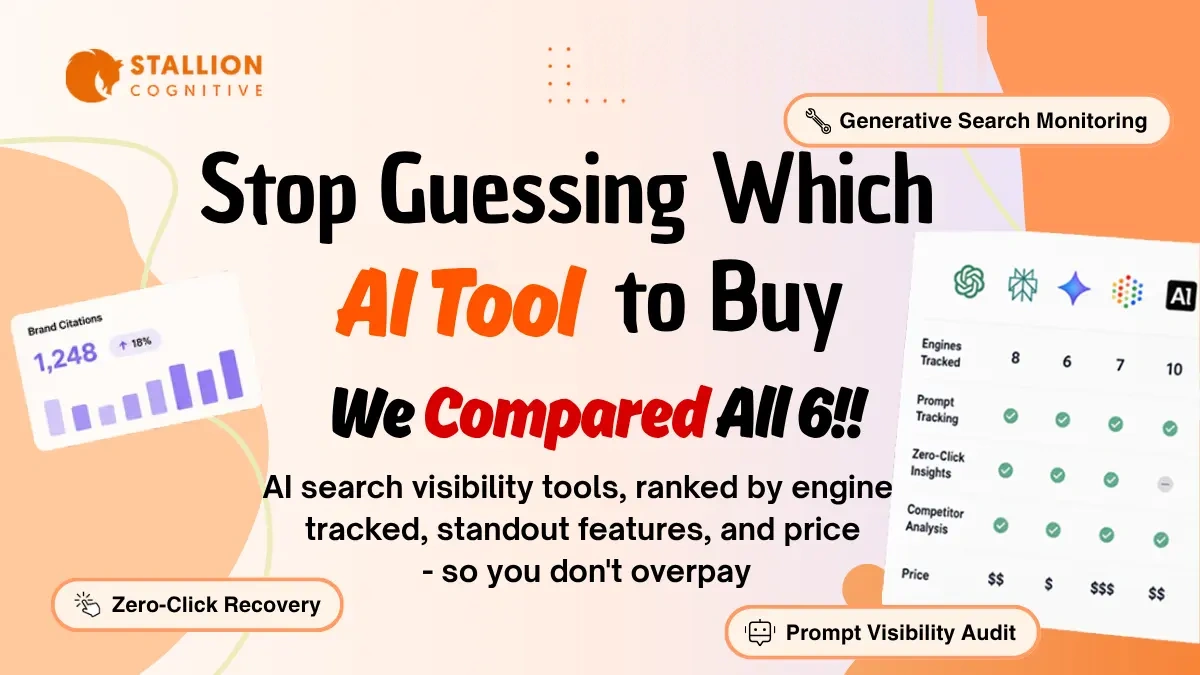
There are dozens of these tools now, and most are noise. Six earn a place in 2026, from Sequoia-backed enterprise systems down to lean trackers a solo marketer can run on a coffee budget. Your pick hinges less on feature count than on which AI engines your buyers actually open.
| Tool | Best for | Starts around |
|---|---|---|
| Profound | Enterprise brand teams | Custom, sales-led |
| AthenaHQ | Multi-client agencies | $295/month |
| Peec AI | Multi-country brands | €85/month |
| Otterly AI | Small teams on a budget | $29/month |
| ZipTie | Google-focused SEOs | $69/month |
| Geoptie | Track-and-optimize DIY | $49/month |
Prices below are starting points and move fast, so confirm the current number on each vendor's own page. These six also attack a problem the broader pile of AI marketing tools doesn't even register.
Profound: Built for the Enterprise
The deepest platform on this list, and it's priced to match.
- Best for: large brands and in-house teams that report to a board.
- Engines tracked: 10+, including ChatGPT, Claude, Gemini, Perplexity, Copilot, and Grok.
- Standout features: Agent Analytics that shows which AI crawlers hit your site, plus the cross-industry Profound Index benchmark.
- Pricing: custom and sales-led, firmly enterprise-tier.
AthenaHQ: Tracking With a Fix List
Y Combinator-backed, and one of the rare tools that tells you what to fix next.
- Best for: agencies and growth teams managing several brands at once.
- Engines tracked: ChatGPT, Perplexity, Gemini, Google AIO and AI Mode, Claude, Copilot, Grok.
- Standout features: an action center that turns each visibility gap into a ranked task.
- Pricing: self-serve from roughly $295/month, cheaper on annual billing, with custom enterprise plans.
Peec AI: Best Across Borders
Clean, affordable, and unusually strong outside the US.
- Best for: multi-region and European brands tracking several languages.
- Engines tracked: ChatGPT, Gemini, Claude, Perplexity, Google AI Mode, DeepSeek, Grok, and more.
- Standout features: Visibility, Position, and Sentiment scored daily and broken out by country.
- Pricing: starts around €85/month, with no core features locked behind higher tiers.
Otterly AI: The Budget Entry Point
Where most small teams should run their first test.
- Best for: solo marketers and small agencies proving the concept cheaply.
- Engines tracked: ChatGPT, Perplexity, Google AI Overviews, Bing, and Gemini.
- Standout features: fast setup and one of the lowest entry prices in the category.
- Pricing: starts around $29/month.
ZipTie: For SEOs Living Inside Google
Narrow on purpose, and built for people losing sleep over AI Overviews.
- Best for: SEOs who care most about Google AI Overviews eating their rankings.
- Engines tracked: Google AI Overviews, ChatGPT, and Perplexity.
- Standout features: screenshots and source checks rather than a sprawling dashboard, billed by query check.
- Pricing: starts around $69/month for 500 checks, with a 14-day trial.
Geoptie: Track and Fix in One Window
The value pick, because it pairs tracking with content tools.
- Best for: agencies and DIY optimizers who want to act inside the same tool.
- Engines tracked: ChatGPT, Claude, Perplexity, and Gemini on every plan.
- Standout features: a Content Studio and unlimited audit reports built in for client work.
- Pricing: starts around $49/month, with a free audit to test it first.
Six strong options still leaves you with one decision to make, and the next part makes it quick.
How to Pick the Right Tool Without Overpaying
Forget the feature spreadsheets for a second. The choice really comes down to three questions answered in order. Which AI engines your customers actually use, what the tool does the moment it spots a gap, and what you can spend without wincing. Map those onto your team size and the shortlist trims itself.
The three questions that decide it
Most buyers get this backwards and shop on price first. Coverage should lead, because a cheap tool watching the wrong engines is money set on fire.
Run it in this order:
- Lead with engine coverage. If your buyers live on ChatGPT and Perplexity, a tool that only watches Google AI Overviews leaves you blind to most of the danger.
- Value action over analytics. A platform that only reports is half a tool, while one like AthenaHQ that suggests fixes hands back the hours you'd burn decoding data.
- Match price to your stage. A solo marketer testing the water wants Otterly or Geoptie, an agency reporting to clients wants AthenaHQ or Peec, and a national brand wants Profound.
- Test the export. Reporting to a board means clean data out, so check that first.
Match the tool to your team and budget
For a business already running a stack of tools for local SEO, the smart move is bolting on one AI tracker rather than tearing anything out. Watch it for a quarter, then decide if the deeper platform earns the upgrade.
Fair warning, the sticker price rarely tells the whole story. Seat limits and per-check billing can push the real monthly cost well past the headline number, so read the fine print before you commit.
Once a tool's picked and the data starts rolling in, the actual work kicks off.
How to Turn Visibility Data Into AI Citations
A tracker fixes your visibility about as well as a scale fixes your weight. The number is just feedback. Real wins come from feeding engines content they can lift clean, direct answers, tidy structure, and sources they already trust. Most brands skip that step, then wonder why the dashboard flatlines.
Why tracking alone changes nothing
Truth is, the gap between tracked and cited is almost always a content problem rather than a tooling one.
A dashboard can point at the hole all day. Only the words on your page actually fill it, which is why the engines reward content that answers fast and proves it faster.
The four-step loop that earns citations
Turn tracking into citations with a tight loop:
- Mine the prompts you're losing. Pull every query where a competitor gets named and you don't, then rank that list by how much each buyer is actually worth to you.
- Answer in the first sentence. Engines lift self-contained answers, so a buried one gets skipped.
- Stack the proof models trust. Original data, named sources, and visible author credentials all raise your odds of a citation.
- Recheck in two to four weeks. Engines recrawl on their own clock, so give changes room before you judge them.
The same prompt-mining reflex behind sharp prompts for keyword research carries straight over here. You're just hunting the questions buyers ask the AI instead of the ones they type into Google.
We watched a financial advisory client go from invisible to cited in Perplexity inside one month. No new tools entered the picture. They simply rewrote each service page to open with a plain answer to the question buyers were already asking, and the engine finally had something clean to quote.
The tool exposes the gap, but the habit of closing it is what keeps AI saying your name.
Conclusion
AI search isn't easing off, and the brands measuring their presence today are quietly writing the standard everyone else will scramble to match next year. The tools have matured to the point where flying blind is now a choice rather than a limitation.
So sit with one question. A year from now, when a prospect asks ChatGPT who's best in your space, will you be guessing at the answer or will you already know it? If you'd rather know, see how our team runs generative engine optimization and turns plain tracking into citations that send buyers back your way.
Frequently Asked Questions
Will AI search replace traditional SEO entirely?
More than the doom takes suggest, classic search still drives real traffic, especially for transactional queries. The sharper read is that AI search sits on top of SEO and feeds off it. Solid technical SEO is still what earns the citation in the first place.
Can you track AI visibility without paying for a tool?
None of the free workarounds come close to a paid platform, but you can spot-check by hand. Ask ChatGPT, Gemini, and Perplexity your top buyer questions, then note who they name. It's slow and unscalable, though it costs nothing and proves the gap is real.
How accurate are AI visibility tools when answers keep changing?
Accuracy improves with sampling. Good platforms run each prompt many times across days, then average the result, because a single ChatGPT reply can swing wildly. Treat the trend line as the truth and any one snapshot as noise.
Do these tools cover AI engines outside the US or in other languages?
Peec AI and a few rivals split tracking by country and language, which counts if you sell across regions. Coverage gets thin for smaller languages, so confirm your exact markets are supported before signing up. US English is covered everywhere.
If nobody clicks, does showing up in AI answers even drive revenue?
The payoff hides one step downstream. Buyers who read your name inside a trusted AI answer come back later as branded searches, direct visits, and warmer leads. You won't see a tidy click in analytics, yet the pipeline effect is real and measurable over a quarter.