
A one-star review lands on a Friday night. The name means nothing to you. The complaint describes a service you have never offered, and by Monday it sits second in your profile where every prospect reads it first.
You want it gone. Working out how to remove a fake Google review is worth twenty minutes of your time, because Google really does take some of them down.
It also says no far more often than most advice admits. What follows is the part nobody writes about. What Google removes, how to report so the report holds up, what to do when the rejection lands, and how to answer in public when your license limits what you can say.
Is that review actually removable?
Usually not. Google removes reviews that break its content policy. A review that is simply unfair, wrong, or written by somebody having a bad week breaks nothing at all. Sorting the review into the right bucket first protects the one appeal you get.
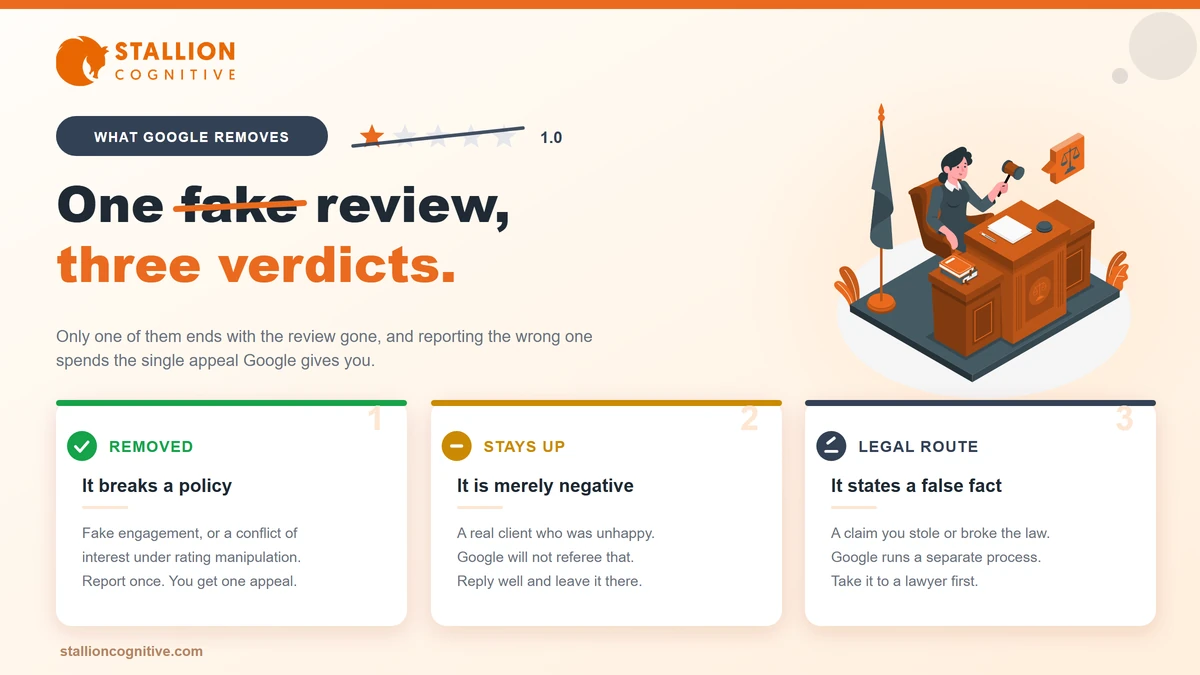
Three buckets cover nearly everything that lands on a firm's profile.
| What you are looking at | A typical example | What to do with it |
|---|---|---|
| Policy violation | A one-star from a name that appears nowhere in your files, posted an hour after two others | Report it with proof |
| Merely negative | A real client who thought your fee was too high and said so | Reply well and leave it up |
| Possibly unlawful | A false claim that you stole money or broke the law | Report it, then get legal advice |
That middle row is where owners lose weeks. A harsh review from a real client is a service problem, and Google will not act as referee.
The panic is fair, though.
Research from Harvard Business School on Yelp ratings, published as a working paper rather than a peer-reviewed article, found that one extra star moved revenue by 5 to 9 percent for independent restaurants. Ratings did nothing for chains. Your firm is not a restaurant and the number does not carry over cleanly. The direction does, and it explains why one visible one-star beside four reviews hurts more than the same review beside sixty.
Why fakes tend to hit weak profiles
There is a fair chance the fake was not random. A peer-reviewed study in Management Science on Yelp review fraud found roughly 16 percent of restaurant reviews were filtered as suspicious. It also found firms were more likely to post fakes when their own rating was weak or had just taken a hit.
So fakes cluster where they do the most damage. Two things follow from that.
- A thin review count is the real exposure. One fake among six reviews sets the tone of the whole profile.
- Review volume is a ranking input. Your count and rating feed your local search ranking factors rather than sitting there as a vanity number.
Check your lead source tracking for the weeks either side of the review. You want to know whether inquiries actually moved.
What does Google actually take down?
Google publishes the list, and it is narrower than owners expect. The prohibited and restricted content policy governs every removal. Five headings matter for a firm like yours.
- Fake engagement: Content that fails to reflect a real experience at the business, including reviews from people who were never clients.
- Rating manipulation: Content based on a conflict of interest, which Google defines as covering current or former employment, a contractual or consulting relationship, and other professional or personal ties such as industry competitors and family members.
- Off-topic: Anything that is not based on an experience at your business, from a complaint about another company to a political rant.
- Harassment: Personal attacks on staff, slurs, and threats.
- Personal information: A review that posts a client's account details, home address, or health information.
Notice what is missing.
Nothing on that list covers a review being wrong, unfair, or brutally worded. Google states that it does not get involved in conflict between businesses and customers.
Rating manipulation is the heading firms underuse, because the conflict-of-interest language sitting inside it reaches further than owners expect. A former employee writing about internal politics falls under it. So does a competitor, a competitor's relative, and somebody who approached you, got declined as a client, and then reviewed a service they never had. Your Google Business Profile is where all of this shows up, and naming the heading beats describing your feelings.
How do you report a fake review so the report sticks?
Report it once, name one policy breach, and stop. Google documents two reporting paths and both reach the same reviewers, so using both on one review adds nothing.
The faster path runs through your profile.
- Open your Business Profile and select Read reviews.
- Find the review and choose the report icon beside it.
- Pick the reason that matches the policy wording rather than your mood.
- Send the report.
The second path is the Reviews Management Tool, and it is the more useful of the two. Every Google review removal request you file shows a status there, using three labels. Decision pending. Report reviewed with no policy violation. Escalated, with an email to follow.
Check that page instead of waiting for mail. We have watched clients assume nothing had happened for three weeks when a decision was already logged.
How long Google takes to remove a review
Google's own help pages say review evaluation typically takes several days. Ignore the two-week figure that gets quoted around the web, since Google does not publish it.
Plan around a week and do nothing in the meantime. Chasing it does not speed it up.
What if several fake reviews land at once?
A burst is a different event from a single fake. Report each review on its own ticket, with its own reason, because a batch complaint tends to get read as one.
Then look at the pattern, since that is what makes the case.
- Three one-stars inside ninety minutes.
- Accounts with no photo and no other review history.
- Wording that repeats across all of them.
Note the pattern in every individual report. Those same signals help you spot fake Google reviews on a competitor's profile too.
What proof should you collect before you hit report?
All of it, before you submit anything, because Google gives you exactly one appeal per review. A thin first attempt spends it.
The reviewers work at volume and know nothing about your business. Your job is to make the breach obvious in seconds.
- A timestamped screenshot of the review, the display name, and the reviewer's profile, taken before any of it can be edited.
- A client-record check showing the name and its variants appear nowhere in your files, with the date you ran it.
- The reviewer's public history, which often shows one-stars left at several unrelated businesses on one day.
- Your ticket reference from the management tool, so the appeal can point back to it.
One case shows why the hour is worth spending. A wealth-management client came to us with three one-stars posted over a single weekend. None of the names matched anything in their records going back six years. Their first report was one line. Google rejected it. The appeal carried the record search, the three profiles side by side, and the ninety-minute window. Two of the three came down.
Write the appeal before you send the report. If you cannot make the case on paper yet, you are not ready to spend the attempt.
Google said no policy violation. What now?
You get one appeal. It lives in the same Reviews Management Tool, under the option to check reviews you reported before. Select the review, submit the form, and lead with the policy category and the proof this time.
Change the argument. Do not repeat it.
A rejected report usually failed because it read as a disagreement with somebody's opinion. An appeal that opens by naming fake engagement or conflict of interest, then attaches the record showing no client relationship existed, is a different document.
Two routes after the appeal is spent
- The legal path: Google documents a separate process for content that breaks local law, routed through its legal troubleshooter rather than the normal flag. Google does not publish a court-order procedure for reviews outside a few country-specific pages, so treat this as a step to walk through with a lawyer.
- The extortion path: A fake one-star paired with a demand for payment is its own reporting category at Google. Never pay it.
The outsourcing offers tend to arrive right about here. Plenty of vendors advertise that they remove fake Google reviews for a flat fee, and the same guaranteed removal promises show up across the reputation industry. They are selling something they do not control. Nobody outside Google decides what Google removes.
Is it illegal to post fake reviews?
Yes, under federal rules, which is separate from whether the review stays up. The Federal Trade Commission's rule on consumer reviews and testimonials, at 16 CFR Part 465, makes writing and selling fake reviews a violation. The top civil penalty stands at $53,088 per violation, a figure that carried into 2026 because no inflation adjustment was made this year.
For a firm being targeted by a competitor, that changes the frame. It stops being only a Google problem.
How do you reply when you cannot confirm they were a client?
Reply without confirming or denying that any relationship existed. Almost every guide on how to respond to negative Google reviews assumes you can write something like we are sorry your visit fell short. For an advisor, a CPA, or an attorney, that one sentence can be a disclosure.
The limits come from two directions. Client confidentiality and privilege cap what you can admit. The advertising rules for advisers then cap how firms discuss client experience in public.
So a safe reply says something true about your process and nothing about this person.
| The situation | What you can safely say | What creates a problem |
|---|---|---|
| Name you do not know | You take all feedback seriously, plus a direct contact route | Saying they were never a client, which confirms you checked |
| Clearly a real client | Acknowledge the concern in general terms and move it offline | Discussing their account, their fee, or their outcome |
| Former employee or rival | You cannot discuss topics outside your client work | Naming them or describing the dispute |
| Reported and pending | Reply normally while the report runs | Announcing that you have reported it |
Keep it to three sentences.
A short, calm, slightly formal reply reads better to the next prospect than a detailed rebuttal. The audience for your reply was never the reviewer.
Do reply, though. An unanswered one-star reads as indifference, and the reply is the one part of this you fully control.
What if the review never comes down?
Then you stop working on the review and start working on everything around it. Plenty of fakes survive the report and the appeal. Knowing what to do when Google will not remove a review is the difference between a bad month and a bad year.
Volume does most of the work. One bad review among nine defines a profile. The same review among seventy is noise, which is why a steady request habit beats any removal attempt.
Three other things earn your attention.
- Your profile: A local SEO audit will surface the issues holding back your visibility, which usually count for more than the review does.
- Your website: Strong trust signals give a doubting visitor somewhere to settle the doubt.
- Your numbers: Watch your conversion rate for a month either side, so you work from evidence instead of dread.
Then handle it out loud. When a prospect raises it, a short factual answer about what you can and cannot discuss in public, followed by references, closes the subject faster than any written reply.
We should be clear about our own limits here. We cannot get a review pulled on demand, and no agency can, because that call belongs to Google. What we can do is build the case properly and fix the profile and site problems around it. If a review is costing you inquiries, talk to us about your local search presence and we will tell you which parts are fixable.
Frequently Asked Questions
Can you turn reviews off on a Business Profile?
Google gives you no setting for that. Reviews are a permanent feature of a verified profile, which leaves a request habit and a reply habit as your only real controls.
Do you need a lawyer to report a fake review?
Reporting runs entirely through Google and needs no legal help. A lawyer earns their fee only once a review makes a false factual claim about fraud, theft, or criminal conduct.
Does asking a client to take a review down ever work?
Sometimes, when the reviewer is real and the issue gets resolved offline. Ask once, attach no conditions, and offer nothing in exchange, since paid-for removal creates a fresh problem of its own.
Will a fake review hurt your position in Google Maps?
Rating and review count both feed local rankings, so a single one-star on a thin profile can shift where you sit. A profile with plenty of reviews absorbs it with little movement.
Should staff reply to reviews, or only partners?
Whoever replies needs to know the confidentiality limits, which usually points to one trained person. What sinks firms is two people replying to the same review with different stories.