
Every professional-services firm that asks about local SEO asks the same thing first. What will it cost?
Most pricing pages hand you a shrug and a range so wide it tells you nothing useful.
Here is a clearer answer.
How much local SEO costs for professional services comes down to a handful of real factors, and once you know them, a quote stops being a guessing game.
You will see the actual monthly ranges, what sits inside a retainer, what pushes your price up or down, and how to judge whether the spend pays off for a firm like yours. Read any quote after this and you will know if it is fair. Let's get started.
How Much Does Local SEO Cost for a Professional-Services Firm?
Most professional-services firms pay between $500 and $3,000 a month for local SEO. A solo consultant sits at the low end. A full-service agency working in a competitive market sits at the top. Industry data from Ahrefs puts the average local SEO spend at roughly $1,557 a month, which is where a lot of firms land once the work is real.
Price shows up in three shapes. You either pay a monthly retainer, a one-off project fee, or an hourly rate.
Retainers are by far the most common because local SEO is ongoing work rather than a one-time fix. Semrush pegs monthly local SEO between $100 and $3,000, with hourly consulting at $50 to $100 an hour for firms that only want occasional help.
Those numbers usually break down by the kind of help you hire.
| Engagement type | Typical monthly range | Best fit |
|---|---|---|
| Freelancer or solo consultant | $300 to $1000 | Single-location firm, light competition |
| Small local agency | $1000 to $2500 | Growing firm in one or two markets |
| Full-service retainer | $2500 to $5000+ | Competitive market, multiple offices, compliance needs |
Treat those bands as directional. Two firms in the same city can pay very different amounts, and the reason almost always traces back to the factors further down this page.
The short version. If someone quotes you $200 a month, you are buying a checkbox. If someone quotes you $6,000 for a single-location advisory practice, you are overpaying. The honest middle is where most good work happens.
What You Pay For Every Month
A monthly retainer buys a set of recurring tasks that keep your firm visible in local search. When a quote just says "local SEO" with a dollar figure, ask for the line items. A real one looks like the table below.
| What you pay for | What it actually does |
|---|---|
| Google Business Profile management | Keeps your map listing optimized, posts fresh, categories correct |
| Citation and NAP cleanup | Makes your name, address, and phone match everywhere so Google trusts your data |
| Review generation | Builds the review count and rating that win the local pack |
| Local link building | Earns local backlinks that lift your ranking authority |
| Location and service pages | Content that ranks for near me and city searches |
| Reporting and strategy calls | Tracks leads and keeps you in the loop |
Two of these deserve a closer look, because they carry most of the weight.
Your profile and your reviews decide the map. The map pack is the three-result box at the top of a local search, and it takes the lion's share of clicks. Getting into it leans heavily on a strong Google Business Profile and a steady flow of reviews. If a firm wants to rank in the map pack, that work is where a chunk of the retainer goes.
Your data has to be consistent. Search engines cross-check your business details across dozens of directories. When your address on Yelp does not match your website, trust drops and so does your ranking. Fixing that is why NAP consistency shows up on every serious retainer.
The rest of the spend goes to the slow-burn work. Earning local link building from real regional sites takes time, and so does building out pages that answer what local clients search. None of it is flashy. All of it compounds.
What Makes Your Price Go Up or Down
Your quote is not random. Five things move it, and knowing them turns you into a buyer who cannot be gouged.
- Competition in your market: Ranking a law firm in Manhattan costs far more than ranking one in a small suburb, because you are fighting more established sites.
- Number of locations: Every office needs its own optimized profile and pages, so a three-office firm is close to three times the work.
- The state of your listings today: A clean, established profile needs upkeep, while a neglected one needs weeks of cleanup before it can rank.
- How much content you need: Firms with thin websites pay more up front because pages have to be built before they can be optimized.
- Compliance review: Regulated firms add a layer, since every public claim may need a compliance check before it goes live.
That last one matters more than people expect.
A financial advisor under FINRA or SEC rules cannot publish marketing copy the way a bakery can. The extra review takes time, and time is what you are paying for.
So when a quote looks high, do not assume you are being ripped off. Ask which of these five factors is driving it. A good provider will answer in plain terms. A bad one will get vague, and that vagueness tells you what you need to know.
Local SEO Cost by Profession
Cost shifts by profession because the stakes and the rules shift. Three things change the math across the firm types we work with most.
- Client value: A single new client can be worth thousands, which raises what a smart spend looks like.
- Regulation: Finance and legal work carry compliance steps that pure-retail businesses skip.
- Trust bar: People vet a firm handling their money or their case harder than they vet a lunch spot.
Financial advisors
Advisors pay a premium because their content passes through compliance and their clients are high-value. A single managed account can be worth years of fees, so a $1,500 monthly spend that lands one client has already paid for itself many times over. The work of local SEO for financial advisors leans hard on trust signals, reviews, and locally relevant content that survives a compliance read.
What we see in practice. Advisors who treat local search as a slow relationship-builder outperform the ones chasing quick wins.
Accountants
Accounting firms feel the sharpest seasonality of any professional service. Demand spikes hard around tax deadlines, then cools. That rhythm changes how the budget flows, because visibility built in the quiet months is what captures the rush. Solid local SEO for accountants usually means steady year-round upkeep with a push before each filing season.
The takeaway for accountants. Pay for consistency instead of a January sprint, or you will miss the searches that matter most.
Law firms
Law firms sit in the most expensive local market of the three, because the competition is fierce and a single case can be worth a fortune. Bidding is brutal, and the map pack is crowded. Effective local SEO for law firms often runs at the top of the ranges above, and multi-office practices push higher still.
Bottom line. For lawyers, cheap local SEO is usually a waste, because it cannot move a truly competitive market.
Is Local SEO Worth the Cost?
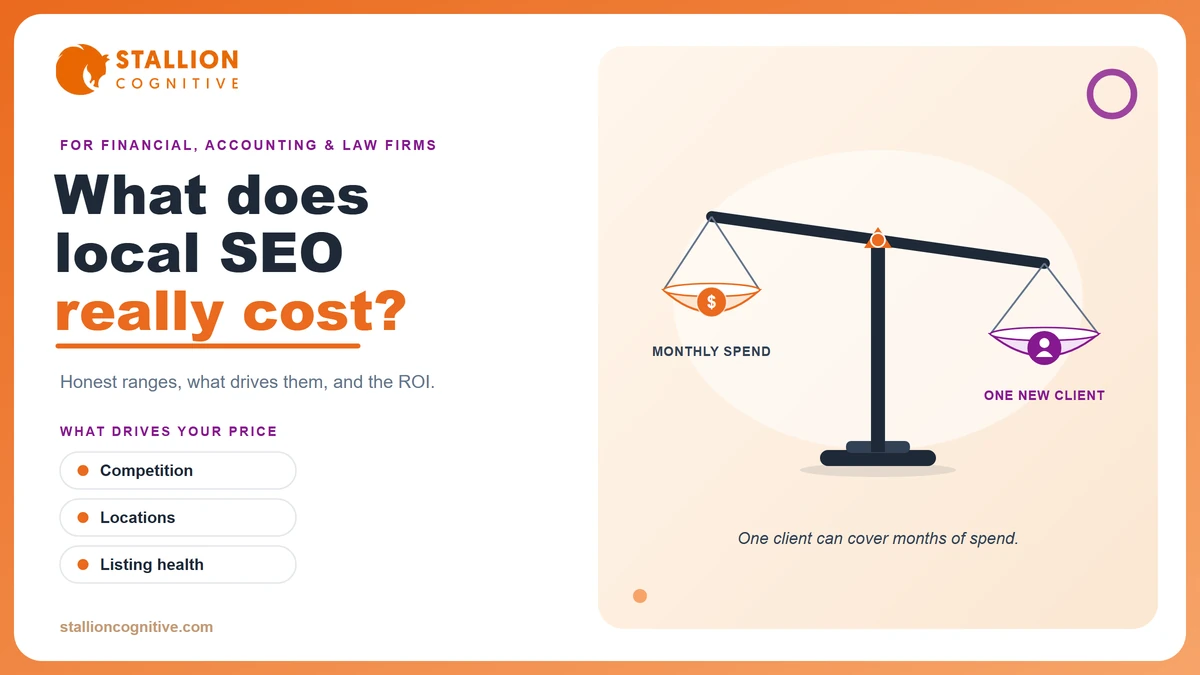
For most professional-services firms, yes, and the math is simpler than it looks. Stop thinking about cost per month. Start thinking about cost per client.
Say your firm pays $1,500 a month, which comes to $18,000 a year. Now say a new client is worth $8,000 to you over the time they stay. You need to land just over two clients from local search across the whole year to break even. Everything past that is profit.
That is why the spend works so well for high-value professions. When one client covers months of fees, you do not need volume. You need a few of the right people to find you at the moment they are searching.
Here is a quick way to size your own number.
- Find your client value: What is one new client worth over their lifetime with you?
- Divide it into the annual spend: That tells you how many clients you need to break even.
- Ask if that number is realistic: For most firms, two or three clients a year from search is a low bar.
HubSpot frames SEO as a budget line you set against expected return rather than a cost you try to minimize. That is the right lens. The firms that get burned are the ones who buy the cheapest option, see nothing move, and conclude local SEO does not work. It works. Underfunding it does not.
Agency vs Freelancer vs In-House
You have three ways to buy local SEO, and they cost very differently. The right pick depends on your budget, your market, and how much you want to manage.
| Option | Typical cost | Best fit | Watch out for |
|---|---|---|---|
| Freelancer | Lower monthly, often $300 to $1000 | Tight budget, simple local footprint | Limited capacity, one skill set |
| Agency | Around 30% more than a freelancer | Competitive market, needs a full team | Padded retainers, junior account handling |
| In-house hire | A full salary plus tools | Large firm with constant needs | Slow to hire, hard to cover every skill |
A freelancer is the cheapest entry point and can be plenty for a single-office firm in a quiet market. The trade-off is capacity. One person cannot be a writer, a link builder, and a technical specialist all at once.
An agency costs more for a reason. Semrush notes agencies charge roughly 30% above freelancers, and what you buy with that premium is a team, a process, and someone accountable when a ranking slips. For a competitive market, that structure usually pays for itself.
Hiring in-house only makes sense once your needs are big and constant. A full salary plus software beats a retainer only when there is enough work to keep that person busy every day, which is rare for a small firm.
Ready to price local SEO for your firm the right way?
Cost is only scary when it is a mystery. Now you can read a quote, spot the drivers behind it, and tell whether the number fits your market and your clients.
The next step is knowing what your own firm should pay, given your location, your competition, and the shape your listings are in today. Want a straight answer on that? Our local SEO team will look at where you stand and tell you what a smart spend looks like for a firm like yours.
Frequently Asked Questions
How long before local SEO pays off?
Most firms see early movement in three to six months, with stronger results by month nine or twelve. Competitive markets take longer. Anyone promising page one in weeks is selling a fantasy, so treat local SEO as a compounding investment.
Can you do local SEO yourself to cut the cost?
Basic tasks like claiming your Google Business Profile and asking clients for reviews are worth doing in-house. The technical and content work is where DIY stalls, because it eats hours you could spend serving clients and rarely matches a specialist's results.
Is there a one-time setup fee on top of the monthly retainer?
Many providers charge a separate onboarding fee to audit your site, clean up listings, and build a starting plan before the monthly work begins. Ask up front so it does not surprise you, and get the deliverables for it in writing.
Do you still need local SEO if you already rank in organic search?
Ranking for a broad term and showing up in the local map pack are two different games. Local SEO targets the "near me" and city searches that bring in clients ready to call, which a general organic ranking often misses entirely.
Are you locked into a long contract, or can you cancel?
Terms vary widely. Some providers ask for six or twelve months because results take time to build, while others work month to month. Read the exit clause before you sign, and be wary of anyone demanding a year with no early-out.