
Someone told your firm to post on Google every week. Maybe an agency, maybe a webinar, maybe the article that ranked first the day you searched for it. So a paralegal or an office manager writes a few lines every Monday, and no one in the building can say what those lines are supposed to do.
The habit feels weightless for a reason. Most of what is written about Google Business Profile posts was written for shops, and for a shop a post about a sale is the whole point of the tool. Financial firms sit on the other side of a policy line that a shop never has to read.
So what can your firm publish? Below is where posts appear, what Google says they do to your ranking, the policy clause that names your industry, and what happened to the Q&A section that half the advice online still tells you to fill in.
What Is a Google Business Profile Post, and Where Does It Show?
A post is a short update attached to your profile that shows in Search and Maps. Google's guidance on creating posts sets out three types, and they work differently enough that the wrong pick wastes the effort.
| Post type | What Google asks for | What it suits |
|---|---|---|
| Update | A description, with an optional photo, video and action button | Firm news, a new service line, a filing deadline reminder |
| Offer | A title plus start and end dates, with an automatic View Offer button | Promotions, which is where regulated firms run into trouble |
| Event | A title with start and end dates and times | Seminars, client briefings, webinars |
Where it lands depends on the device. On a computer it shows up in the "From the owner" part of your profile. On a phone it sits in the "Updates" or "Overview" tabs, and Google may feature it on the profile itself.
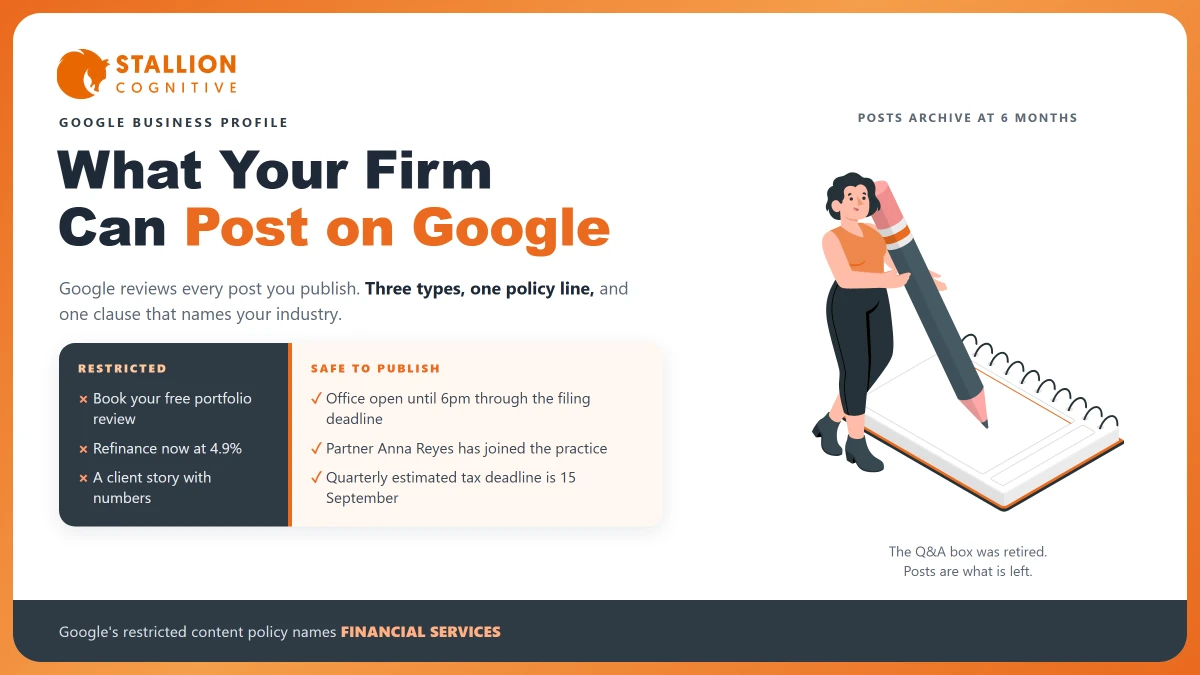
The lifespan is the part most firms have wrong. Google states that "Posts older than 6 months are archived unless a date range is set." The seven-day expiry echoed across the advice sites, and carried in our own older writing, appears nowhere in what Google has put out.
An update you wrote in March is still sitting there in August. That changes how carefully you ought to write one.
Before any of this is worth doing, the profile underneath has to be real. A post on a listing that is not verified reaches no one, so verify your Business Profile first, and check for a duplicate Business Profile that would split your posting over two records.
Do Google Posts Actually Affect Your Ranking?
Google names three things that decide local results. Posts are not one of them. Its local ranking guidance says that "Local results are mainly based on relevance, distance, and prominence," and it sums up the third as "how well-known a business is," based on "info like how many websites link to your business and how many reviews you have."
The same page carries a line worth reading twice if an agency has ever promised you a position. Google says flatly that "There's no way to request or pay for a better local ranking on Google."
So the posting box is not part of how ranking works. What Google does say about profile content is tighter and more use, which is that "Businesses with complete and accurate info are more likely to show up in local search results." Accuracy is the quality named there. Volume of posting is not named anywhere near it.
That leaves posts doing a job worth having, just not the one they get sold for:
- They answer a question before the call: A prospect reading your profile at 9pm can see that you handle probate, or that the office closes at 4pm on Fridays.
- They fill space a rival's profile leaves empty: Two firms side by side in the results, one current and one blank, look nothing alike to a human being.
- They give a reason to click through: The action button sends someone to a page you control rather than leaving them on Google.
Measure them on that basis. If your profile is not appearing at all, posting more often will not fix it, and the reasons a listing stays hidden are covered in why a listing goes missing.
The Policy Line That Names Financial Services
The clause below is where advice written for shops stops working for your firm. Google's prohibited and restricted content policy, under the heading Restricted content, states:
The content you upload may not feature calls to action or offers for the sale of products or services that are subject to local legal regulations. This includes, but is not limited to, alcohol, gambling, tobacco, guns, health and medical devices, regulated pharmaceuticals, adult services, and financial services.
Read the scope closely, because the clause is narrower than it first looks and the difference is the whole practical point. What it restricts is a call to action or an offer tied to the sale of a regulated service. A firm posting about itself falls outside that.
That gives you a working line to write against:
- Restricted: "Book your free portfolio review, this month only." A call to action tied to the sale of a money service.
- Restricted: "Refinance now at 4.9%, apply through the link." An offer for a regulated product.
- Fine: "Our Ballston Spa office is open until 6pm through the filing deadline."
- Fine: "Partner Anna Reyes has joined the practice, working with owner-managed businesses."
- Fine: "The quarterly estimated tax deadline is 15 September."
A second clause on the same page reaches further than most firms expect. Google does not allow content "that contains private or confidential information such as personal financial information, government-issued IDs, contact information linked or associated with a name, or sensitive information."
So the client's win story is out. It is exactly the post a content calendar asks for, and exactly the post that clause was written about.
What a Compliant Post Looks Like for a Regulated Firm
Write the post as a plain fact about the firm rather than an ask to buy. The test takes a second. If the sentence would need a disclaimer on your website, it needs one here too, and there is nowhere to put it.
| Instead of | Publish |
|---|---|
| Free consultation for new investors, book today | We take new clients in September. The contact page has our intake form |
| Cut your tax bill by 30% with our planning service | The 2026 contribution limits changed in January. Our note explains what moved |
| Best financial advisor in the Capital Region | Our team has worked with closely held businesses in the Capital Region since 2014 |
| Apply now for our retirement package | Anna Reyes speaks on retirement income at the Chamber breakfast on 12 October |
Notice what the right-hand column has in common. Every line can be checked and none of them promises an outcome, which is also why your compliance reviewer waves the whole column through without once asking for a meeting.
That is the difference between a posting habit that lasts and one that dies off in week three.
Events are the safest format you have. An event has a date, a place and a speaker, and none of those is an offer.
Where the Q&A Box Went
For years the standard advice was to seed your own profile with questions and answer them yourself. That advice now describes a feature that is not there.
Google shut the Q&A API on 3 November 2025. Its developer changelog gives the reason in Google's own words, which are that "On November 3, 2025, we will be discontinuing the My Business Q&A API as we are in the process of updating the Q&A functionality and user experience." After that date, "you can no longer read or post questions and answers using the API."
The public section followed. Google has put out no help-centre notice, though the article that once explained managing Q&A is gone, and owner reports of the box disappearing run from late 2025 through this year.
The design explains the retirement well enough:
- Anyone could answer, including a rival firm or a former client.
- Other users picked the winner, since the answer shown was the one with the most votes rather than the one from you.
- Wrong answers stayed up for years, because nothing expired and no one was reading them.
For a firm that answers to a regulator, a public box no one was running, where a stranger explains what you do was always a liability sitting beside the asset. Does your current profile strategy still assume it exists? Any document recommending a Q&A section is out of date, and the questions clients used to ask there now need answering somewhere you control, meaning the profile text, the services list and your own site.
Why Your Post Came Back Not Approved
Google reviews each post after you publish it, and the status shows as Live, Pending or Not Approved. A rejection is a content call rather than a profile one, though a run of rejections draws the sort of notice that leads to a Business Profile suspension, which costs weeks rather than minutes.
What sends a professional firm's post back:
- A regulated call to action: The clause quoted above, and by far the most common cause for firms in finance, law and insurance.
- Client detail: Names, figures or facts that fall under that same private-information clause.
- Contact details in the body text: Phone numbers and web addresses belong in the profile fields and the action button.
- Claims you cannot back up: Best, top-rated and number one all invite a closer read.
- Repeated text: The same paragraph posted again and again reads as machine-written filler.
A rejected post needs rewriting rather than resending.
Sending the same words twice is what turns a content call into a profile one.
What Posting Cadence Can You Defend?
Google names have no required rate, and any specific number you have been given came from somebody's observation rather than from Google. What the guidance does establish is the six-month archive window, and that tells you the useful thing. A post is not a throwaway status update, and a thin one sits on your profile for half a year.
So write to the calendar your firm already has:
- Deadlines the client can act on, which most firms have a dozen of.
- Changes to hours, address, staff or service lines, which are accurate work as much as marketing.
- Events you were holding anyway.
- Nothing at all, in a quiet month. An empty week beats a made-up one.
The rest of the profile carries more weight than the posting box, and reviews are the part Google names directly under prominence. If the profile has four reviews, the work with the highest return is asking clients for reviews rather than another Monday update. A quarterly local SEO audit picks up both in one pass.
The Rules That Actually Bind You
Posts are a publishing space on an asset that ranks for other reasons. Used well they answer the question a prospect has at the moment they are deciding whether to call, and that is worth a few minutes a month.
What binds you comes down to this:
- You may post. The limit falls on selling rather than on speaking.
- No call to action for a regulated service, which is the clause naming financial services.
- No client detail, under the private-information clause on the same page.
- Six months of shelf life. Write it as something you would be happy to find in February.
Which of your last five posts would survive that list? For most firms the honest answer is two, and the two that survive are the ones no one thought were marketing. Our local SEO work starts by reading the profile against the published policies, because a profile built on advice written for shops carries risks the firm never agreed to take.
Frequently Asked Questions
What happens to your posts if the profile gets suspended?
They stop showing along with the rest of the profile. Winning it back restores the listing rather than the content, so treat anything you publish as tied to the profile's health rather than stored somewhere safe.
Does deleting an old post affect the profile?
Removal takes the content down and leaves the profile itself untouched. Old posts that no longer match your hours, staff or services are worth clearing out, since accuracy is the quality of Google names.
Can posts be scheduled in advance?
Outside tools offer scheduling and the profile itself is limited here. Now that posts archive at six months rather than weekly, a posting queue solves a problem most firms no longer have.
Do photos count as posts?
Photos upload on their own and sit in a separate part of the profile. An update can carry a photo, and a photo alone is not an update, so a firm adding images has published nothing anyone can read.
Can more than one person at the firm publish posts?
Profile access comes in levels, and anyone with a management role can publish. Given the content rules, most firms do better naming one person and having a second read anything that names a service.