
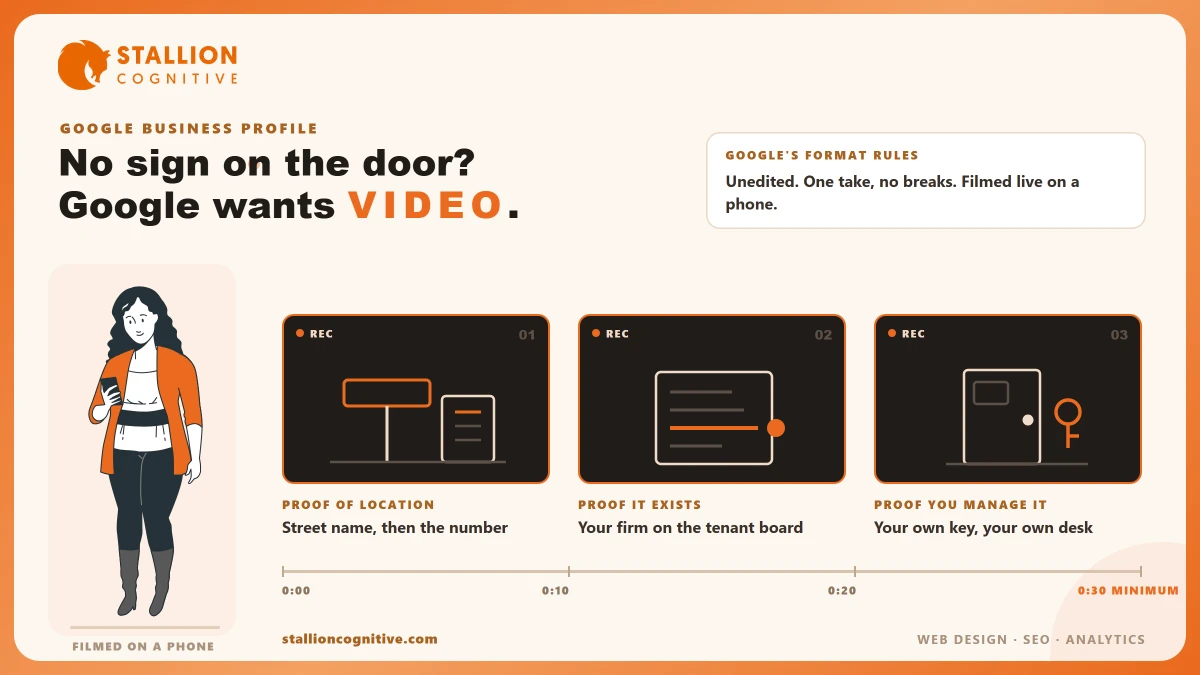
An advisory firm on the fourth floor of a shared building gets to the last step, and Google asks for a video. Film the outside signs. Film the equipment you work with. Film enough of the premises to prove you are really there.
There is no sign with the firm's name on it. The equipment is three laptops. The door to the suite says the landlord's name.
So the video gets filmed anyway, submitted, and rejected. Then it gets rejected twice more, and somebody decides Google has a bug.
Google does not have a bug. The instructions were written for businesses with a shopfront, and passing them from a fourth-floor suite takes a different approach rather than a better camera.
Which Verification Route Will Google Give You?
Whichever one it decides on, and you do not get to choose. Google's own list of verification methods runs to six, and it reads your category, your address type and your history before offering you one of them.
Two firms on the same corridor can be handed different routes.
| Route | What it needs from you | Typical wait | Who tends to get it |
|---|---|---|---|
| Video recording | One unbroken live take on a phone | Up to 5 business days | Most service businesses now, and most shared addresses |
| Live video call | The same evidence, answered in real time | Booked slot | Some regions only, and easier than a recording |
| Phone or text | A code to the listed business number | Minutes | Profiles Google already trusts |
| A code to a domain-matched address | Minutes | Rare, usually where domain and business name agree | |
| Search Console | A website already verified on the same account | Immediate | Firms whose site is verified under a firm Google account |
| Postcard | A code posted to the address | 1 to 2 weeks | Fewer categories every year |
The Search Console row is worth knowing about before you start, because it is the least painful route on the list and firms rarely notice it is there. If your website is already verified under a firm-owned Google account, say so when the option appears.
- Category drives the offer: Service-area categories attract video far more often than retail ones.
- A shared address raises the bar: Suites, floors and coworking desks all read as higher risk.
- History matters: A profile that was suspended or edited heavily gets a harder route.
Nothing you do makes a softer route appear. What route did Google actually offer your firm? Whichever it was, you can arrive at it prepared, and that is where most of the failures turn out to be avoidable.
What the Video Has to Show, in Google's Words
Google names all three of them. Its guidance on verifying with a video recording is clear about the content and just as strict about the format.
The format rules first, because breaking one of them wastes the attempt before anybody watches it.
"An unedited, unique, and complete recording with no breaks", "at least 30 seconds long", "recorded and uploaded from a mobile device".
Live capture is required. A video you shot yesterday and uploaded today will not pass, and neither will one stitched from two clips.
Then the content. Google asks the video to show location, existence and authority, in that order.
| What Google asks for | What a shopfront films | What a fourth-floor firm can film |
|---|---|---|
| Proof of location | Exterior signage with the business name | Street sign, building number, the building's tenant board, then the lift and floor indicator |
| Proof the business exists | The professional tools, equipment, or products you use for work | Headed paper, business cards, client files, practising certificates on the wall, branded screens |
| Proof you manage it | Opening up the shop, using the till | Opening the suite door, signing in at reception, logging into the system you work in |
| One continuous take | Walk the shop | Street to board to lift to suite to desk, in one unbroken walk |
Google also names what to leave out. Do not film "sensitive info like bank account, tax, or ID numbers", private information, or other people's faces.
That last exclusion catches firms out. A walk through a shared reception picks up other tenants and their visitors, so film it early in the morning or angle away from the desks.
Why Professional Firms Fail It
Because two of Google's three proofs assume a physical trade. Read the wording again and the mismatch is plain.
"Exterior signage" assumes a name above a door. "Specialized machinery" assumes a workshop. A financial planner in a serviced office has a landlord's sign, a lift, and a laptop, so a video filmed exactly to the instructions shows a corridor and a stranger's branding.
Which of those two proofs would your building actually give you?
- No exterior name: The building carries the landlord's mark, and yours is on a tenant board at best.
- No equipment that reads as equipment: A monitor looks like any other monitor.
- Shared reception: Filming it captures other firms, which Google asks you not to do.
- A regulated dislike of filming: Client files, screens and letters are all private, so the natural instinct is to film nothing useful.
- The registered address is not the working one: Firms often list an accountant's or a formation agent's address, which nobody can film.
The fourth point quietly causes most repeat attempts.
Faced with client privacy, people film an empty meeting room and a blank desk, which proves a room exists and proves nothing about a business working inside it.
The fifth point is fatal rather than difficult. An address you cannot walk into is an address you cannot verify, and no amount of filming fixes it.
How Do You Film One That Passes Without a Storefront?
Plan the walk before you start recording, because you get one continuous take and no editing. Write the route down, do a dry run without recording, then film it once.
- Start on the street: Capture the street name sign and the building number in the same shot.
- Film the tenant board: Your firm's name in the building's own directory does the work exterior signage would have done.
- Walk in and keep filming: Reception, then the lift, then the floor indicator showing your floor.
- Let yourself in: Open the suite with your own key or card, on camera, without cutting.
- Show the firm inside: Headed paper, business cards, a practising certificate, a nameplate, a branded screen.
- Show yourself working: Sign in to the system you use daily. Do not show what is on the client screens.
- Say who you are: Name yourself and your role out loud, and name the firm.
The Swaps That Do the Heavy Lifting
The two swaps below carry most of the weight. A tenant board stands in for exterior signage, because it is the building's own record of who occupies it. Headed paper and certificates stand in for equipment, because they are the working tools of an advisory business in the same way a machine is for a workshop.
Keep the take under two minutes.
Longer gives a reviewer more to object to, and the floor is only thirty seconds. If a colleague can film while you walk and open the door, that reads better than one hand doing both, and neither of you needs to appear on camera.
What to Do When Verification Is Refused
Send another one rather than start again, and change one thing at a time. A fresh profile inherits none of your history and loses any reviews the existing one holds, so building a second listing is the worst response on the table. It also hands you a duplicate profile to clean up later.
Work through the likely cause in this order.
- Not continuous: The commonest fault, and it includes the pause while you fumble for a key card.
- Location never established: No street sign, no building number, or the board was unreadable on film.
- Nothing proved a business: A room with furniture is not evidence.
- Authority never shown: Nobody opened anything and nobody said who they were.
- Address mismatch: The address on the profile does not match the building you filmed.
Address mismatch needs fixing on the profile before you film again. The rules Google applies to a professional firm's address are the same ones that produce a suspended Google Business Profile, so it pays to settle the address question first.
Support is worth using after two failed tries.
Ask which of the three proofs was missing, because a reviewer will sometimes tell you and the answer saves a third guess. Have you asked, or has the firm simply been filming again and hoping?
How Long It Takes, and What Not to Touch
Up to five business days, on Google's own numbers, and often less. The hard part is that nothing visible happens while you wait, so the temptation is to tidy the profile in the meantime.
So leave the profile completely alone.
- No edits to the name, address or category: Any of the three can restart the review.
- No new photos: They queue behind the verification and add nothing to it.
- No second submission while the first is pending, because they can cancel each other.
- No ownership changes: Moving the profile between accounts mid-review loses the attempt.
- Do keep working on the website, since none of that touches the profile.
The profile stays live in a limited form while you wait, so existing reviews stay visible and the listing does not vanish. What you lose is the ability to be found reliably, which is the point of the whole job and the reason the map pack stays out of reach until this clears.
So use the waiting time well.
Get your name, address and phone number matching everywhere else first, because NAP consistency is what Google checks your video against, and a mismatch you fix now is one fewer reason to refuse.
The Setup That Makes Re-verification Painless
Verification comes round again. An office move, an ownership change, a suspension appeal, or a Google spot-check can all put you back at the same step, so the work is worth doing once properly.
- Own the account: A partner or director on a firm Google account, never a junior's login.
- Get on the tenant board: Ask the landlord in writing, and treat it as an SEO asset rather than an errand.
- Keep a nameplate on the suite door: Cheap, and it is the single most useful prop in the video.
- Keep the address the same everywhere: Website footer, letterhead, directories, the profile.
- Film a reference walk now, while the profile is healthy, so the route is known when you need it.
- Give agencies manager access only: They can work without ever holding the verified account.
Everything on that list also feeds ordinary Google Business Profile optimisation, so none of it is wasted effort if the check never comes round again.
The reference walk is the one people skip and later wish they had. It costs two minutes today and takes the guesswork out of a job that will otherwise arrive on a deadline.
Would your firm pass today, as the building stands?
Where This Leaves You
Google chooses the route, the video needs location, existence and authority in one unbroken take, and the two proofs that defeat professional firms both have workable stand-ins. A tenant board answers the signage question. Headed paper and certificates answer the equipment question.
What follows is worth carrying out of this.
- Never create a second profile: A refusal is a resubmission, and a fresh listing throws away your reviews.
- Fix the address before you film: An address nobody can walk into cannot be verified at all.
- Leave it alone during review: Editing the name, address or category can send you back to the start.
Say you have failed the video twice and cannot work out which proof is missing. That is a short piece of work with a definite answer, and we sort out verification and address problems for financial and professional firms as part of local search work. Have your profile checked before the third attempt, because the pattern is usually visible from the outside.
Frequently Asked Questions
Can our agency verify the profile on our behalf?
They can film and submit as a manager, and many do. Ownership should still sit with a partner on a firm-owned account, because verification travels with the account and an agency that leaves can take the access with it.
What happens to our reviews while the profile sits unverified?
Existing reviews stay visible and clients can keep leaving them. What weakens is how reliably the profile surfaces in Maps and local results, so the reviews carry on arriving while fewer people see them.
Does an unverified profile still show on Maps?
It may appear, usually lower and less often, and Google can restrict parts of it. Treat any visibility you have in this period as short-lived rather than as proof that the check is somehow optional for your firm.
Do we need to re-verify after a partner leaves the firm?
Not for the profile itself, provided ownership sits with the firm rather than the person. Move ownership before the leaver's account is closed, since getting a profile back from a closed account is far harder than shifting it in advance.
Is a coworking desk ever enough for an address?
A hot desk is not, because you cannot show a fixed, staffed base. A private lockable office inside a coworking building can be, provided your firm is on the door or the tenant board and you can open it on camera.