
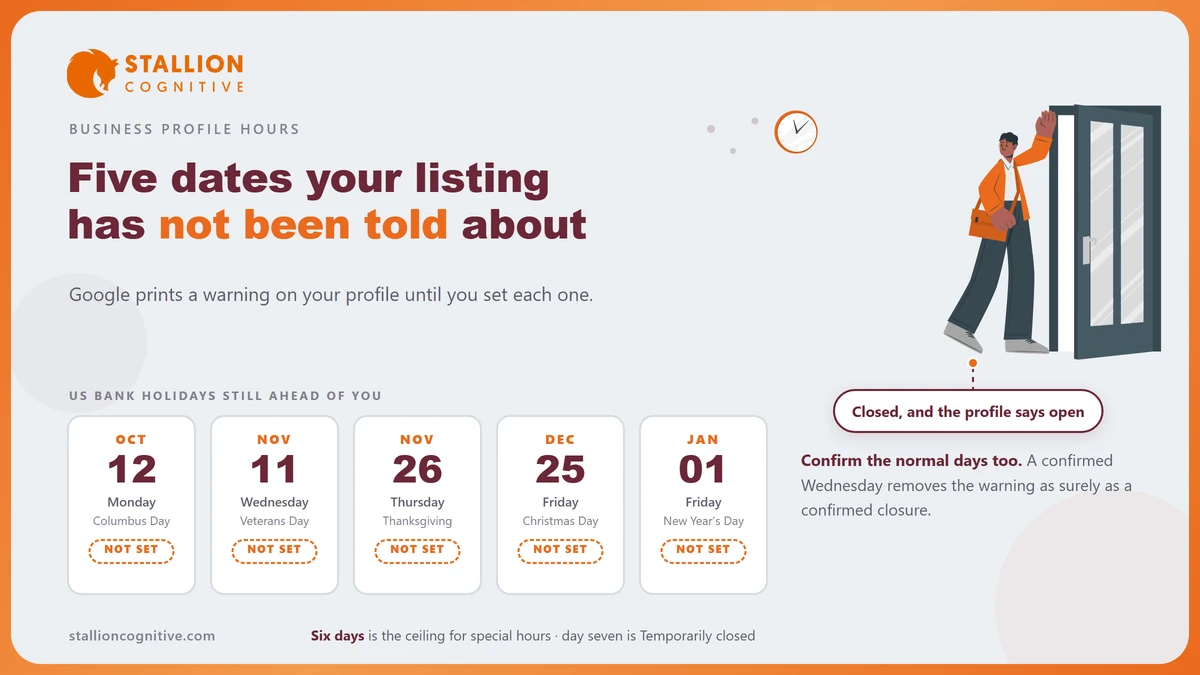
A wrong opening time on Google costs you the client who drove over and found the lights off.
Google Business Profile hours are the field clients check last and firms update least. Most sit untouched since the listing was claimed.
Google knows they go stale, so around every major holiday it prints a warning on your profile saying your hours might differ, and setting special hours is the only thing that clears it.
The whole job takes twenty minutes once a year.
What Google does when your hours go stale
Google does not leave the field blank and hope. It adds a caution to the profile, and that caution is visible to everyone searching your firm's name that week.
The page on holidays on Google states it plainly. On the holidays it lists, "a warning may appear on your Business Profile that tells users your business hours might differ."
The searcher reads it as doubt, and the doubt attaches to you.
- Who looks surer, you or the firm above you? That listing carries confirmed hours and yours carries a hedge, which is a difference the reader notices without naming it.
- It invites a phone call you did not want: Somebody rings to ask whether you are open, and that call reaches a voicemail if you are not.
- It stays until you act: The warning goes when you set hours for the date, and at no other point.
A confirmed holiday closure beats an unconfirmed open. Google's advice is to set the dates even when nothing changes, because confirming that Thursday is normal is itself an answer.
For a firm that takes appointments and not walk-ins, the stakes look lower and are not.
A prospect deciding whether to call at 4:40pm on a Friday is reading that row.
Regular hours, special hours and more hours
Three fields control what your profile says, and most firms have filled in one.
| Field | What it holds | When you touch it |
|---|---|---|
| Main hours | The standard week your door is open | On a permanent change, and after a move |
| Special hours | Named dates that differ from the standard week | Before every holiday, and for any planned closure up to six days |
| More hours | Extra windows for a named service, such as phone cover or drop-off | Once, when the pattern is stable |
More hours is the field nobody knows exists, and it is the one that suits a professional firm best. An accountant whose front desk is staffed until 5pm but whose phone line runs to 7pm in filing season has two true answers to publish, and main hours can only hold one.
The three do not override each other cleanly, so read them as a ladder. Main hours describe the week, special hours describe named dates, and more hours describes a named service.
Getting the standard week right first is the part that pays.
Everything else is an exception to it, and an exception to a wrong baseline is still wrong.
Why do special hours sometimes never appear?
Because one setting has to be right first, and it sits on a different part of the screen. Google's own instruction is direct. For special hours to show on your Business Profile, "set your business hours to Open with main hours."
A profile set to open without main hours will take your holiday dates, save them, show none of them, and warn you about none of it.
Do it in this sequence.
- Open your Business Profile, select Edit profile, then Hours.
- Check the status first, and set it to open with main hours before you touch anything else.
- Fill the standard week, even if it is the same seven rows you would have written five years ago.
- Select the edit control beside Special hours in the Business hours section.
- Review any dates Google has already suggested, then add the ones it has missed.
- For each date, either untick Closed and enter times, or leave Closed ticked.
- Save, then load the profile in a private browser window and read what a client sees.
Saving is not publishing. Read the live profile before you close the tab.
Did the entry actually take? The last step answers that in about ten seconds, and nothing else does.
When should a firm mark itself temporarily closed?
At seven days, and the number is a published threshold rather than a judgement call. Google's special hours guidance allows the field for a business that "temporarily adjusts its hours of operation or remains closed for up to 6 days in a row."
Six days is special hours. Seven days is a different setting, and using the wrong one is visible.
Past that point Google's instruction changes.
- A closure of seven or more days in a row should be marked as Temporarily closed instead.
- The same applies when you do not know how long the closure will last, such as a flood or a lease dispute.
- Temporarily closed is reversible and is designed to be reversed, so it carries none of the finality people fear.
- Permanently closed is a different status again, and it is the one to keep well away from unless the firm has actually shut.
An office refit that runs a fortnight is the case firms get wrong most often. They set fourteen days of special hours, Google treats the pattern as noise, and the profile spends two weeks telling people to come in.
If the listing disappears altogether while you are working on it, that is a separate fault and it is covered in missing from Maps and in what happens with a suspended profile.
The dates a US financial firm has to load before January
Five bank holidays fall between now and the new year, and a professional firm is closed on all five whether or not its profile says so. The Federal Reserve publishes the bank holiday schedule years ahead, which makes this a copying job.
| Date | Holiday | Day it falls on |
|---|---|---|
| 12 October 2026 | Columbus Day | Monday |
| 11 November 2026 | Veterans Day | Wednesday |
| 26 November 2026 | Thanksgiving Day | Thursday |
| 25 December 2026 | Christmas Day | Friday |
| 1 January 2027 | New Year's Day | Friday |
Christmas and New Year's Day both land on a Friday this time round, and that is the pair firms misjudge. Most lose the Thursday afternoon as well and never say so, and the first week of January becomes a two day week that clients will read as normal.
Accounting firms carry a second calendar on top of that one. The IRS gives an automatic six month extension on an April filing date, which puts the extended deadline in mid October and your longest days of the autumn right beside Columbus Day.
Load all five in one sitting, including the ones where nothing changes. A confirmed normal Wednesday is worth as much on the listing as a confirmed closure.
The Federal Reserve also prints the rule for holidays that fall at a weekend. Read it once, so you know which Monday your bank contacts are away.
The twenty minute routine that keeps it right
Do it in one sitting in early autumn, and the profile carries itself for the next fifteen months.
- Set the standard week from the door, and never from what the partners intend to do.
- Load all five holiday dates from the table above in one pass, including the ones where nothing changes.
- Add a more hours entry for anything on a different clock, such as a phone line or a document drop-off.
- Take a screenshot of the finished hours panel and put it wherever your team keeps its annual checklist.
- Diary a five minute check for the first week of December, when late changes tend to arrive.
Why bother with the screenshot? Anyone with access can edit a Business Profile, the history is no help, and it is the only proof you will have when a Tuesday quietly turns into a half day.
Firms that treat this as a diary task get it done. The ones waiting for it to feel important are the ones open on Thanksgiving, and hours feed the trust signals behind Map Pack ranking alongside everything else you publish.
Where that leaves your listing
Hours are the cheapest accurate thing on your Business Profile and the one most likely to be wrong today. Google has made the rules public, published the warning it shows when you leave the field alone, and drawn a hard line at six days.
- Fix the standard week first: Everything else is an exception to it.
- Load the holidays in one sitting: Five dates carry you to next January.
- Stop at six days: Day seven is Temporarily closed, and the two are not interchangeable.
Google also verifies hours by other means, which is worth knowing before one arrives, and Google's automated calls explains what that sounds like. Once the profile is accurate you can read Business Profile performance without wondering whether the numbers are describing a listing that was telling people the wrong thing. If you would rather have the whole profile looked after properly, that is what our local SEO service is for.
Frequently Asked Questions
Our office is appointment only. Should we publish hours at all?
Publish the window in which somebody answers the phone, and use more hours for anything that runs longer. An empty hours panel reads as an abandoned listing to both Google and a prospect.
Can two people at the firm edit the hours?
Anyone with manager access can change them, and the profile keeps no history worth reading. Keep a screenshot of the correct panel so a disputed change can be settled in a minute.
What happens if we simply leave the holiday dates blank?
Google adds its own caution to the listing for that week, telling searchers the hours might differ, so your row carries a hedge while the firm above you shows confirmed times.
Does changing hours affect where we rank locally?
Accuracy feeds the trust signals under local visibility, though nobody climbs by editing a Tuesday. Treat it as removing a reason to be passed over.
We are moving offices in November. What do we set?
Keep the current hours until the last working day at the old address, change the address on the day, then load special hours across the gap. Never mark the firm permanently closed during a move.