
A local SEO report lands in your inbox on the first working day of the month. It carries a rank position, a views figure, a bar chart with more blue in it than last time, and a short paragraph explaining why all of that is good news.
Most of it is hard to read fairly, and the agency is not the reason. The numbers underneath come from a system that counts in a way nobody explains, holds less history than you would assume, and cannot produce the single figure the report puts at the top.
Google documents every part of this. The documentation is spread across help pages that nobody sends you.
Where Do the Local Numbers Live?
Your website analytics cannot see most of what happens on a Google Business Profile. Someone finds your firm in Maps, reads the opening hours, taps the phone number and calls you, and because no browser ever loads your site, Google Analytics records nothing at all.
That call was real business.
It sits in a report you have to open yourself, and Google calls that report Performance. The name used to be Insights. You reach it by searching for your own firm while signed in as the owner, or through the profile manager if you look after several offices. Nothing appears at all unless the profile is verified, which is the first thing to check against an empty screen.
Google's help page for the report lists a dozen things it can show, and about half of them belong to restaurants and shops. An advisory practice, an accountant or a law firm will see these.
- Views: How many people saw the profile on Search and on Maps.
- Searches: The wording people used before it appeared.
- Calls, directions and website clicks: What those people did next.
- Messages and bookings: Only where you have switched those features on.
That list is short enough to read in full every month, which is more than can be said for the report built out of it.
What Does Google Count as a View?
The views number leads every local report, and it is the one most often misread.
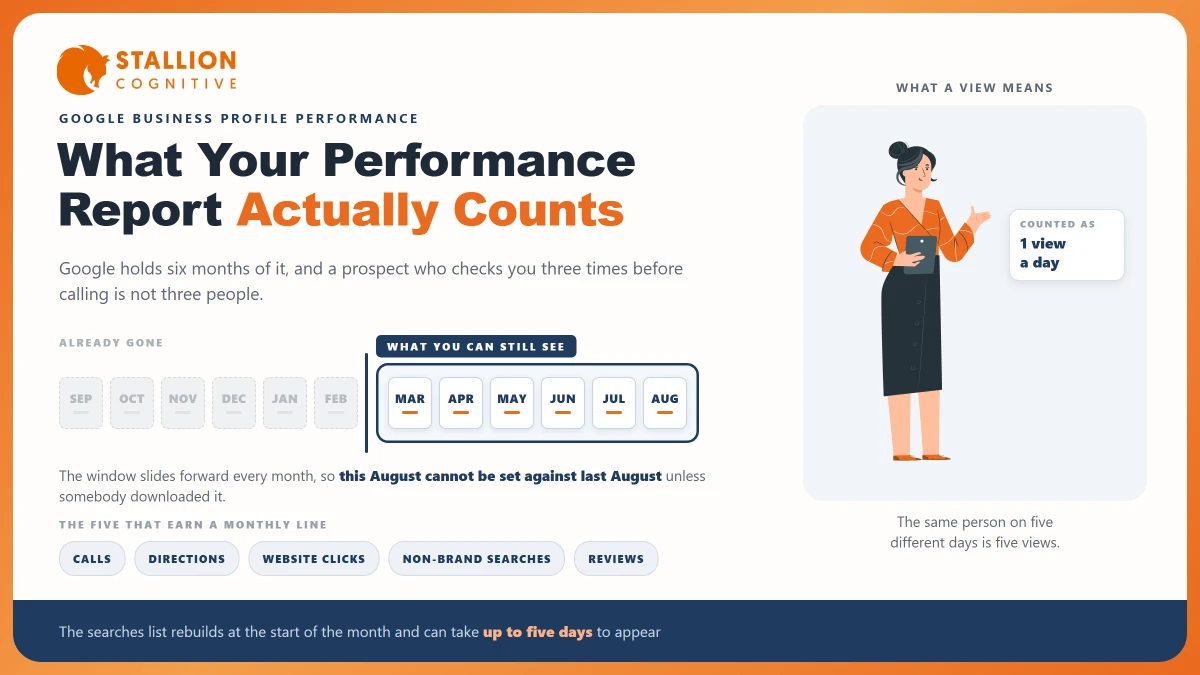
Google counts unique people per day. Its help page for the report says so plainly, that "a user can be counted a limited number of times if they visit your Business Profile on multiple devices, such as desktop or mobile, and platforms, such as Maps or Search. A person can only be counted once a day." The same page adds that Google does not count multiple visits on the same day.
Work through what that does to a monthly total.
A prospect who checks your firm on Monday, again on Wednesday and again on Friday before calling shows up as three views. A different prospect who opens your profile eight times in one afternoon while weighing you against two rivals shows up as one. What the number tracks is days of interest, so an afternoon of hard comparison shopping looks identical to a glance.
| Field | What it does | Worth the effort for a firm |
|---|---|---|
| Name and address | The record everything else hangs from | Yes and it is the reason to claim at all |
| Phone and website | The two taps a prospect actually makes | Yes |
| Category | Decides which searches you are eligible for | Yes and it is the field most often left empty |
| Hours | Shown as open or closed in the moment | Yes |
| Photos | The visual identity on the card | Worth a handful of the office and the team |
| Actions | Buttons sending people to your own site or booking tool | Yes where you take bookings online |
| Showcases | Promotional panels for offers and new items | Rarely since a regulated firm has little to promote this way |
| Location insights | Apple's own view of activity on the card | Read it and expect less detail than Google gives |
Read the right-hand column before you read anyone's chart. Two of those rows explain how a profile can look busy in a month when the phone was quiet.
There is a second gap worth knowing about. Google says the view count "only counts the views of your Business Profile and not the overall views of your business on Google", which is why the figure in the report sits below the one in Google's notification emails.
Both are correct, and they are counting different things.
The Six-Month Wall
Google keeps six months of Business Profile performance data. The clearest statement of it sits in Google's documentation for the Analytics link, which says that "Google Business Profile metrics are available for the last 6 months. Reports in Google Analytics can only display data within this period, even if your selected Google Analytics date range is longer."
Last August has already gone.
What does that cost you in practice? You cannot compare this August with last August, you cannot show a partner two years of direction requests, and you cannot prove the quiet spell in March was seasonal. Month over month is the widest comparison Google leaves open, which makes it the reporting standard by default and never by choice.
The fix is dull and takes about ten minutes a month:
- Open the Performance report and set the range to the calendar month that just closed.
- Download it, which Google offers as a file you can keep.
- Save it somewhere that outlives whoever is currently running your marketing.
- Do the same for the searches list, because that one is built separately.
A firm that started this a year ago can answer questions the six-month window cannot. Everyone else is reading a rolling half year and calling it a trend.
If you have already met Google's data retention settings on the Analytics side, this is the same problem wearing different clothes, and it has the same answer.
Why Is There No Single Map Pack Position?
Every local report carries a rank number near the top. That number is being asked to do something the system underneath cannot support.
There's no way to request or pay for a better local ranking on Google.
Those are Google's words on its own help page, and they are worth holding in view while you read any local proposal that promises a position.
Distance Is Part of the Ranking
Google's help page on improving local ranking names three things it weighs.
- Relevance: How well a Business Profile matches what someone is searching for.
- Distance: How far each business is from the customer who is searching.
- Prominence: How well-known a business is.
Because distance is an input, your position moves as the searcher moves. You might be second for someone standing outside your building, sixth for someone four blocks away, and missing entirely for someone across the county. All three are your real rank. A report printing one of them has quietly picked a spot on the map and hoped nobody would ask which.
What Should You Ask For Instead?
The useful version of the question names a place. Where do we appear for a prospect in the town our office sits in, and where do we appear in the two neighbouring towns we want work from?
That is answerable and worth a good deal more than one digit, so ask for it in this form:
- Our position in the town the office sits in, taken from the town centre.
- Our position in each neighbouring town we want work from.
- The date and the spot on the map each reading was taken at.
Where a firm is missing from the map in places it should be showing, the causes are separate work, and we go through them in the post on not showing on Maps.
Should You Link the Profile to Analytics?
In June 2026 Google connected the two systems, so the local numbers can now sit beside your website numbers in one property. Google describes the point of it as seeing "how people find and engage with your business on Google Search and Maps alongside website and app data".
It is free, it takes a few minutes, and it removes a real annoyance for anyone who has been reading two dashboards and adding them up by hand.
What the documentation says about it will decide whether it suits your firm:
- What comes across: Interactions, website clicks, calls, directions, messages, bookings and menus. The searches list stays behind in the profile.
- Who can do it: An Editor or Administrator role on the Analytics property, plus Owner or Manager permission on the profile.
- What breaks for multi-office firms: Google states that where several profiles are linked, "you won't be able to segment or filter GBP metrics by an individual Business Profile(s)". Three offices become one blended number with no way back.
That last point is the reason a two-office firm should stop and think before switching it on. The six-month wall travels across with everything else, so the link tidies your reporting without adding a single day to your history.
Where the real question is where your leads come from, this helps a little and does not settle it.
The Five Numbers Worth a Monthly Line
A local SEO KPI list usually arrives with a dozen numbers on it, which guarantees nobody reads past the third. The ones below carry information about whether the profile is bringing you work.
| Google Business Profile | Apple Business | |
|---|---|---|
| Published ranking factors | Relevance, distance and prominence, documented | None published |
| Verification | Per location, often by video | By phone, or once for the whole organisation |
| Reviews | Central to the profile and to ranking | Not part of the place card |
| Performance data | Detailed, held for six months | Location insights, lighter |
| Cost | Free | Free |
The fourth row does the most work and gets the least attention. A profile found only by people typing your firm's name is serving people who already knew about you, and Ahrefs measured how much of search that covers when it studied around 150 million US keywords in May 2025 and put branded search volume at 45.7% of the total. When the searches list starts filling with service wording and place names instead, the profile has begun finding strangers.
Now look at what is absent from the table. Photo views, follower counts and a rank position with no location attached all move on their own, and none of them changes what you would do on Monday. The six numbers we use to judge a website leave out the same kind of thing for the same reason.
How Do You Read a Month-Over-Month Change?
One piece of timing spoils more monthly reports than anything else on this page. Google says the searches metric "is updated at the start of each month" and that "it might take up to 5 days to show up". Reports get pulled on the first or the second. The list is often missing or half built, and last month looks like a collapse that never happened.
Pull the report on the sixth. Half the drops people panic about are Google still writing the file.
Beyond the timing, the reading holds up if you compare like with like. A 31-day month against a 28-day month is a four percent gap before anything real occurs, so use whole calendar months on both sides. And treat one month as noise until a second month agrees with it, which matters most for a firm whose work arrives in seasons.
A tax practice reading February against January is measuring the calendar. The same practice reading February against the previous February would be learning something, and that is exactly the comparison the six-month window has taken away from it. The export habit further up this page exists for exactly that comparison, which is the one worth owning.
What to Do This Week
Open the Performance report, set it to last month, and download the file. That one action turns a rolling six-month window into a record that grows.
Then read the searches list with a single question in mind.
How much of this is our own name?
The answer tells you whether the profile is working as a signpost for people who already know you, or as a way of being found by people who do not. The whole job takes about fifteen minutes.
- Download last month's Performance report and keep the file somewhere permanent.
- Read the searches list and work out how much of it is your firm's own name.
- Note the five numbers from the table above, then leave them alone until next month gives you a second reading.
Where the numbers look healthy and the phone stays quiet, the gap usually sits between the profile and the site it points at. Our team is happy to review your site and tell you which of the two is costing you the work.
Frequently Asked Questions
How far back does Google Business Profile data go?
Six months, and no further. Google states its Business Profile metrics "are available for the last 6 months", and reports will not show anything older even when a longer date range is selected. Download each month to build a longer record.
Why is the views figure lower than my notification email?
They count different things. Google says the metric "only counts the views of your Business Profile and not the overall views of your business on Google", so the email figure covers a wider set of appearances across Google.
Can you see who called your firm from the profile?
The report gives a count of taps on the call button and no caller details at all. Pairing that count with your phone records for the same dates is the closest anyone gets to a name.
Does a competitor checking my profile inflate the numbers?
A little, though less than people fear. Google counts each person once per day, so a rival opening your profile repeatedly on one afternoon adds a single view to that day's total.
What should a small firm actually report each month?
Calls, direction requests, website clicks, the searches list and new reviews. Five lines, set against the same five from the previous calendar month, with a note on anything unusual that happened inside the business itself.