
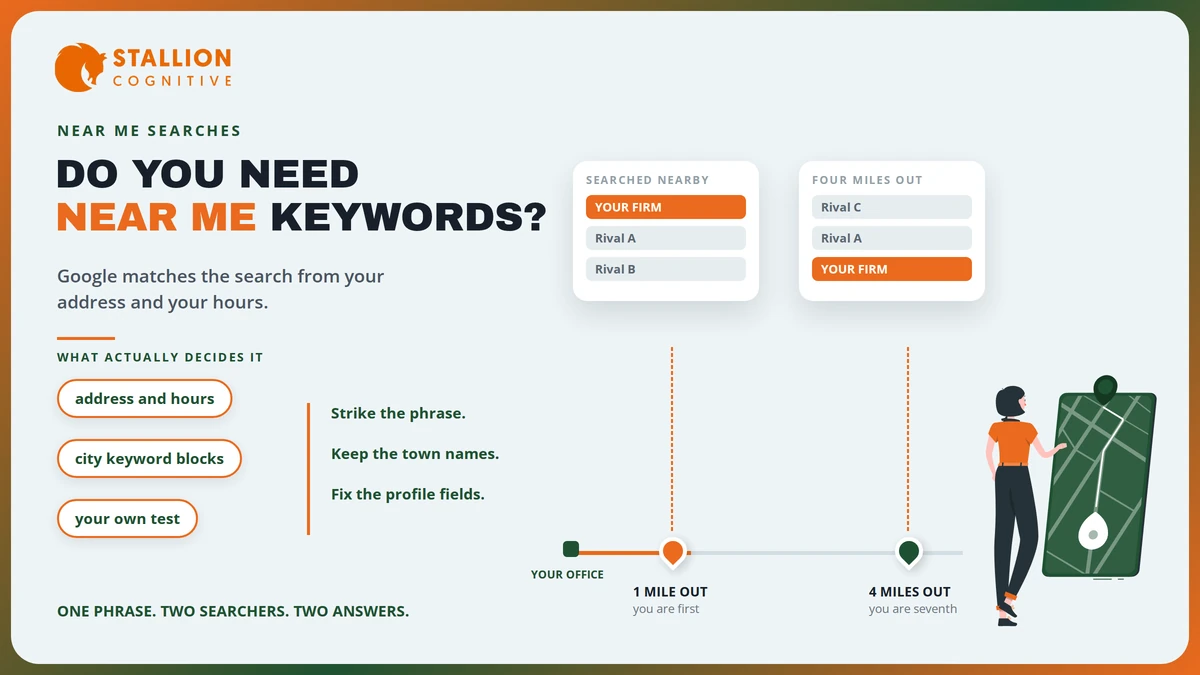
Google matches a near me search using your address and your hours, and nothing you type on the page changes that.
Somebody has probably told your firm to put near me keywords in a title or a service page. It is a common ask, and it fixes nothing.
The searches are real and worth having. What earns them sits somewhere else entirely.
Here is where that place is, and what to stop paying for.
What a Near Me Search Actually Is
It is a phrase with the location left out. Somebody types "financial advisor near me" because typing the town is extra work on a phone, and the phone already knows where it is standing.
That habit rides on hardware most people carry. Pew Research Center found in fieldwork run through 2023 that 90% of US adults own a smartphone, which is the device the phrase was built for.
Three things separate it from an ordinary search, and only the first is obvious.
- The query is incomplete on purpose: The searcher expects the machine to fill in the missing half.
- The answer set is different for every person: Two people a mile apart get different firms in the same order.
- Your own test is worthless: Searching it from your office tells you what your office sees.
That last one causes more wasted meetings than anything else in local search. A partner searches the phrase from the conference room, sees the firm in third place, and takes that back to the marketing meeting as a fact about the market, when all it describes is one building on one network on one afternoon, and the number would have been different from the car park.
Where Does Google Get the Searcher's Location?
The device answers first. Everything else fills the gap. Google's explainer on ranking results states the principle without hedging:
"Our systems can also recognize many queries have a local intent."
The same page says Google uses your location, your past search history and your settings to decide what is most relevant. So the location arrives whether or not anybody types it.
The browser standard behind the precise version is public, and the Geolocation API lists what feeds it:
"Common sources of location information include Global Positioning System (GPS) and location inferred from network signals such as IP address"
| Signal | How precise it gets | When it is used |
|---|---|---|
| Device location | Street level | The phone has permission and the app asked |
| Wi-Fi and cell signals | A few hundred metres | Common indoors, where satellites fail |
| IP address | A district or a city | Desktop, or permission refused |
| Saved home or work | Exact, and often wrong | The searcher set it once and moved |
None of these is a field on your website.
All of them sit on the searcher's side of the box.
Why the Phrase on Your Page Is Not the Match
Google has published a worked example, and it credits the match to your profile. The help page on business information says a hair salon "might appear in local search results for people who search for 'salons near me' or 'salons open now' because you've provided information that includes your address and hours".
Read what is doing the work in that sentence. The address and the hours carry the match, and no phrase on any page is mentioned at all.
Once you see that, the ordinary advice falls apart in three places:
- A page saying near me forty times still sits at whatever distance it sits at.
- A firm with no address and no hours on its profile misses the match with perfect copy.
- A firm two blocks closer wins the pin even with a thinner page, which is the part nobody enjoys hearing.
If your profile is not appearing at all, this is the wrong post. Start with not showing on Maps, because a missing profile cannot match anything.
Does Adding Near Me to a Title Help?
It does not help. At volume it becomes a policy problem. Google's spam policies name the shape of the mistake in their own words, giving as an example of keyword stuffing:
"Blocks of text that list cities and regions that a web page is trying to rank for"
Titles carry a second problem. Google generates the title it shows from the page and from what other sites say about it, so the words you typed may never reach a searcher's screen.
That is a lot of risk for a phrase that buys nothing.
Four steps get you out of the habit without losing anything:
- Take the phrase out of the title and put the service and the town in.
- Check the page still answers the question a nearby client would ask.
- Confirm the address and hours on the profile are right to the suite number.
- Leave it alone for a month before judging it.
It is a smaller job than the one you were sold.
The Business Name Is the Costliest Place to Try It
Some firms give up on the page and put the words in the listing name instead. Google's name guidelines treat that as a violation rather than a tactic:
"Including unnecessary information in your business name isn't permitted, and could result in the suspension of your Business Profile."
The banned additions named there include location information and keywords.
A suspension costs weeks and a fresh verification round.
- The name field is a legal record: It should read the way it reads on your door and your letterhead.
- A rival can report it: Anybody can flag a stuffed name, and competitors do.
- Recovery is slower than the gain: You lose the pin while you argue, during the months you were trying to win.
A firm that has already done this should change it back before somebody else notices, and should verify the profile once the name is clean again.
Where Near Me Language Does Belong
There is one honest use for it, and that use is a question. People do ask near me questions out loud, and a page that answers one in plain language reads well to a human and gives an assistant something to quote.
| Place | What to write | Why it works |
|---|---|---|
| An FAQ answer | Who you serve and how far you travel | Answers the real question behind the phrase |
| A service page line | The towns you actually cover | Specific, checkable, useful to a reader |
| A profile description | Your work and your area in plain words | Read by people deciding whether to call |
| Anywhere else | Nothing | The phrase adds no meaning to a sentence |
The point is that the sentence has to be true and useful without the phrase in it. Write the answer, and the words take care of themselves.
What Actually Puts You in the Near Me Result
Distance is fixed, and the other two inputs are not. Google names distance, relevance and prominence, and only the last two take instruction from anybody at your firm.
- Fill the profile out completely, because the fields are what the match reads.
- Pick the primary category that names the work, since a wrong one hides you from the query.
- Earn reviews steadily, as Google names review count as an input to prominence.
- Build local links from bodies you already belong to.
- Write the service pages for the towns you serve, using the language a client uses.
Nothing on that list involves the phrase. Most of it is the same work described in the map pack guidance, and the budget question sits in what local SEO costs.
The gap between firms is rarely copy. It is usually that one of them filled in the profile and the other filled in a spreadsheet.
Where This Leaves Your Keyword List
Strike the phrase and nothing breaks. The searches keep arriving, because they were never being won by the words in the first place.
- Keep the town names: They belong in page copy where a person would say them.
- Drop the phrase itself: It earns no match and costs you a clean title.
- Fix the profile fields: Address, hours, category, in that order.
- Track it properly: A single position from your own desk is not a reading of anything.
- Judge it in quarters: Local movement is slow and monthly reports exaggerate noise.
A keyword list that survives this cut is shorter and more useful, and it pairs with the way we choose long-tail phrases for a firm with nine pages and no budget for a tenth.
Our team builds and maintains websites for advisers, accountants and law firms across the US, and we take this phrase out of more keyword lists than we put into them. Ask us about SEO if you want the list read before you pay for content against it.
Frequently Asked Questions
Do our competitors gain anything by doing it anyway?
Usually nothing beyond a worse-reading page. Where one of them does outrank you, the cause is almost always the pin, the review count, or a primary category somebody left on a default and never revisited.
How far does a small firm realistically reach?
Reach depends on how many rivals sit between you and the searcher. Downtown that is a few blocks. In a rural county it can be thirty miles.
Does a second office widen what we can be found for?
A staffed second office with its own profile earns a second pin. A mailbox or a hot desk will not, and claiming one anyway puts both profiles at risk.
Can we tell from our reports which visits came this way?
Search Console groups queries, so the phrase turns up as its own rows. Read them as a trend line.
Is any of this different inside Google Maps itself?
Mechanics stay the same while behavior changes. People inside Maps are closer to acting, so your hours, your phone number and your directions carry more weight than anything you wrote.