
Your site probably has a testimonials page. It probably holds five or six short quotes, most of them saying some version of "great to work with," and a first name with an initial.
It probably gets very little traffic.
That page is not useless, but it is being asked to do a job it was never built for, and the job it can do is being spent in the wrong place. Most of what it can achieve is decided by two rules. One comes from Google, about how proof content is allowed to look in search results. The other comes from your regulator, about what a client quote has to say out loud.
Neither rule appears anywhere on the pages now ranking for testimonial page examples, which are all galleries of other firms' layouts.
Testimonials and Reviews Are Not the Same Asset
A testimonial is something you collected, you edited, and you published. A review is something a client posted somewhere you do not control. Both are proof, and they behave in completely different ways.
The table below sorts the three kinds of proof by what each one can do for you.
| Testimonial on your site | Google review | Case study | |
|---|---|---|---|
| Who controls the wording | You | The client | You, with client sign-off |
| Can you remove a bad one | Yes | No | Yes |
| Shows in Google results | No | Yes, on your profile | Sometimes, as a ranking page |
| Carries a number | Rarely | Almost never | That is the point |
| Needs a note for a regulated firm | Yes | Yes | Usually |
Read that third row again, because it is where most testimonial pages go wrong. Firms build the page hoping it will change how they look in search, then leave it alone for three years because nothing about it ever seems to move. The one asset in the table that reliably changes a search result is the one they do not control.
Which is why asking clients for Google reviews and gathering testimonials are two separate jobs with two separate goals. Reviews work on the search result itself, while testimonials work on the visitor who has already arrived on your site and is quietly deciding whether to believe any of it.
Why Will Your Testimonial Page Never Show Stars?
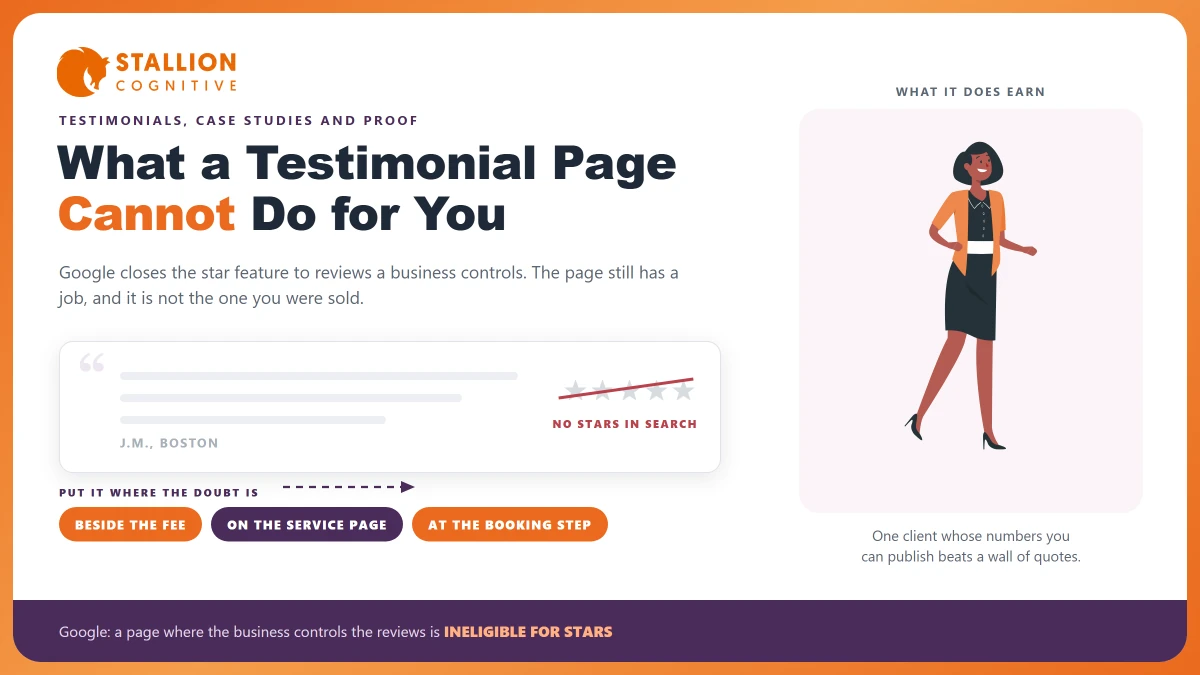
There is an exact reason for it, and Google prints it. In the review snippet docs, Google says that "if the entity that's being reviewed controls the reviews about itself, their pages that use LocalBusiness or any other type of Organization structured data are ineligible for star review feature."
Your testimonials page is the firm reviewing itself, so it does not qualify, and no plugin changes that.
Google closes the workaround in the same place. The rule applies when "a review about entity A is placed on the website of entity A, either directly in their structured data or through an embedded third-party widget." That wording rules out the three fixes firms usually reach for next:
- A widget does not help: Pulling your own reviews back onto your own page does not create the star feature.
- Ratings have to come from users: Google asks that they be "sourced directly from users," which rules out a score you set yourself.
- The markup still has to match the page: Google's general markup rules ask that code describe what a reader can see.
Firms get sold this all the time. A developer or a plugin offers to add review markup so the listing shows gold stars in Google, the markup goes on, the stars never show up, and nobody goes back to find out why the code was never eligible in the first place.
What that leaves is worth being clear about. The page has no search decoration to win, so its whole value is what it does to a human who is already on your site and already deciding.
What a Regulated Firm Has to Put Next to the Quote
If you are an investment adviser registered with the SEC, a client quote is advertising, and the marketing rule has covered it since its compliance date of 4 November 2022. Testimonials are allowed, and they are allowed with strings attached.
The notes have to be clear and easy to see:
- Whether the person is a current client: A quote from someone who is no longer a client, or never was one, has to say so.
- Whether they were paid: Any payment, cash or not, has to be named, along with the terms of the deal.
- What conflicts exist: If the tie or the payment sets up a real conflict of interest, that gets spelled out too.
Two more conditions sit behind the page instead of on it. You need a written deal with anyone you pay for a quote, unless the payment stays at or below $1,000 across the past twelve months. And you cannot pay someone for a quote if you know, or ought to know, they have a barred event against them inside the past ten years.
Accountants and insurance firms sit under other rules, and state-registered advisers under their own state version. So the exact list shifts, while the habit behind it stays the same wherever you are registered.
Whoever regulates you has a view on that page. A wall of praise from "J.M., Boston" tends to fail on who said it before anyone reaches the harder question.
The same tension runs through SEO compliance work in general. The marketing instinct wants the warmest quote on offer, and the rule wants the line that cools it, so both end up on the page.
Where Does Proof Actually Belong on the Site?
One change here moves results more than any redesign of the page itself.
A testimonials page is somewhere people have to choose to visit, and almost nobody makes that choice unless they are already hunting for a reason to say no. They hit doubt somewhere else on the site, and if the proof is not there, they leave with the doubt.
So proof gets moved to the point of doubt:
- Beside the price: Doubt peaks where money shows up. If you publish your prices, the line underneath should be a client saying the fee was worth it.
- On the service page before the home page: A quote about tax work belongs on the tax page, and a broad quote on the home page is wallpaper.
- On the booking step: The consultation booking page is the most nervous screen on the site, and it is usually the barest.
- Next to the person: Your bio pages are where someone checks whether you personally can be trusted, which is where a client's words land hardest.
- On the page itself, last: Keep it. It catches the few people who read everything, and it gives you somewhere to link.
That order is on purpose. The page is the weakest slot, and it is the one most firms build first and only.
When a Case Study Does What a Quote Cannot
A quote says a firm was good to work with. It cannot say what changed, because a client speaking off the cuff has no numbers to hand and could not print most of them anyway.
A case study carries the mechanism, and for a buyer of professional work that is the whole interest. Someone weighing up three accountants already assumes all three are pleasant. What they cannot find anywhere is what happens in month one.
The trade is that a case study costs more to make and needs client sign-off. That is also why your rivals have not written one, and why a case study page can rank for a search a quotes page never will.
A prospect who reads one case study to the end knows more about working with you than a prospect who read nine quotes.
For a regulated firm there is one more limit worth naming early. Return figures drag in their own ad rules, layout demands and time-period conditions. That does not rule case studies out, and it does steer them toward process and outcome instead of returns, which tends to be the better story anyway.
Building a Case Study Page a Prospect Finishes
The failure mode is a case study written like a brochure, where the firm is the hero and the client is scenery. People stop reading those in the first paragraph.
A shape that holds attention:
| Section | What goes in it | Length |
|---|---|---|
| The situation | The client's business and the problem in their words | Short |
| What was actually wrong | The diagnosis, including anything the client had got wrong | Medium |
| What was done | The sequence, and the reasoning behind each step | Longest |
| What changed | The exact result, with the time it took | Short |
| What the client said | One quote, placed after the evidence | One paragraph |
Naming the trade and the rough size does most of the work here. "A 40-person maker of car parts in Ohio" lets a reader place themselves, and "a client in the Midwest" does not. Then put the quote after the evidence instead of at the top, so it reads as backup and not as a claim.
Leave the name out where you must. A named trade, a real number and a cleared quote beat a famous logo with nothing under it.
What to Measure Once It Is Live
Proof content usually gets measured on nothing, which is how it survives for years in the wrong place on a site.
None of these readings needs new software or a new report:
- Does the case study page get search traffic? Case study pages can rank. If yours has been live six months with no impressions, the title is about your firm and not about the reader's problem.
- Do people who see proof book more often? Compare the booking rate on service pages carrying a client quote against those without one. It is a rough sum and still the most useful one you can run.
- Where does the doubt sit? If people reach the fee section and leave, that is where the next quote goes.
A high-converting website is mostly the result of putting the answer next to the question, and proof is an answer.
Where This Leaves Your Testimonials Page
Keep the page. Stop asking it to move your rankings, because Google's own rule shuts the star treatment out and no amount of code reopens it.
Then work through the following, in this order:
- Move your five best quotes off the page and onto the pages where people hesitate.
- Run the notes past compliance before anything goes live, since a page pulled after review costs more than one written right.
- Write up one client whose results you can print with permission.
One real case study will outwork a wall of quotes, in search and in the meeting, and it gives every other page on the site something solid to point at when a reader starts weighing you against the two firms they are also emailing.
We build and optimise websites for financial and professional firms, including the proof on the page that decides whether a visitor books. If you want to know where your own site loses people who were nearly convinced, talk to our team.
Frequently Asked Questions
Can we use a client's full name and photo?
With written permission, and only if the required notes are there too. Many regulated firms use a first name, last initial, trade and city, which is enough for a reader to judge without naming the client.
How many testimonials should the page hold?
Between six and twelve, picked for range of situation instead of for volume. Twenty near-identical quotes read as less believable than six that describe clearly different problems.
Do video testimonials work better than written ones?
They are harder to fake and readers treat them that way. They also carry the same duty to disclose, and the disclosure has to be as clear on screen as it would be in text.
Should we reply to a testimonial the way we reply to a review?
There is nothing to reply to, since you published it. Reply behaviour belongs on platforms you do not own, where a public answer is visible to every future reader.
What if we have no client we can name at all?
Write it up with the name left out, a named trade and a real number, then say plainly why the client is not named. Readers accept privacy from a professional firm without needing the reason spelled out.