
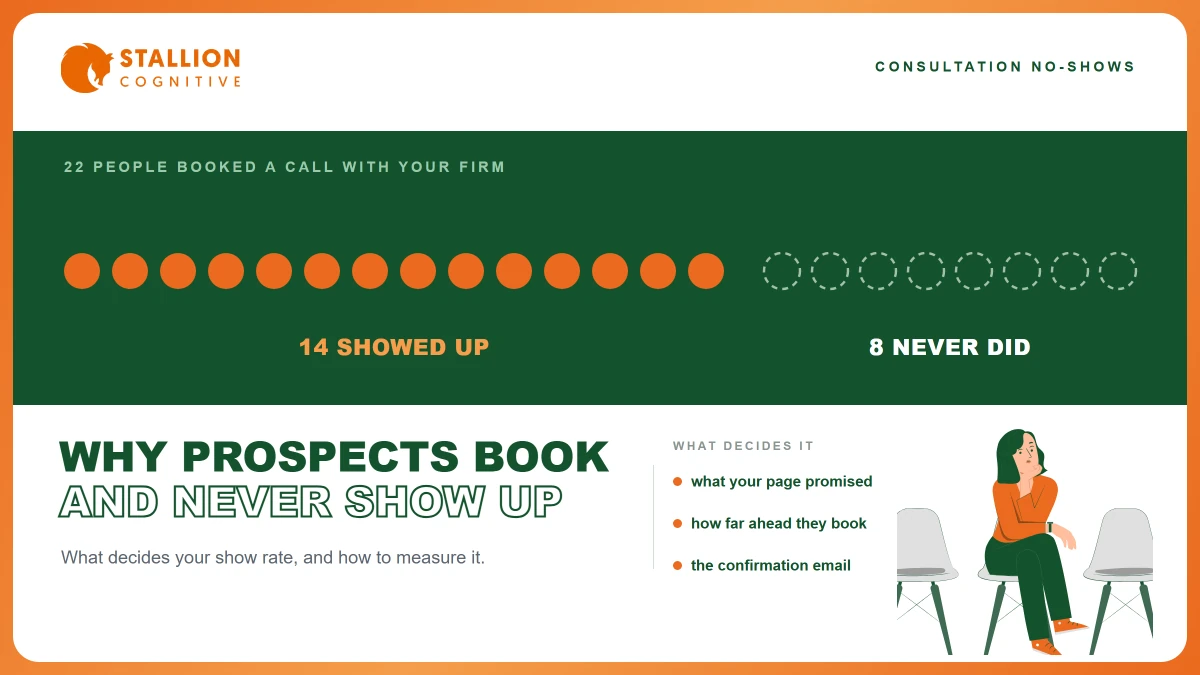
Twenty-two people booked a call with your firm last quarter. Fourteen turned up.
Nobody wrote the other eight down anywhere.
Missed consultations get treated as a calendar problem, so the fix on offer is always another reminder. Reminders help. They also leave most of the gap sitting exactly where it was.
Your consultation booking page settled most of it before any reminder went out — in what it promised the meeting would be, how far ahead it let people book, and what it asked for first.
We rewrite those pages for advisory and accounting firms, and the pattern repeats.
Let's start with the number nobody records.
Why do prospects book a consultation and then not show up?
Booking costs them nothing. Attending costs them an hour. Every no-show lives in the gap between those two prices.
Most explanations stop at forgetfulness. Forgetting is real, and it is the smallest piece.
- They were never qualified: An open calendar accepts anyone, including students, vendors and rivals.
- The meeting had no shape: A quick chat about your needs promises nothing they cannot already get from your website.
- The urgency passed: They booked during a Tuesday panic and felt fine by Friday.
- They found the answer elsewhere: Your own content sometimes finishes the job before you meet.
- The confirmation never arrived: It landed in a spam folder, so they assumed the booking failed.
Read that list again as a website problem. Four of the five were settled before the slot was ever picked.
Is a booked meeting even a conversion?
Only if it happens. A booking is an intention, and your analytics records it as a win the second the slot is taken.
That gap quietly wrecks everything downstream. You tune the page for bookings. Bookings climb, revenue sits still, and nobody can explain why.
Two numbers side by side fix it.
- Booked: How many slots were taken.
- Held: How many of those meetings actually happened.
The ratio between them is the only conversion figure worth reporting on a booking page. Firms watching website enquiries without it measure effort rather than results.
What do reminders fix, and what do they leave behind?
They work. They also stop well short of finishing the job. The clean evidence sits in healthcare, where missed appointments have been studied properly for decades.
A 2016 randomised trial in the International Journal of Pediatrics gave one group a text reminder on top of the standard voice message.
"No-show rate was significantly lower in the intervention group (23.5%) than the control group (38.1%)"
Read both numbers, in that order. The reminder cut absences by nearly fifteen points. Almost a quarter of patients still failed to arrive.
Two honest caveats belong here. These were clinic visits rather than sales calls. A patient feels a missed slot differently from a prospect. The direction still carries across, because the reason is the same. A reminder solves forgetting and touches nothing else.
Why does the wording of a reminder change the outcome?
A reminder is a message, and messages persuade. The same channel, sent at the same hour, gets different results depending on the sentence inside it.
Two randomised trials published in PLoS One in 2015 tested that across nearly 20,000 hospital appointments.
"a message including the cost of a missed appointment to the health system produced a DNA rate of 8.4%, compared to 11.1% for the existing message"
One sentence about cost moved turnout by 2.7 points across ten thousand people.
Nothing in that result is about scheduling software. It is about telling somebody what their absence takes from another party. Your firm can do the same without inventing anything.
- Weak: This is a reminder of your appointment on Tuesday at 2pm.
- Stronger: We have held Tuesday at 2pm for you and pulled your filings ahead of it. Tell us by Monday if the time no longer works.
The second version names a real cost and offers a real exit. Both halves are doing work.
What does a consultation booking page have to do?
Make the promise, mostly. A prospect turns up for a meeting they can picture and skips one they cannot.
Buyers now arrive having done the reading. In HubSpot's 2025 sales report, which surveyed more than 1,000 sales staff, 74% said AI is making it easier for buyers to research products. That is what sellers believe rather than what buyers were measured doing. It still points somewhere useful. A meeting that offers only a general chat is up against a search box that already answered them.
| What the page promised | What the prospect expects | What happens at the meeting time |
|---|---|---|
| Free consultation, no detail | A pitch they can dodge | The highest absence rate we see |
| A book a call button under a service list | Something vague and low stakes | Bookings climb, held meetings do not |
| A 30-minute review of last year's return, bring a copy | A specific piece of work | They arrive, usually with the document |
| An initial meeting at $250, credited to the first invoice | A commitment with a price | Fewest bookings, best attendance |
| Reply and we will find a time | A conversation with a person | Slow, and the strongest hold rate of all |
What the page promised the meeting would be
- Name the length, so an hour never surprises anybody.
- Name the output, whether that is a number, a document or a plan.
- Name who will be in the room, by job rather than by name.
How far ahead your calendar opens
- A slot fourteen days out gives the problem time to feel smaller.
- Capping open slots at seven days lifted held meetings for every firm we have tried.
What you asked for before the slot
- One question rather than a form: What are you hoping to sort out?
- A document, where it fits: Last year's return, the current fee agreement, the policy schedule.
- A phone number: So a same-day change reaches them.
- Nothing else: Every extra field trades a real booking for tidier data.
The qualifying questions that work on a website form work the same way here. A multi-step form is the same idea, split across screens.
Whether your confirmation actually reaches them
- Send the confirmation from your own domain rather than the scheduling tool's.
- Check your sending records are set up, because emails going to spam look the same as a cancelled booking.
- Watch load time on the booking page itself, since slow pages lose people mid-flow.
Do free consultations no-show more than paid ones?
In our client work, every time. A price does two jobs at once, and only one of them involves money.
- It removes people who were never buying.
- It tells everyone left that the hour carries value.
The trade is real and worth naming. Charging cuts the top of the funnel, sometimes hard. A firm that needs volume should not pull that lever first.
A middle option exists and most firms skip past it. Keep the meeting free, then put one qualifying question in front of the calendar. You get the filter without the price barrier.
Listing your fees on the site does similar work earlier in the journey.
What should a regulated firm do differently?
Run intake before the slot rather than inside it. An advisory practice, a CPA firm and a law office all have work to do before agreeing to meet somebody, and an open calendar skips every bit of it.
- Conflicts: A law firm needs to know who sits on the other side before a first talk starts.
- Scope: An adviser cannot say anything useful without knowing whether the person has $80,000 or $8 million.
- Records: Whatever gets said in that hour may need keeping, and that call belongs before the meeting.
Scheduling vendors write for salons and clinics, where the booking is the sale. At your firm the booking is a request to be considered.
Treating a request as a sale is what fills a calendar with meetings you should never have taken. One extra field ahead of the slot does more than any reminder ever will.
How do you measure this without buying anything?
A spreadsheet settles it. Five columns, updated weekly. You will know more than your dashboard tells you now.
| Column | What to write | What it tells you |
|---|---|---|
| Date booked | The day the slot was taken | The gap between booking and meeting |
| Date of meeting | The slot itself | Whether long gaps cost you attendance |
| Source | Search, referral, ad or newsletter | Which channel sends people who arrive |
| Held | Yes or no | The figure the whole sheet exists for |
| Outcome | Proposal, no fit, or no contact | Separates a wasted hour from a good one |
Run it a full quarter before changing anything. A show rate built on eleven bookings is noise. We will not act on one either.
Source is the column most firms leave out. It usually proves the most useful of the five. Referrals hold far better than search traffic. A referred prospect has a person to disappoint. Pull lead source data into the same sheet and you will see it inside a fortnight.
A three-partner tax practice in the Capital Region came to us with 44 bookings in a quarter and 26 held. We rewrote what the page said the meeting would cover, capped the calendar at seven days, and added one question ahead of the slot. The next quarter produced 31 bookings and 27 held. Fewer bookings, more meetings, and the partners stopped blocking out afternoons that vanished.
Our limitation, stated plainly. We do not run your intake and we will not rewrite a booking page without 60 days of booked-against-held figures. We have turned down two of these projects because the firm tracked bookings only, and there was nothing to work from.
What should you change first?
Start with the sentence on the button and the sentence in the confirmation. Both are ten-minute edits, and both outrank any new scheduling tool.
- On the page: Say what the meeting covers, how long it runs, and what to bring.
- In the confirmation: Name what you will prepare, and give an easy way to move it.
Then count booked against held for ninety days. What would your own ratio say about the page? If you would rather work through it with someone, our website review starts from those two numbers.
Frequently Asked Questions
How long should a first appointment run?
Thirty minutes suits most first meetings and looks easy to fit on a busy calendar. An hour signals a sales process and gets skipped more often.
Should we offer evening or weekend slots?
Evening slots fill quickly and hold poorly in our work, because they compete with family time nobody defends on a Tuesday. Weekend hours send a signal about your firm that partners rarely intend. Test one before opening both, and watch the held column.
How should we handle a repeat absence?
Offer one reschedule with a short note, then stop offering. A second miss carries real information about fit. Move that person to your newsletter and spend the hour on somebody who arrived.
Does a phone call hold better than a video link?
Phone tends to hold slightly better. It asks less of the person. Video needs a quiet room, a working camera and a tidy background. Offer both at booking and record which one they picked, since the pattern differs by firm.
Should a partner sign the follow-up, or an assistant?
A named partner lifts turnout more than any template we have tested, and the effect is largest at the first booking. People find it harder to skip a person than they do a system. Keep the note to three lines and reply yourself if they answer.