
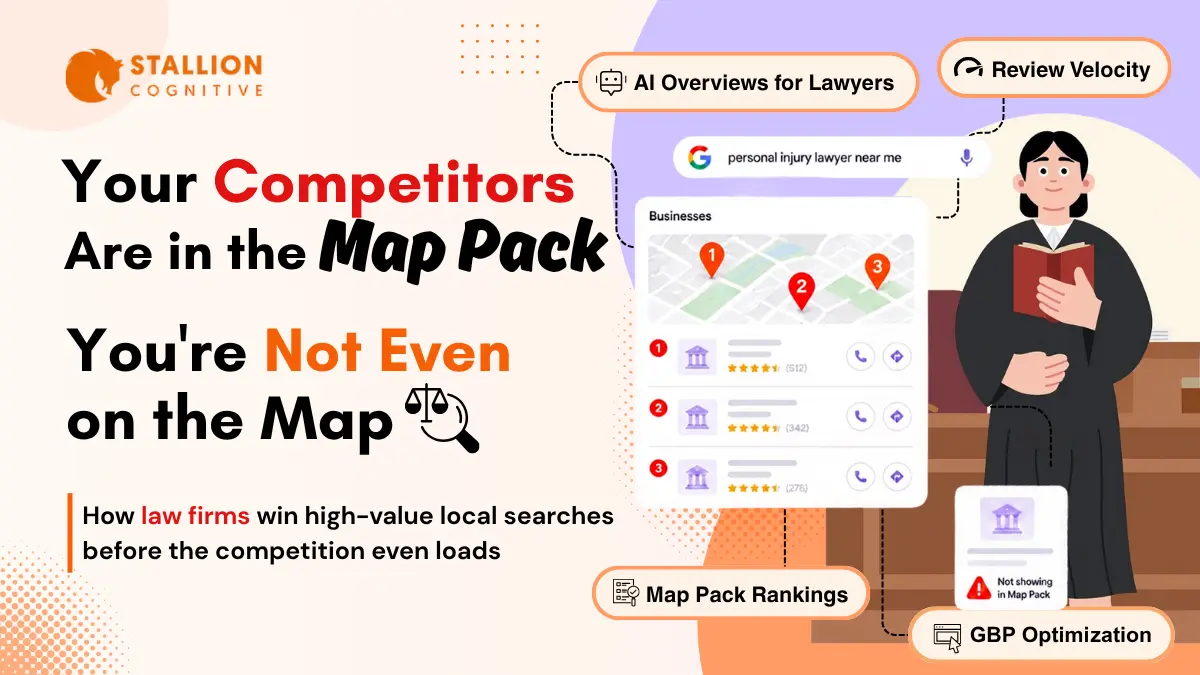
The firm ranking first for "criminal defense attorney Chicago" right now isn't necessarily the most experienced one in the city. It's the most visible in local search. For legal clients who make a call within minutes of hitting Google, that distinction is everything.
Legal clients search with urgency. Someone looking for a DUI attorney at 10 PM isn't browsing five firm websites or bookmarking options for later. They're calling the first credible name they see in those top three map results, and that's the decision made. Local SEO for law firms is built around that moment.
Understanding why legal search behaves differently from other service categories is where every effective strategy starts.
Why Local SEO for Law Firms Works Nothing Like Standard Service SEO
Law firms compete in a search category where intent is almost always urgent and transactional. Someone searching "defense attorney" or "injury lawyer" is ready to call within minutes. Google recognizes this and holds legal content to stricter trust standards than most service categories. Relevance, authority signals, and content depth all carry more weight here.
Most local SEO playbooks treat a law firm the same as a plumber or a dentist. That approach costs practice rankings they should already own.
Legal Search Intent Is Transactional by Default
There are two types of searches competing for a law firm's attention, and each one demands a different response.
Informational legal queries (research phase, slower to convert):
- "how to fight a DUI charge in Texas"
- "what does a personal injury lawyer cost"
- "steps in a criminal defense case"
Transactional legal queries (ready to call, converting fast):
- "criminal defense attorney Houston free consultation"
- "DUI lawyer near me open now"
- "personal injury firm Dallas"
The map pack is built almost entirely for transactional intent. Firms holding those top three spots pick up the calls that turn into retained clients. And here's what we see consistently in audits across competitive legal markets: firms that invest heavily in blog content but leave their Google Business Profile untouched routinely lose to smaller practices with a fraction of the website polish.
Truth is, the map pack doesn't grade your homepage design.
Is Your Google Business Profile Actually Set Up for Legal Searches?
Your Google Business Profile drives the majority of local pack visibility for law firms. According to Google's official local ranking documentation, every local result is evaluated on three factors: proximity to the searcher, relevance of the profile and content to the query, and prominence built through reviews, citations, and links. For law firms, relevance and prominence are almost entirely shaped by how the GBP is built and maintained.
Most law firms have a GBP. Very few have one built to compete.
The GBP Category Problem Costing Law Firms Rankings
The primary category is the single most influential relevance signal you control. Most firms waste it.
Selecting "Lawyer" gives Google zero useful signal about what your practice actually does. Look, most firms miss this because category selection feels like a formality. The right selection by practice area:
- Personal injury: "Personal Injury Attorney"
- Criminal defense: "Criminal Justice Attorney"
- Estate planning: "Estate Planning Attorney"
- Probate work: "Probate Attorney"
- Family law: "Family Law Attorney"
Google added these granular subcategory options over the past year. They match far more precisely to what clients type during urgent searches than a generic tag like "Lawyer" ever will.
Secondary categories cover the rest. List all your practice areas there, but never let the secondaries pull focus from the precision of the primary.
Review Velocity: Why Consistency Outranks Count
Total review count matters far less than most firms think.
What Google actually weighs is review velocity, meaning how consistently new reviews are arriving. A firm with 400 reviews but none in the past three months will often lose map pack position to a competitor with 80 reviews and five new ones this week. Clio's 2025 Legal Trends Report shows that reviews and online reputation are among the primary factors legal clients consider when deciding which firm to contact first.
A small Dallas criminal defense firm ran a simple review request system. They sent a direct text within 48 hours of every favorable outcome with a link straight to their GBP review page. They averaged six to eight new Google reviews per month and moved from position four to position two within a quarter. The consistency of incoming reviews drove it.
Build this into your intake close process:
- Ask within 48 hours of a positive outcome, when client goodwill is at its highest
- Send a direct link to your GBP review page specifically, skipping the homepage
- Aim for five to ten new reviews per month as your baseline target
- Respond to every review within 48 to 72 hours, favorable or critical
Firms that respond to 80% or more of their reviews see measurable improvement in local pack rankings and click-through rates from the results page.
How to Build Practice Area Pages That Win City-Level Rankings
A practice area page ranks when it proves your firm operates in that jurisdiction. Location-specific content referencing local courts, state statutes, and common local charges consistently outperforms generic service descriptions in competitive legal search. Every page needs its own locally-authoritative prose. Templated content across 20 pages gets treated like thin content by Google.
Here's the catch with most practice area pages we audit. They describe what the firm does in terms that could apply to any practice in any state. Google's EEAT framework (Experience, Expertise, Authoritativeness, Trustworthiness) penalizes that hard in legal niches.
| Element | Generic Page | Locally Optimized Page |
| Title tag | "Criminal Defense Attorney" | "Criminal Defense Attorney in [City], Free Consultation" |
| Content depth | General service overview | References Harris County Criminal Courts, Texas Transportation Code |
| Schema | None | LegalService + LocalBusiness with full NAP |
| Internal links | None | Links to related practice areas and contact page |
| Trust signals | None | Bar memberships, case outcomes, client testimonials |
| CTA | "Contact us" | "Call 24/7, same-day consultations available" |
What Google Actually Wants to See on a Practice Area Page
Each page needs to prove your firm actually operates in that jurisdiction.
A Texas DUI defense page should reference Texas Transportation Code sections and mention Harris County Criminal Courts or Tarrant County courts by name, depending on where cases are heard. Readers and Google both recognize the difference between a firm that knows the local legal terrain and one recycling a national template.
We've seen law firms with 30 practice area pages where every single one reads like the same template with a find-and-replace on the practice name. Those pages don't rank.
Every locally-optimized practice area page should include:
- The specific courts and jurisdictions the firm appears in
- State statute references relevant to that practice area
- Local context (how this charge or case type typically plays out in this county)
- A locally-specific CTA with real availability information
If you want to understand the exact signals pushing competitors above you in local search, content depth and local specificity are almost always at the root of the gap.
Winning this in a standard practice area is achievable in most mid-sized markets. Criminal defense in a major metro is a different level entirely.
Criminal Defense Local SEO: Competing in the Hardest Niche in Legal Search
Criminal defense runs at a higher level of competition than most legal niches. In cities like Chicago, Houston, and Los Angeles, you're up against practices that have been building local authority for years, some backed by agencies working exclusively in criminal defense marketing. Getting into the top three in those markets requires the full picture. GBP optimization, citation depth, locally specific content, and schema markup all have to be in place.
Citations, Directories, and NAP Signals for Defense Firms
Citations, meaning your firm's Name, Address, and Phone number consistently listed across the web, are a core supporting signal in attorney SEO. For criminal defense especially, directory presence matters because clients in urgent situations often check Google, Avvo, and Martindale-Hubbell before making a call.
Priority sources to establish and actively maintain:
- Google Business Profile: Verified, complete, actively updated with posts and Q&A
- Avvo: Free listing minimum, full attorney profile with practice areas
- Justia: Essential for credibility signals in legal search
- FindLaw: High-authority legal directory, consistent NAP critical
- Martindale-Hubbell: Peer-reviewed rating carries weight with sophisticated clients
- State bar association directory: Primary trust anchor for any practice
- Local Chamber of Commerce: Geographic relevance signal Google recognises
Every character of your firm's name, address, and phone number must match exactly across all of these. "Suite 200" in one listing and "Ste. 200" in another creates a conflict Google reads as uncertainty about your firm's legitimacy. In criminal defense, a margin like that shows up in the rankings.
For major market firms, 60 to 100 consistent citations is the target. Our best local SEO tools guide covers the citation platforms we use for this work, and our local SEO services include a full citation audit as standard.
What's the Technical Layer Separating Page-One Law Firms from Everyone Else?
LegalService and LocalBusiness schema markup tells Google what your firm is, where it operates, and which services it provides. This structured data reinforces your GBP's NAP signals and strengthens Google's confidence in your firm across its entire index. Most law firms competing in the local pack haven't touched this layer yet.
What separates the top three from the next five in competitive legal markets is almost always the technical side. Schema is the highest-impact piece of it.
How LegalService Schema Strengthens Every Practice Area Page
The LegalService schema type, a subtype of LocalBusiness from schema.org, is the most specific structured data type available for law firm pages.
Implement these three schema types across your site:
- LegalService schema on every practice area page, specifying practice area, jurisdiction served, and full contact details
- LocalBusiness schema on your homepage and contact page, with complete address, phone, hours, and geographic coordinates
- FAQPage schema on pages answering common client questions, structured so AI systems can extract and cite individual answers
The FAQPage schema is worth particular attention right now. These are the pages showing up in Google's AI Overviews, the answer summaries loading before traditional organic results on legal queries. Google's structured data documentation walks through implementation specifics, and our GEO vs AEO vs SEO guide breaks down how these answer formats are reshaping local search visibility.
Firms appearing in those AI summaries built clean structured data before their competitors did. The whole system works together. GBP signals, locally authoritative practice pages, clean citations, and schema markup all reinforce each other.
If your firm runs more than one office, the rules shift, and you'll want the dedicated approach in our guide to multi-location local SEO for law firms.
The Firms That Show Up Are the Firms That Win
High-value legal clients don't scroll. They call the first firm in the map pack that looks authoritative, has recent reviews, and clearly operates in their city. By the time someone reaches a fourth or fifth result, they've already made a call.
Firms that build this full system don't just win today's searches. They become increasingly difficult to displace over time because each layer compounds the one before it. A well-maintained GBP feeds review velocity. Review velocity feeds prominence. Prominence feeds ranking. Rankings feed calls.
The practices dominating competitive local legal markets share one thing: they didn't build it once and walk away. Their GBP stays active. Their practice pages stay locally current. Their citations stay clean. New reviews come in every week.
Is your firm's local presence built to compete at that level, or are there gaps costing you cases right now? Book a local SEO audit with our team and let's find out exactly where you stand.
Frequently Asked Questions
How long does it take for a law firm to rank in the local pack?
Consistent GBP and citation work generates first movement within 60 to 90 days. Top-three map positioning in competitive markets typically takes six to twelve months. Criminal defense and personal injury in major metro areas tend toward the longer end of that range.
Are legal directories like Avvo and FindLaw worth the investment?
Free listings on Avvo, Justia, Martindale-Hubbell, and FindLaw pull their weight as citation sources even when they send little direct traffic. Paid upgrades on any single directory are hard to justify before auditing NAP consistency across all of them. Fix the accuracy first, then evaluate premium placements.
Can a law firm rank in the local pack for multiple practice areas at the same time?
Ranking for multiple practice areas from one GBP profile is harder than most firms expect, because Google gives each profile one primary relevance signal. Firms with separate offices can maintain separate profiles for distinct practice areas. A single-location firm typically owns one or two niches thoroughly.
Does the physical location of a law firm's office affect local search rankings?
Proximity to the searcher is among the strongest local ranking signals and one determined entirely by where your office sits. A downtown address in your target city will consistently outperform a suburban one for city-specific searches. Law firms serious about local search factor this into their office location decisions.
What should a law firm include in its Google Business Profile description?
The GBP description should mention your primary practice areas, the cities and counties you serve, and what makes your firm the right call for someone in that specific legal situation. Google doesn't use it as a direct ranking signal, but potential clients read it when deciding between two equally-ranked firms.