
Search for review response advice and you will be told, within about two paragraphs, that replying to reviews lifts your Google rankings. Several pages will tell you Google confirmed it.
Google did not confirm it. What Google published is narrower and more useful than the version in circulation, and reading it properly changes where you spend your effort.
Replying is still worth doing at every firm. The reason is not the one you have been given, the timing works differently than you think, and the reviews that repay a careful answer are not the ones most guides point at.
Does Responding to Google Reviews Help Your Rankings?
Yes, at one remove. The gap between those two is worth holding onto, because Google documents one of them as a ranking input and the other as something different, and most advice on this topic runs them together. Google's page on how local results are ranked sorts everything into relevance, distance and prominence. Reviews sit under prominence, where Google writes that "More reviews and positive ratings can help your business's local ranking."
Replies turn up in a different sentence doing a different job. Google says that "When you reply to customer reviews, it shows that you value their feedback. Positive reviews and helpful replies can help your business stand out." Standing out describes the person reading your profile rather than where you sit.
| What Google names | The wording it uses | Where a reply touches it |
|---|---|---|
| Review count | "More reviews ... can help your business's local ranking" | Replying goes with more reviews arriving |
| Star rating | "positive ratings can help your business's local ranking" | Replying goes with a higher average |
| Replies themselves | "helpful replies can help your business stand out" | Named for readers rather than position |
So where does the gain come from? The chain runs through the count and the rating.
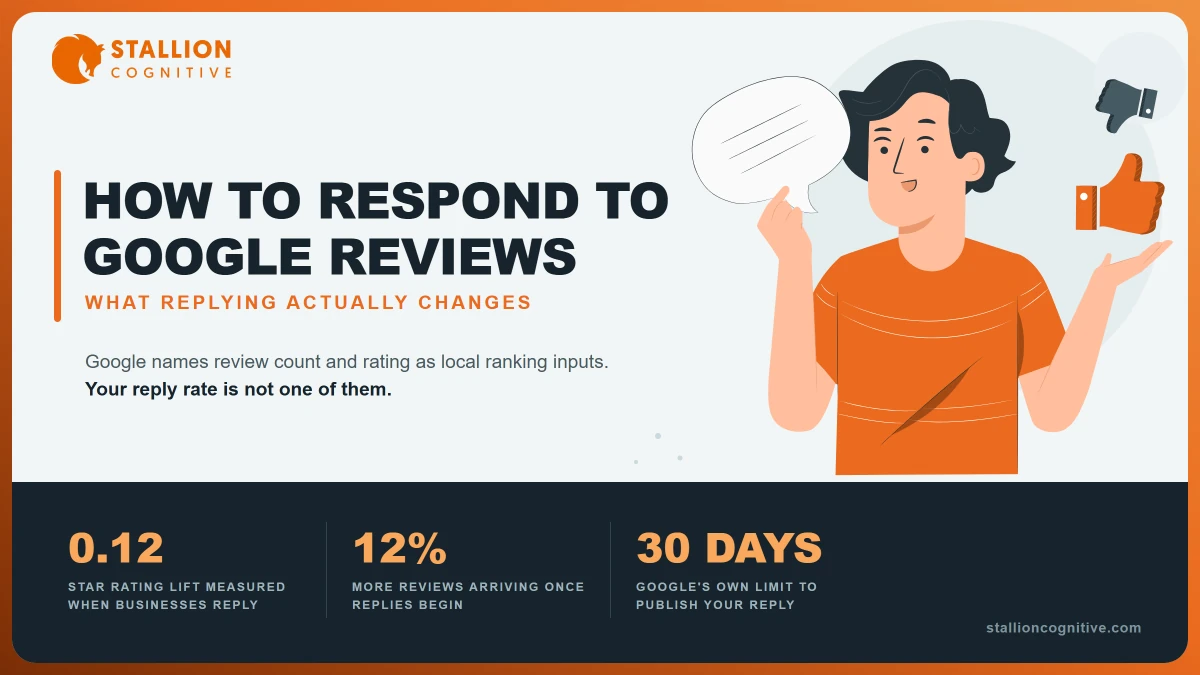
There is measured evidence for that middle step. A study in Marketing Science tracked hotels that started replying to reviews and found a 0.12-star lift in ratings alongside a 12% rise in review volume.
Twelve percent more reviews at a higher average is the exact input Google describes. The mechanism is real. It just runs one step away from the reply, which is why "reply to rank" is the wrong instruction and "reply because it changes what arrives next" is the right one.
Why Does Your Reply Take So Long to Appear?
Because Google screens replies the way it screens reviews. Its own guidance on managing reviews says replies "usually take up to 10 minutes to review, but sometimes a review can take up to 30 days."
Almost every guide on this topic tells you to reply within 24 hours. That advice covers your side of the clock, where it is sound enough, and every firm should still aim to answer the same day rather than the same fortnight. The part nobody mentions is that a reply written on Monday may stay hidden from prospects for a month.
So how do you tell whether the habit is working? Not by looking at the profile.
Four practical facts sit in the same document, and none of them shows up in the popular guides:
- You must be verified first: Replying is locked until the listing is confirmed, so verify your Business Profile before you build a process on top of it.
- The reply posts as the business: Your own name is not shown beside it, which settles one worry partners raise before they agree to reply at all.
- The reviewer gets told: The person who wrote the review hears about your answer, and that is the route behind every case of a client quietly changing what they wrote.
- Replies can be edited: You can change or delete a reply after it goes live, so a clumsy first try is recoverable.
A second listing will also split the effect. Where one exists for the same firm, half your replies land on a record nobody reads, and a duplicate Business Profile needs sorting out before the reply habit means much.
How Do You Respond to the Four Kinds of Review?
Reply to all four, and put your thinking into two of them. Everything a firm meets sorts into a rating with detail, a rating with no words at all, a complaint from someone you know, and a review from a name that appears nowhere in your files.
| The review | What the reply does | What to leave out |
|---|---|---|
| Positive, with detail | Confirms a real client wrote it, briefly | Service names, offers, anything that reads as marketing |
| Positive, rating only | Acknowledges without inventing a story | Thanks for feedback that was never given |
| Critical, recognisable client | Shows the next reader how you handle a complaint | The account, the fee, the outcome, any specifics |
| Not a client, or policy-breaking | Holds the line without confirming anything | Whether you checked your records |
Which of those four do you get most of? For most firms it is the second, and almost nobody writes for it.
The fourth kind has its own rules and its own risks, and we have covered it apart from this in the guide to a fake Google review, including what you can safely say when you cannot confirm the person was ever a client. Read that one before you answer one of these.
The critical review is where the effort belongs
Research in the Journal of Marketing Research split replies to negative reviews from replies to positive ones and found the two run opposite ways:
- Replies to complaints helped: They improved the opinion of people who reviewed later, and a tailored reply helped more than a generic one.
- Replies to praise hurt: The effect ran the other way, and tailoring made it worse rather than better.
The authors read that second finding as doubt. A reader watching a firm work a piece of praise into a sales moment marks down the praise.
So the split is easy. Answer the complaint with care, at length where the case needs it, because the audience is the next prospect reading down the page. Answer the compliment briefly.
What a critical reply looks like when client privacy binds
Thank you for raising this. We would rather work through the detail with you directly than in public, so please call the office and ask for the partner responsible for your file. We take every concern about our service seriously.
Nothing in that confirms a client, describes work, or argues back. It hands the reader one useful signal, which is that somebody is home.
The Star-Only Review With No Comment
A rating with no words is the most common review a professional firm gets and the one no template covers. Clients who would never write a paragraph about their accountant will still tap four stars on the way out of a car park.
There is nothing to answer, which is the whole problem. Thanking someone for their "kind words" when they wrote none reads as a bot, and asking what went wrong on a silent three-star invites a paragraph that was never coming.
So what do you write when the client wrote nothing?
Thank you for the rating. If there is anything you would like to tell us about the work, the office line is always open.
That works for a five and for a two. It notes what happened, asks for detail without pushing, and claims nothing about an experience you cannot see.
The silent one-star is the version that worries people, and it is worth being clear about what it is not. A rating with no text does not break Google's content policy, because a policy breach needs content that breaks a rule.
It stays up. The reply below it is the only part you hold.
The Lines to Cut From Every Template You Find
Most published templates were written for restaurants and shops, and three habits travel badly into professional services. Read any template you find against this list before it goes near your profile.
- The incentive step: Some widely read guides include a step suggesting you offer something to settle a complaint. Google's contribution policy bars offering incentives in exchange for reviews, and a public offer sitting under a review is the version most likely to be read that way.
- The service mention: "We are so glad you loved our tax planning service" turns a client's compliment into an advert, which is the move the research above found produces doubt.
- The named detail: Retail templates tell you to repeat specifics back to the customer. In a regulated firm those specifics are private, and repeating them in public is a disclosure no matter who raised it first.
- The apology that admits a fact: "We are sorry your returns were filed late" confirms a service failure in writing, on a page anyone can read.
- The first-name greeting: Harmless in a coffee shop. On an advisory firm's profile it confirms you know the person, which is the one thing a reply to a disputed review must never do.
How many of those sit in the template you are using now?
Regulated firms have a gap they cannot close
Where a client's praise counts as a testimonial your firm answers for, you may have to attach a disclosure to it. Google gives you nowhere to put one. You cannot edit a client's words and you cannot add a line beneath them, so the reply box is the only surface you have, and it is a poor place for compliance wording.
That is a design problem rather than a writing problem, and it points at three habits:
- One approved form of words, signed off once instead of reviewed reply by reply.
- Short replies, because every extra sentence is another thing to clear.
- Someone qualified looking at the process before the first reply goes out rather than after it.
Who Should Sign the Reply, and How Do You Fix One You Posted?
One trained person, and the fix is easier than most firms assume. Replies publish under the business name, so the question is not whose name shows but who knows the client-privacy limits well enough to write inside them.
Where firms come unstuck is two people answering the same review with different accounts of what happened. That is visible, permanent until edited, and worse than a slow reply.
To correct one that has already published:
- Open the review in your Business Profile and choose the option to edit or delete the reply.
- Rewrite it rather than deleting it outright, since a review with no reply reads worse than a review with a plain one.
- Expect the new version to go back through screening on the same timetable as the first.
- Note what went wrong in whatever document holds your process, because the same gap will produce the same reply again.
Who at your firm holds that access today? At a lot of firms the honest answer is a former marketing supplier.
One more reason to keep replies plain is that they are screened against the same content rules as reviews, and a reply that breaks them can be pulled. A pattern of removals is not the kind of attention a profile benefits from, and anyone who has been through a Business Profile suspension will tell you how much of the firm's visibility rides on that one record.
What a Reply Habit Changes in Your Local Results
Less than the advice promises, and more than the numbers first suggest. A 0.12-star lift sounds like rounding error until you sit it next to a firm with eleven reviews, where one point on average decides whether the profile reads as 4.4 or 4.6 to someone weighing up three names.
Both studies here measured hotels, on travel sites, with far more reviews than a professional firm carries. Neither one measured accountants. The direction of the finding is the useful part, and the size of it in your market is not something anyone can hand you.
What the evidence supports, stated plainly:
- Replying goes with more reviews arriving and a higher average, and those two are what Google names as ranking inputs.
- The gain that has been measured sits with replies to critical reviews.
- Replying to praise is worth doing for the reader, and worth keeping short.
- None of it works on a profile that is unverified, duplicated, or missing from Maps.
That last point is where most firms actually lose. A careful reply habit sitting on a profile with the wrong primary category earns very little, and the profile problems are the cheaper fix.
If your firm is not showing on Google Maps or is not turning up in the Map Pack for the searches that matter, start there and add the reply habit on top.
Which of your last ten reviews got a reply? Our local SEO work begins with the profile and the review process together, because a reply is only worth what the profile under it can carry.
Frequently Asked Questions
Is there a length that works best for a reply?
Short for praise, longer only where a complaint needs it. Four sentences covers almost everything. Length signals effort, and effort spent defending yourself in public reads worse to the next reader than a brief, calm answer.
What should we do when a review mentions our fees?
Address the principle and never the amount. You can say that pricing is discussed before any work begins and offer to go through it privately. Confirming what one client paid is a disclosure, even when they raised it first.
Can someone outside the partnership be given access to reply?
Business Profile access comes in levels, so an assistant or agency can be added without handing over ownership. The constraint is training rather than access. Whoever holds it needs to know what cannot be said.
What if the same client posts the same review twice?
Reply once, to the newer one. Duplicate postings usually happen by accident across two accounts or devices. Answering both draws attention to the repeat and makes the profile look thinner than it is.
Does replying change where a review sits on our profile?
Google publishes no ordering rule tied to replies, so treat any claim about pushing a bad review down as guesswork. Ordering shifts with recency and relevance signals that no business controls directly.