
Search your firm's name. If a box shows up down the right side of the results with your logo, address and hours in it, you have a panel. If nothing shows up, someone has probably told you this is a gap worth paying to close.
The advice you will find is very consistent, and it is also aimed at someone else.
Almost every page ranking for this question gives the same five steps, and step three is usually to make a Wikidata entry and work toward a Wikipedia page. That is how famous firms end up in Google's Knowledge Graph, and none of it is available to a twelve-person advice firm.
Following that route tends to produce exactly the kind of news coverage Wikipedia refuses to count.
Google's own help pages give a shorter answer.
What Is a Knowledge Panel, and Which One Are You Looking At?
A knowledge panel is Google's summary of a thing, built from what it holds to be true instead of from any one page. Google is plain about where the data comes from. "Facts in the Knowledge Graph come from a variety of sources that compile factual information."
For a business, two different boxes get called the same name, and they work in different ways:
| Business Profile panel | Knowledge Graph panel | |
|---|---|---|
| What sets it off | A checked Google Business Profile | Enough backing from across the open web |
| Usual subject | Any local firm with a profile | Famous brands and public companies |
| Can you create it | Yes, by checking a profile | No |
| What you can edit | Most fields, straight away | Nothing directly, only requests |
| Realistic for a small firm | Yes | Rarely |
Most firms asking this question already have the first one on offer, and have either not checked it or not filled it in. For most readers that is the whole job, and it is also the step the guides treat as a warm-up before the Wikidata work.
Why Is There No Way to Create One?
Google's knowledge panel page is blunt. Panels "are created automatically by Google Search Algorithm when there is enough information available on the open web."
So there is no form to fill in and no way to apply. That one sentence settles more than it looks:
- Nobody can sell you one: Panel creation is not a thing an outside firm does, though a service by that name gets sold to professional firms and priced well.
- What an agency can improve is the backing, which is worth paying for and is a different product from the one on the invoice.
- Google names the route for a business: The same page says firms "have special Business Profile panels and should use Business Profile to create, claim, and make suggestions to those."
That last line is the one that matters. Google's own instruction, for a business, is to go and use Business Profile instead of building a Wikidata entry.
The Panel Your Firm Can Actually Control
The effort belongs here, and none of it is exciting.
- Check the profile: An unchecked profile can be shown, edited by the public, and merged with a copy without your knowing. If you have not done it, verify your Google Business Profile before anything else on this list.
- Fill every field, including the ones that feel pointless: That means category, service list, service area, hours, attributes and description. Blank fields are why a rival's panel is tall and yours is a stub.
- Look for a second profile: A duplicate profile splits your signals in two, and Google then has to pick which of the two to trust.
- Keep it alive: Google Business Profile posts and fresh photos give Google a reason to treat the firm as current.
- Check that it shows up at all: A full profile that never appears is a different fault, covered in not showing on Google Maps.
None of that is entity SEO as the term is usually sold, and it is the version that works for a firm with one office and no press team.
Who Is the Wikipedia Advice Really For?
It helps to know why the standard advice fails here, or it keeps coming back.
Wikipedia's rule for firms says a company counts if it "has been the subject of significant coverage in reliable, independent secondary sources," and that "only unpaid sources count." Then it lists what does not count, and the list is the problem:
- Press releases, press kits and similar PR material.
- Any paid or sponsored articles, posts and other pieces.
- Brief announcements, standard notices, and routine coverage, which the rule defines to include hiring, product launches and results.
- Brief or passing mentions inside wider articles.
Now read that against what a marketing plan for a professional firm actually produces. Most of it is a release about a new hire, a paid profile in a business journal, or a quote in a round-up. Every one of those is ruled out by name, and the rule closes by saying no firm counts simply for being large. So a firm can spend three years doing everything its marketing plan asks of it, build up a respectable folder of press cuttings, and still sit exactly as far from a Wikipedia page as it did on the day it started.
Wikidata is easy, and it is not the lever
Wikidata is a different project with a much lower bar. Its notability page accepts an item that "refers to an instance of a clearly identifiable conceptual or material entity that can be described using serious and publicly available references."
Your firm clears that bar, and so does almost any registered business. Which is why making the entry does not deliver a panel:
- A signal anyone can create carries little weight on its own, so it cannot be the mechanism.
- Being listed is not the same as being backed up, and the panel turns on backing.
Make the entry if you like, since it is free and does no harm. Just do not expect a panel to follow it.
The Code That Tells Google Who You Are
The part of this you fully control is what your own site says about itself.
Google's organisation markup page is unusual in saying "there are no required properties." So you add whatever applies to you. These are the fields that earn their place:
- Your web address: Google says this helps it "uniquely identify your organization," which makes it the cheapest field on the list to get right.
- Your logo: Google says adding it "can help Google better understand which logo you want to show, for example in Search results and knowledge panels." If the wrong image keeps appearing beside your name, this is usually why.
- Your profile links: Google calls these pages "on another website with additional information about your organization." This is the field that ties the scattered versions of you into one firm.
Placement matters and Google is exact about it. One page describing the firm is enough, and Google says you do not need this block on every page. A plugin repeating it across a whole site adds nothing to how Google names you.
The profiles worth listing are the ones a stranger could check. That means your Business Profile, your LinkedIn page, your entry on the public register, your professional body listing and your Crunchbase record.
For a regulated firm the register entry is the strongest of the set, because it is the one nobody can fake.
One Firm, One Name, Everywhere
Naming fails most often for a dull reason, which is that the firm is not always one thing.
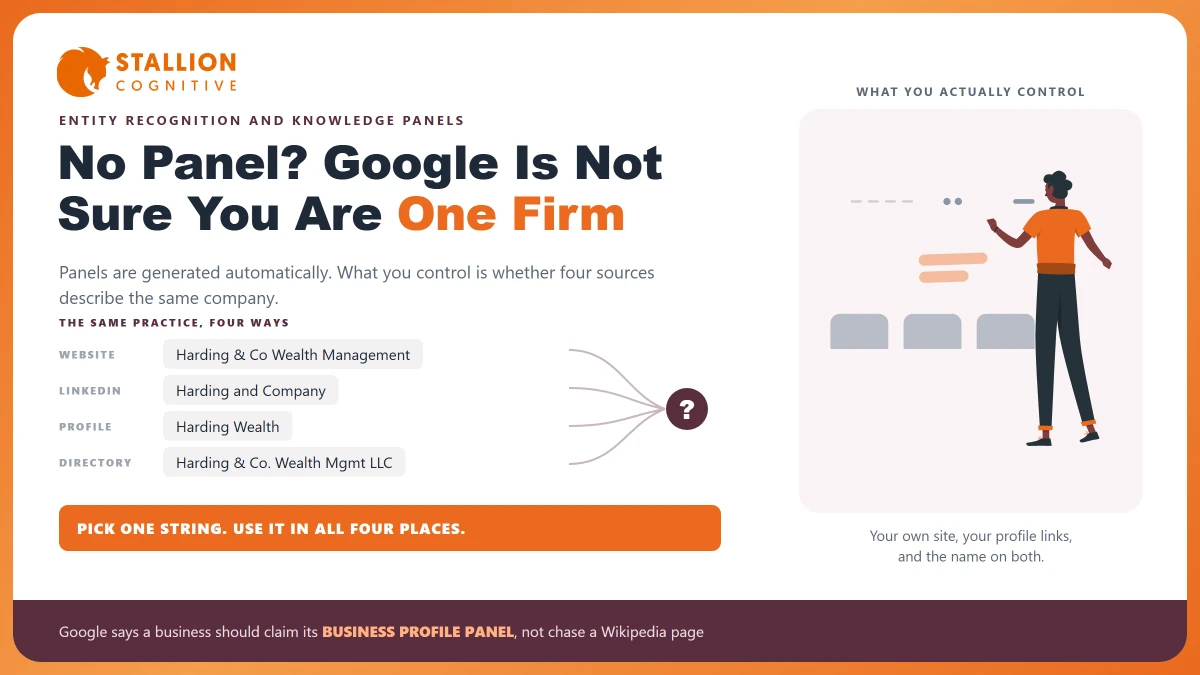
Think about what Google has to sort out when one practice shows up as "Harding & Co Wealth Management" on its website, "Harding and Company" on LinkedIn, "Harding Wealth" on its Business Profile and "Harding & Co. Wealth Mgmt LLC" on three directories.
Each version looks like it might be a different firm, and Google's systems have to work out whether that is one company or four. Until they settle it, you get no panel.
Nothing is being withheld from you, because Google has not yet settled whether the four versions of your name are the same company.
Fixing this is dull and it is the best work on the list:
- Pick the exact legal or trading name you want to be known by, punctuation and all.
- Use that same string on the site, the profile, the register, LinkedIn and every directory.
- Change the ones that disagree, which is the same discipline behind NAP consistency.
- Make sure your bio pages name the firm the same way, since person and firm are tied together through them.
Mentions of the firm by other sites help too, and how those get earned is covered under local link building. The point that matters for naming is that a mention counts even with no link on it, which is also why brand mentions behave differently from backlinks.
When the Panel Shows Something Wrong
Wrong information in a panel is more common than no panel, and the fix is limited by design. If you are the official contact, Google says you can claim the panel and suggest changes, with no guarantee that a suggestion is acted on.
On fixes, Google says it may remove information that is "demonstrably false or outdated" and may decline to act on "facts that are reasonably disputed or lack demonstrative evidence." So the outcome tends to split along these lines:
- Is there a public record behind it? A wrong founding year backed by a filing is usually fixable.
- Is it a matter of taste? A description you dislike, or an old trading name you have moved on from, may not be.
Panels are not edited into shape. The workable route is to fix the source instead of the panel, so update the register, the profile and the directories, then let the backing change behind you.
Where to Start This Week
Search your firm's exact name and see what comes back. Then search the three most common misspellings of it, because that often turns up a second version of you that Google has been tracking.
From there the route depends on what you found:
- No panel at all: Check and complete the Business Profile. That is Google's own advice for a business, and it is the only route with a switch you can throw.
- A panel with gaps: Add organisation markup to one page with your web address, logo and profile links, then make the firm's name identical in every one of those places.
The Wikidata entry can wait, and the Wikipedia page is not the prize it has been sold as. What moves a panel is agreement between sources, which is why the dull naming work beats the exciting work every time.
We build and optimise websites for financial and professional firms, and naming work is part of how we make a firm readable to search and to AI tools that cite sources. If you want to know which version of your firm Google currently believes in, speak to our team.
Frequently Asked Questions
How long does a panel take to show up after we fix things?
Weeks to months, and it runs to no timetable. Profile changes tend to show fastest because Google trusts its own product. Backing from other sites moves at the pace those sites get crawled again.
Does a panel help us rank better?
There is no ranking bonus attached to having one. What changes is how much of the results page your brand fills on a name search, so it affects clicks more than position.
Can a rival's panel show up on our brand search?
It happens when Google is unsure which firm a search refers to, usually where two names are close. Making your own name consistent is the defence.
Should we hire someone to build a Wikipedia page?
Paid editing without saying so breaks Wikipedia's terms, and pages made that way get deleted. The real obstacle is the coverage bar, and no vendor can shortcut it.
Do we need a Wikidata entry at all?
It costs nothing and does no harm, so make one if you want the record to exist. Treat it as housekeeping and expect nothing more from it.