
A prospect who types eleven words into Google has already decided most of what they want. That is the whole case for long-tail work, and it is a strong one for a firm charging five figures a year.
The problem is the tooling. Every number you use to pick those phrases was built for a different kind of business, and two of them mislead you in the same direction.
Here is what that costs. A term your tool calls difficult can be sitting on a page-one result set made entirely of firms your size. A term it reports as zero searches can bring you two enquiries a quarter, which at your fees is a better year than a thousand visitors who wanted a definition.
The rest of this page covers what the scores actually measure, where the phrases come from, and how to decide which ones deserve a page of their own.
What a Long-Tail Phrase Is Worth to a Firm Like Yours
Start with your own arithmetic, because it changes which phrases look attractive.
Take a firm whose average engagement is worth eight thousand a year and which keeps clients for six years. One new client from search is worth tens of thousands over that span, so a phrase with twenty searches a month only has to work once or twice a year before the effort behind it has been repaid several times over. That is a very different test from the one a high-volume business applies, and it is why advice written for ecommerce keeps steering firms wrong.
Marketers judge a phrase on traffic. You are judging it on how likely the person typing it is to become a client. Which of those two audiences is your site written for at the moment?
- What a short phrase brings you: Students, rival firms, people three years from needing anyone, and a bounce rate that tells you nothing.
- What a long phrase brings you: Someone who has named their situation in their own words, which is the closest thing to a qualified enquiry that search produces.
The same logic sits underneath is SEO worth it for a professional firm, and it is worth reading alongside this if you have not run those numbers yet.
Why Does the Difficulty Score Mislead You?
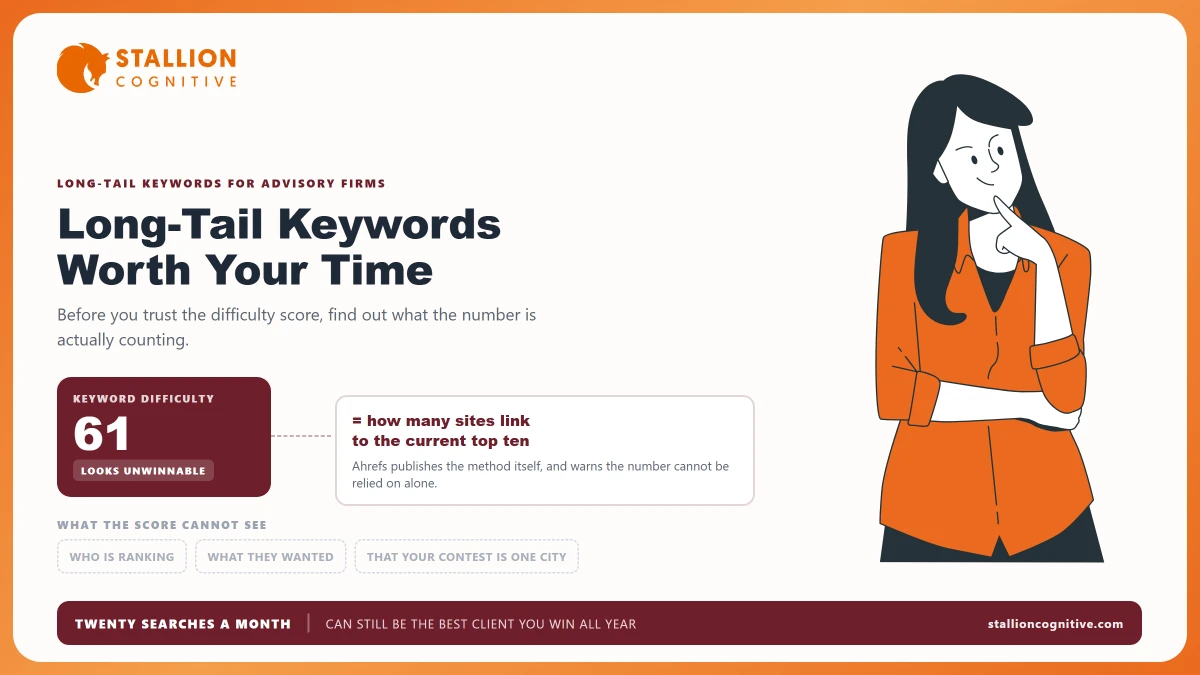
Because it is a backlink count wearing a percentage sign.
Ahrefs is open about the method. Its own glossary says "we pull the top 10 ranking pages for your keyword and count how many websites link to each", then plots the result "on a logarithmic scale from 0 to 100". It goes further and states the limitation plainly. The same keyword difficulty entry says the score "is always only an estimation because Google does not disclose all its ranking factors", and that "you can't rely on keyword difficulty metric alone".
Read that back and the gap becomes obvious. The score has no idea who is ranking, what the searcher wanted, or whether the contest is national.
| What the score measures | What it does not see | Why that bites a local firm |
|---|---|---|
| Backlinks to the current top ten | Whether those pages answer the question well | A thin page with strong links scores as hard and loses to a better page |
| A single national result set | That your result set is your metro area | City-level pages are often small firms with almost no links |
| Nothing about intent | Whether the searcher wants a definition or an adviser | A definitional term looks easy and converts at nothing |
| Nothing about the page type | Whether the top ten are directories and tools | A directory-dominated result set is unwinnable at any score |
The practical move is to stop reading the number and open the results. Look at who holds the first five positions for the phrase, in your city, in a private window. If four of them are firms with one office and a website much like yours, the score is describing a fight you are not in.
The Volume Number Hides the Terms You Want
Google's own documentation explains why your best phrases look dead.
Keyword Planner defines average monthly searches as "the average number of times people have searched for a keyword and its close variants", and separately warns that "your search volume statistics are rounded". Both quotes come from the Keyword Planner help page.
Why would a phrase you know people type report as zero? Google's own help page gives both reasons, and the interface shows neither.
- Close variants get folded together: The specific phrasing that describes your ideal client sits inside a bucket with a dozen others and never appears as its own line.
- Rounding pushes anything small to zero: Which is exactly where a five-figure engagement hides. A phrase reported at zero can still be typed by forty people a year, and forty is a plentiful supply when you need six clients.
Volume is a filter built for advertisers buying clicks at scale, which is a business you are not in.
Where Do High-Intent Phrases Actually Come From?
Not from a tool's suggestion tab. The good ones come from four places, and three of them cost nothing.
- Your own enquiry calls: Write down the sentence a prospect uses to describe their problem before you have explained anything. That sentence is usually a search query already.
- Google autocomplete and the related searches: Type the start of your service plus a qualifier and read what completes. Completions come from real queries, so a phrase that completes has someone behind it.
- The People Also Ask box: Every question in there is a phrase Google has decided is adjacent to your term, which makes it a map of the doubts around your service.
- Search Console, once you have any history: The queries report shows phrases you already appear for and nobody clicks, which is a shorter route to results than inventing new ones. If you are not appearing at all yet, not showing up on Google is the earlier problem to fix.
The fourth source is the one firms skip and it is the richest. You are usually already ranking on page three for a handful of phrases that describe your work precisely, and the fix is a section on an existing page instead of a new one.
Which Phrases Deserve Their Own Page?
Very few of them. A phrase earns a page when it describes a distinct service someone would buy on its own, and when a reader arriving on that page would need nothing else.
Everything else belongs somewhere inside a page you already have.
| Phrase shape | Example of the shape | Where it belongs |
|---|---|---|
| Service plus city | The service you sell, named with your metro area | Its own page, and the anchor of your local work |
| Service plus a client type | The same service framed for one profession or situation | A section on the service page, with its own heading |
| A question about the service | What something costs, how long it takes, what happens first | An FAQ entry or a heading, never a page |
| A comparison | Your approach against the obvious alternative | A single comparison page, never one per rival |
| A definition | What a term means | A blog post, and only if you have something to add |
Rows two and three are where firms go wrong in both directions. Some bury a strong phrase in a paragraph nobody scrolls to, and others build a thin page for a question that would have been three sentences. Grouping the related ones properly is what topic clusters are for, and where two of your pages end up chasing the same phrase you have keyword cannibalization to sort out first.
The Trap of a Page for Every Phrase
The tempting version of this strategy is a page per phrase, generated quickly, one for every city and client type you can think of. Google has a policy with a name for that.
"Scaled content abuse is when many pages are generated for the primary purpose of manipulating search rankings and not helping users."
The spam policies page names three forms of it, and the one worth reading twice is "creating many pages where the content makes little or no sense to a reader but contains search keywords". Note that the policy says nothing at all about how the pages were made. Handwritten and generated pages fall the same way once the pages are thin.
There is a simpler reason to avoid it. Forty near-identical pages give a prospect forty chances to conclude that nobody at your firm writes.
Two or three pages that answer a question properly outperform the alternative every time, and they are also the only version you can maintain. If you want a measure of whether the ones you have are working, a good SEO score explains why the tools disagree about that too.
What This Looks Like on a Nine-Page Site
Picture a four-partner accounting practice with nine pages. There is a home page, three service pages, an about page, a team page, a contact page and two blog posts.
The keyword list that fits that site is roughly fifteen phrases where a spreadsheet would have offered two hundred, and they land in three groups of very different size.
- Three service-plus-city terms: One each on the three service pages, and these are the only phrases that get a page to themselves.
- Six or seven client-type and question phrases: Every one becomes a heading or an FAQ entry inside a page that already exists.
- The remaining four or five: These go on the blog across the next year, one at a time, and only where the firm has something specific to say.
The part that takes the longest
Writing the sections. Adding a heading is quick, and filling it with something a rival could not have written is the actual work.
- A weak section: Restates the service name and the city three times and tells the reader nothing new.
- A section worth having: Names a threshold, a deadline or a number the reader can check against their own situation.
The part firms skip
Checking afterwards. Six months later the Search Console queries report will tell you which of the fifteen did anything, and that list is the input for the next fifteen.
- What to look for: Phrases sitting at position eight to twenty, which are the ones a stronger section can move.
- What to ignore: A phrase with impressions and no clicks, until you have read the title the searcher actually saw.
Measuring it properly is the same discipline as knowing if your website is working at all.
Where This Leaves Your Keyword List
Open the results page before you open the tool. The score is a backlink count and the volume is a rounded bucket, and neither can see that your contest is a handful of firms in one city.
Then be ruthless about placement, because this is where most lists go wrong.
- A phrase that names a service someone buys on its own gets a page.
- Everything else gets a heading, an FAQ entry or a paragraph inside a page you already own.
Fifteen phrases placed properly will do more for a four-partner firm than two hundred in a spreadsheet, and you can actually write them. Our team can build that list against your fees and your city and tell you which of your existing pages should carry it. Start with our SEO services and we will show you the phrases you already rank for and never noticed.
Frequently Asked Questions
Do long-tail phrases work for a brand-new website?
They are the only realistic starting point. A new site has no authority to contest broad terms, and specific phrases have shorter result sets and weaker competitors. Expect months before anything moves.
Should we pay for a keyword tool at our size?
A paid tool helps most with the Search Console history you already own for free. For a nine-page firm site, autocomplete, the People Also Ask box and your own enquiry notes will carry you a long way.
What if a phrase has no reported search volume at all?
Zero in a tool means below its rounding threshold, and not zero people. Judge it on whether a real prospect would type it and whether you can answer it better than the current results.
What changes if we open a second office?
Each staffed location earns its own local terms, and those multiply faster than anything else on the list. Build the second set only once the office has a real address and someone answering the telephone there.
Who should own the keyword list, us or the agency?
Keep it yourselves, in a document you control. An agency should propose and measure it, and a list you cannot see is a list you cannot take with you when the relationship ends.