
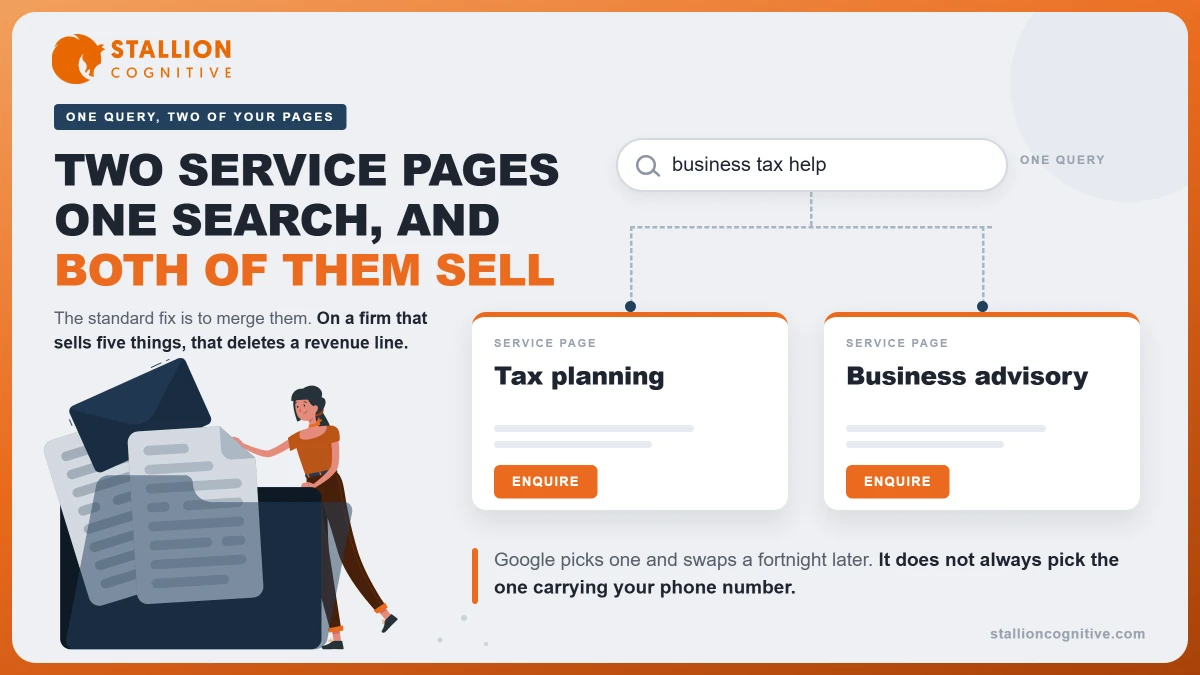
Your firm handles tax planning, audit, payroll, advisory and company secretarial work. Each has its own page. Those pages went up over six years, written by whoever held the marketing budget at the time, and two of them now answer the same search.
Keyword cannibalization is what happens next. Google picks one, swaps to the other a fortnight later, and enquiries land wherever it happened to be pointing that week.
Most advice says merge the two pages. That works on a blog. It falls apart when both pages sell something, because merging them means telling one group of buyers you no longer do the thing.
What Keyword Cannibalization Looks Like When You Sell Five Services
It rarely looks like two identical pages. On a firm with five service lines it looks like two pages that a partner would call obviously different and a searcher would call the same thing.
Somebody searches for business tax help. Your tax planning page and your advisory page both answer to it, in slightly different words.
Four shapes cover almost everything we find in an audit.
| Collision type | What it looks like on your site | How much it costs |
|---|---|---|
| Two service pages | Tax planning and advisory both answer business tax help | High, because both pages take enquiries |
| Service page and blog post | A post about payroll outranks the payroll page | Medium, the traffic still arrives on the wrong page |
| Two location pages | Two office pages written from one template | Medium, and it grows with each new office |
| Two old blog posts | Nobody has opened either since 2023 | Low, and the easiest of the four to settle |
The first row is the expensive one, and it is the row almost no guide writes about. The other three have a page you are willing to lose. That row does not.
Why Most of What Gets Called Cannibalization Is Costing You Nothing
Before anyone starts merging pages, check whether there is a problem at all. A good deal of what gets flagged is a site working normally.
Ahrefs puts the test plainly in its guidance on keyword cannibalization, saying that "you only have a real cannibalization issue when multiple pages target the same keyword and hurt a site's organic performance". Pages rank for hundreds of terms each. Two of yours trading places on one of them, while both hold their other rankings, is not costing you a client.
The sharper version of the test is about intent. Ahrefs adds that the trick "is to look for pages that target the same keywords and fulfill the same or very similar intent". So a page about the cost of an audit and a page about who legally needs one can share a term all year and never take anything from each other, because the people typing it want different things.
Does that describe your two pages, or do they answer the same question twice?
- Fake collision: Both pages appear for one term, both keep their own traffic, and neither has slipped.
- Real collision: Both pages appear for one term, both sit below where either used to be, and clicks fell on both.
- Worst version: The page that ranks is the one with no enquiry form on it.
Run the check before the surgery. Firms lose more from merging two healthy pages than from leaving a harmless overlap alone.
How Do You Find the Real Collisions in Search Console?
Search Console shows you which of your URLs Google actually returns for a query, which is the one thing a keyword tool has to guess at. Start there rather than with software that matches strings.
Open the Performance report and filter to a query you care about. Then switch to the Pages tab with that filter still applied. What comes back settles it.
- A single URL: Google has already made its choice and nothing is competing.
- Two URLs across the period: Google is swapping between your pages as it re-evaluates them.
- Two URLs inside the same week: Both are being shown, and the term is splitting your clicks now.
Does every second URL need fixing? That depends on whether both pages are holding their own traffic, which is the next thing to check.
Running an SEO Content Audit Without Buying a Tool
An SEO content audit for this only needs a spreadsheet and an afternoon.
- Export your top two hundred queries: Sort by impressions rather than clicks, because a collision suppresses clicks and leaves impressions behind.
- Filter each query to its pages: Note every query returning more than one URL over the last six months.
- Mark which pages sell: Put a flag against any URL with an enquiry form or a phone number on it.
- Check the direction of travel: Compare the last three months against the three before. Two pages both sliding is your real list.
- Rank by revenue at stake: A collision on partnership tax advice beats one on a post about office parking.
The pages that come out of step five are usually four or five URLs rather than forty. Most of what a tool flags never reaches this list, which is the point of running it this way. If a page is missing from Search Console altogether, that is a different problem, and not showing up on Google covers where to look.
When Two Service Pages Collide and Neither One Can Go
Here is the case the standard advice cannot handle. Both pages rank for the same term, both split the signal, and both take enquiries for work you actually sell.
Merging them costs you a service line. Deleting one costs you a service line. So the fix has to be separation instead.
Two pages that both convert are a positioning problem rather than a tidying problem. You have two products sharing one description, and the description is the part that has to change.
Service Page Overlap Between Two Things You Both Sell
Separation means giving each page a different buyer, a different question and a different first paragraph. The keyword is the last thing to change, and often it does not need to.
- Split by buying trigger: Tax planning is bought before year end, advisory is bought after a bad quarter. Write each page to its moment.
- Give each one a different lead question: A page that opens by answering what a searcher asked stops competing with a page answering something else.
- Break the anchor overlap: Fifteen internal links reading tax help pointed at both pages is what taught Google they were the same, so internal linking is where the separation gets enforced.
- Let the weaker page point up: If one page really is the main treatment, link to it from the other in the body copy, which is the same move a topic cluster makes.
Location pages behave the same way and go wrong faster, because the template makes overlap the default. Two offices sharing one paragraph of copy is multi-location local SEO done from a copy and paste.
Separation takes longer than merging and it keeps both revenue lines. Most firms we audit have been quoted the merge because it is the faster job to bill.
Does Duplicate Content SEO Carry a Penalty?
No. Google says it directly in its canonicalization documentation, noting that "some duplicate content on a site is normal and it's not a violation of Google's spam policies".
What happens instead is a choice. Google "chooses the page that, based on the factors (or signals) the indexing process collected, is objectively the most complete and useful for search users", and the pages it passes over get crawled less often rather than removed.
Two details in that documentation change how you should act.
- Your canonical tag is advisory: Google describes a canonical preference as a hint rather than a rule, so a tag does not settle an argument between two strong pages.
- The signals do get pooled: Google's guidance on duplicate URLs says consolidation "helps search engines to be able to consolidate the signals they have for the individual URLs (such as links to them) into a single, preferred URL".
So duplicate content SEO is a targeting problem rather than a compliance one. Nobody is going to fine you. You are simply asking Google to pick, and it will pick without reference to which page pays your invoices.
Matching the Fix to the Collision
The right move depends entirely on which of the four shapes you have. Applying one fix to all of them is how firms delete pages that were earning.
| What you found | The move | Why |
|---|---|---|
| Two service pages, both selling | Separate the intent, keep both | Merging costs a revenue line |
| Service page beaten by a blog post | Point the post at the page and trim the overlap | The post keeps its traffic and stops competing |
| Two location pages sharing copy | Rewrite one against its own market | Templates create the collision, rewriting ends it |
| Two dead blog posts | Consolidate into the stronger one | Nothing is lost and the signal pools |
| A page nobody should have built | Redirect it | The links survive the page |
For the last two rows the mechanics are already settled, and content decay walks through consolidating a weak post into a strong sibling. Whenever a URL does come down, 301 redirects carry its links across.
The cheapest fix never reaches this table at all.
Ask which existing page a new page will compete with, at the brief, when changing the answer costs nothing but a conversation. Settling keywords per page at that moment prevents most of what an audit later finds, and the on-page SEO checklist is where that check belongs.
Where This Leaves Your Service Pages
Run the Search Console filter on your five most valuable queries this week. It takes about twenty minutes and it will either produce a short list worth acting on or tell you the overlap you have been worrying about is harmless.
Then hold the line at the brief.
- Before a new page: Name the page it might compete with.
- Before a merge: Check that you are willing to lose the service line.
- Before a delete: Look at what still links to it.
Which of your service pages are answering the same search this month, and do you know which one Google is showing? We run this audit for professional firms most weeks, and the answer is rarely the page the partners expect. Talk to our search team before anyone merges a page that was earning.
Frequently Asked Questions
How often should a firm re-run this check?
Twice a year suits most practices, plus once after any batch of new pages goes live. Firms publishing monthly should look quarterly, since new content is what creates fresh overlap.
What if a blog post outranks the service page it supports?
Treat it as traffic arriving at the wrong door rather than a fault. Link from the post to the service page high in the body, trim the commercial language out of the post, and let the page it feeds do the selling.
Do our Google Ads and organic pages compete with each other?
Paid and organic results occupy separate slots, so one does not suppress the other in the way two organic URLs do. Reporting is where they get tangled, because a visitor may well arrive through both before enquiring.
How long after a fix before rankings settle?
Give it four to eight weeks. Google has to recrawl both pages and re-evaluate which one it prefers, and separated pages usually move before merged ones because nothing needs reindexing from scratch.
Does having similar pages for different cities count?
Location pages built from one template are among the most common versions of it. The test is whether a reader in either city would notice the pages differ. Where they would not, Google does not either.