
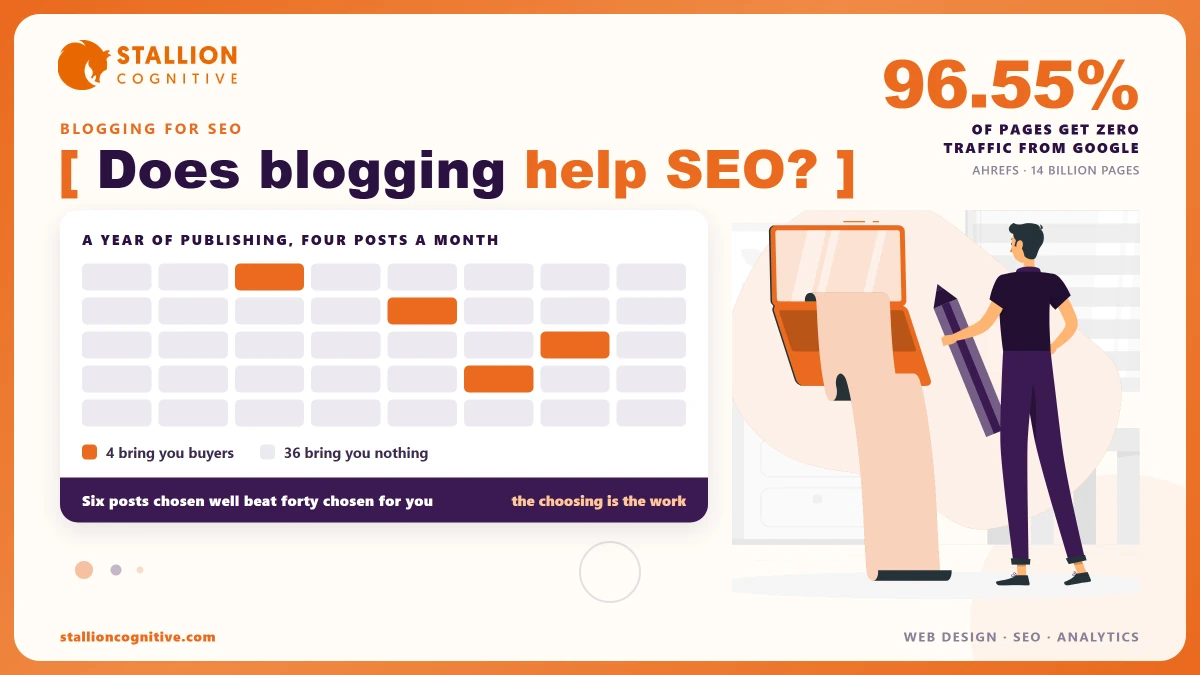
The proposal usually has a line item near the bottom. Four blog posts a month, twelve months, and a figure attached that turns out to be a real share of your marketing budget. Nobody in the room can tell you which four posts, or what happens if none of them rank.
So does blogging help SEO for a firm like yours? Yes, with conditions that most proposals leave out. A blog can bring you people who are actively looking for what you sell, and it can also absorb two years of budget while producing a tidy archive nobody reads.
Effort and word count do not separate those two outcomes. What separates them is which questions you decide to answer, and whether anybody out there is actually asking them.
Does Blogging Help SEO or Just Fill Your Website?
Both, depending on the post. Every page you publish is another chance to match a search, and search engines cannot rank a page you never wrote. That is the whole mechanism, and it is real.
The catch is the base rate. Ahrefs studied around 14 billion pages and found that 96.55% get zero traffic from Google, with a further 1.94% picking up between one and ten visits a month. Those numbers describe the whole web rather than your firm, but they should still reset what a normal month looks like. Publishing forty posts and watching thirty-six of them sit at nothing is the expected result and not a sign that something broke.
Firms get burned the same way each time. The retainer promises volume, volume turns up on time, and the monthly report counts pages published instead of people arriving.
Nobody lied anywhere along the way, and the wrong thing simply got measured.
- A post that ranks brings a small, steady trickle of people who were already searching.
- A post that does not rank still costs the same to produce and still needs updating later.
- A blog with no owner decays quietly, which is a separate problem worth understanding before you scale up. See how content decay works.
None of that argues against blogging. It argues against buying blogging by the kilo.
What Does Google Say About Publishing Volume?
Google publishes a list of self-assessment questions for anyone wondering whether their content is any good. One of them reads like it was written specifically about content retainers.
"Are you producing lots of content on many different topics in hopes that some of it might perform well in search results?"
That question sits in Google's guidance on helpful content alongside two others worth reading aloud at your next agency call. Google asks whether the content is "primarily made to attract visits from search engines" and whether you entered a topic area "without any real expertise, but instead mainly because you thought you'd get search traffic."
Read those three together and a familiar content plan starts to look risky. Forty posts a year across every topic loosely connected to your industry is the exact shape Google describes as a warning sign.
The same guidance asks something more useful, which is whether you have "an existing or intended audience for your business or site that would find the content useful if they came directly to you." That test is easy to run on any proposed post. If a current client would not read it, a stranger will not either.
- Written for a person who has a decision to make and money to spend.
- Written for a crawler in the hope that volume eventually pays off.
- Google's documented position is that the first one wins, and a firm in a regulated field carries a higher bar again because trust matters more when money is involved.
Which Posts Earn Traffic for a Firm Your Size?
A small firm has a narrow band of posts that actually work, and everything outside that band is a hobby. The pattern we see across client sites is simple enough. The winners answer a question a buyer asks in the last week before they pick up the phone.
| What you asked for | What a low-traffic account often returns | Why |
|---|---|---|
| Last week's conversions by city | Blank or partial rows | Narrow date range, low event counts |
| Age and gender of enquirers | Withheld entirely | Age and gender data below the threshold |
| Which search terms brought a page its traffic | Rows missing | Not enough users behind each query |
| Same report over twelve months | Usually populated | Wider window clears the threshold |
That last row matters more than its traffic suggests. A post that earns nothing from Google can still close business if your team sends it to prospects, and it costs the same to write as one nobody uses.
The Trap in the Middle of That Table
Industry commentary feels like the most impressive thing to publish, which is why so much of it exists. It reads well, it flatters the author, and it brings in an audience of people who do the same job as you. Those readers do not become clients.
- Check who linked to your last commentary post, and check whether any of them could hire you.
- Compare that against your cost-and-pricing pages, which usually carry the highest enquiry rate on a professional-services site.
- If your archive is heavy on commentary and light on buyer questions, the fix is a change of topic rather than a change of volume.
How Long Before a Post Does Anything?
Longer than most proposals imply, and less predictably. Google's own SEO starter guide puts it plainly, noting that "some changes might take effect in a few hours, others could take several months," and adding that "there are no secrets here that'll automatically rank your site first in Google (sorry!)."
That range is uncomfortable to sell against, so agencies tend to replace it with a tidier promise, and the tidier promise is usually half a year. As a planning assumption it is fine. As a guarantee it is worthless, because the same post published on two different sites will behave differently depending on what else those sites have earned.
| Report | The question it answers | How often | What a bad answer looks like |
|---|---|---|---|
| Traffic acquisition | Where visitors come from | Monthly | One channel supplying almost everything |
| Landing pages | Which page they arrive on | Monthly | Your money pages absent from the list |
| Events, filtered to form submissions | Did anyone enquire | Monthly | The event does not exist |
| Pages and screens, twelve-month window | What the site is actually for | Quarterly | Old blog posts outranking your services |
The first row is the one worth acting on early. A post still not indexed after a month has a technical problem rather than a quality problem, and the fix belongs in a different conversation about why a site is not showing up on Google.
Everything after that row is a waiting game with occasional useful signals.
How Many Posts Do You Actually Need?
Fewer than you have been quoted, almost certainly. Work it backwards from the enquiries you need instead of forwards from a publishing calendar, and the arithmetic changes the plan quickly.
Say a good post in your niche eventually brings 40 visits a month, and say one in fifty of those visitors enquires. That post produces under one enquiry a month at steady state, which sounds bleak until you remember it keeps doing so for years without further cost. Now assume only one post in five reaches that level, which is generous against the base rate quoted earlier.
The maths gets you somewhere useful. Five well-chosen posts a year, sustained, is a real programme. Forty posts a year on whatever was trending is a budget line with no thesis behind it, and the break-even arithmetic for a firm your size is worth running before you sign anything.
- Pick the questions first. List the ten things prospects ask before they hire you.
- Check somebody searches them. A phrase with no search volume belongs on a sales page instead.
- Write the best answer available, then stop and see what happens for a quarter.
- Update rather than add. A post at position 11 is worth more attention than a new post at nothing.
- Kill what fails twice. Two rewrites with no movement means the query is not winnable for you.
What to Publish if You Can Only Manage Six a Year
Six is enough to matter if you spend them well. The constraint is useful because it forces the choice that unlimited budget lets you avoid.
Start with the questions your own team answers on the phone every week. Those are proven to be things buyers ask, they need no keyword research to justify, and you already know the answer better than any writer you could hire. Cost, timelines, what happens if things go wrong, and how you differ from the cheaper option nearby.
- Two on cost or pricing, because buyers search for money questions and most firms refuse to answer them.
- Two on the service you most want to sell, written for someone deciding rather than someone learning.
- One on the objection you hear most, answered in full, including the cases where you are the wrong choice.
- One on a local or sector question that a national competitor cannot answer as well as you can.
Getting those six technically right is the easy part, and an on-page SEO checklist covers it. Choosing them is the part that decides whether the year was worth it.
How Do You Tell if the Blog Is Working?
Not by the number of posts, which is the metric most reports lead with because it always goes up. A blog that is working shows movement in a specific order, and that order is what you should ask to see.
- Impressions before clicks. A post gaining impressions is being shown and is not yet chosen.
- Clicks before enquiries. Traffic with no enquiries usually means the wrong visitors rather than a broken page.
- Enquiries before revenue. Attribution gets murky here, and knowing where your leads come from is its own piece of work.
Ask for that sequence at every reporting call. An agency that reports published volume and nothing downstream of it is telling you something, and there are other SEO agency red flags worth knowing before renewal.
The Question That Settles It
Twelve months in, ask which specific posts produced enquiries and how many.
- A confident answer names pages. Two or three URLs, with numbers attached to each.
- A vague answer names concepts. Brand awareness, topical authority, laying foundations.
The second kind means nobody has checked, and you have been paying for output rather than results.
Where This Leaves Your Decision
Blogging helps SEO. Buying blog posts by the month, with nobody deciding which questions they answer, mostly helps whoever is invoicing you. The firms that get something out of it publish less, choose harder, and measure further down the funnel than published count.
Three things are worth doing before you sign a content retainer.
- Ask which ten questions the posts will answer, and check each one has searchers behind it.
- Ask what happens in month seven if none of the first six posts has moved.
- Ask who reviews the drafts for accuracy, because in a regulated field that person is also your record.
We look at content plans and search data for professional-services firms most weeks, and the answer is often that six of the forty proposed posts are worth writing. Talk to our search team before you commit to a year of it.
Frequently Asked Questions
Should we delete old blog posts that never ranked?
Rarely deleted outright. Check whether the page earns links or gets used in sales first. If it does neither and duplicates a stronger page, fold the useful parts into that page and redirect. Removal without a redirect throws away whatever authority the URL had.
Can we use AI to write the posts?
Google judges the result rather than the tool. Drafting with AI and publishing with no subject expert reviewing it produces the thin, generic pages those quality questions are designed to catch.
Does the blog need to be on our main domain?
Keep it on the main domain under a subfolder wherever possible. A separate blog domain splits the authority you are trying to build and adds technical work with no upside for a firm your size.
How much should a single post cost?
Wide range, driven by who writes it. A researched post from someone who understands your sector costs several times a generic one and is worth it, because the generic version competes with everything else that was generated the same way.
A rival firm puts something new out every week. Does cadence itself matter?
Check which of their pages actually rank and which queries those pages win. Most weekly publishers earn from a handful of URLs and carry the remainder as dead weight. Match the pages that work for them, never the frequency.