
A website redesign costs $3,000 to $10,000 for most small businesses, and $15,000 to well past $100,000 once the site gets large or complex. That is the honest range, and where your website redesign cost lands inside it depends on how much of the site actually changes.
We redesign sites for a living, and the first thing owners ask is rarely about design. It is whether the whole thing is worth doing at all right now.
That is a fair question, and it deserves a real answer before anyone quotes you.
So this walks through the actual numbers, what moves them, the signs that say you are overdue, and how to tell a quick refresh from a full rebuild before a quote ever hits your inbox. Let's get into it.
How Much a Website Redesign Costs in 2026
Most small business redesigns run $3,000 to $10,000. Mid-market and B2B sites with custom UX and integrations land around $15,000 to $40,000. Large or heavily custom rebuilds climb past $100,000. The biggest single swing is how much you keep versus how much you tear out and start again.
A redesign and a brand-new build get priced differently, and that trips people up. If you are starting from nothing, the business website cost question is the one to read first. A redesign carries existing content, structure, and history, and that can cut the bill or quietly pad it, depending on the shape the old site is in.
| Redesign scope | Typical cost | What it covers |
|---|---|---|
| Template refresh | $500 to $3,000 | New theme, restyle, light content edits |
| Small business redesign | $3,000 to $10,000 | Custom design on a handful of pages, on-page SEO |
| Mid-market / B2B | $15,000 to $40,000 | Custom UX, integrations, content migration, CRO |
| Enterprise / complex | $75,000 to $100,000+ | Full rebuild, custom functionality, large content sets |
Find the row that sounds like your site.
The number still moves inside that row, and the deciding factor is usually one owners have not thought about yet. That is what the next section is for.
What Actually Drives Your Redesign Price
Ask us why one redesign quote comes in at triple another for two sites that look alike, and the answer is a short list of choices. Add more of any one and the price moves.
- How much you keep: Reusing solid content and a working structure is cheap. Rebuilding the whole site structure from a blank page is where the hours pile up.
- Custom or template: A restyled theme is fast and affordable. A design drawn around your brand and your buyer takes real design and development time.
- Content migration: Moving 30 pages is a task. Moving 3,000, with redirects and reformatting, is a project with its own budget line.
- Functionality: A brochure site is one thing. Bookings, client portals, payment processing, and CRM integrations each pile on scope.
- SEO and speed: A redesign that protects rankings and ships with clean Core Web Vitals costs more than a pretty shell that tanks your traffic on launch day.
- Who does the work: A solo freelancer costs less than an agency team, and the gap shows up in strategy, testing, and what happens after go-live.
None of these is the design itself.
You are paying for decisions about scope, and the one owners underestimate every single time is content migration.
Signs You Need a Redesign, and What Each One Costs to Fix
The clearest sign is not how the site looks to you. It is what it does to the people who land on it. When any of the patterns below feels familiar, the real question stops being whether to redesign and starts being how much of the site has to change.
We keep a longer list of signs your website is outdated. The ones below are the expensive kind.
- It falls apart on a phone: When the layout breaks or shrinks on mobile, you are losing most of your visitors. A responsive mobile-friendly fix is sometimes a refresh, and sometimes a sign the whole build is old.
- It loads slowly: A sluggish site bleeds visitors and rankings. The fix can be cheap, or it can expose a bloated theme that only a rebuild solves for good.
- Traffic comes but nobody converts: People arrive, enquiries do not. That is usually a structure and messaging problem, and structure is the pricey part to change.
- You cannot edit it yourself: If every small change means emailing a developer, the CMS is working against you, and moving to one you control is a mid-tier redesign.
- It no longer matches the business: You have added services and shifted your positioning, and the site still tells the old story. This one is rarely a refresh, because the whole message needs retelling.
The pattern across all of these is simple. Cosmetic problems are cheap to fix. Structural ones are not, and most owners find out which they have only once the quote lands.
Redesign, Refresh, or Rebuild?
Three words get thrown around like synonyms and priced nothing alike, so it pays to know which one you actually need before you shop.
The table below sorts them fast.
| Approach | What changes | Typical cost | Right when |
|---|---|---|---|
| Refresh | Colors, fonts, images, light copy | $500 to $3,000 | The site works, it just looks tired |
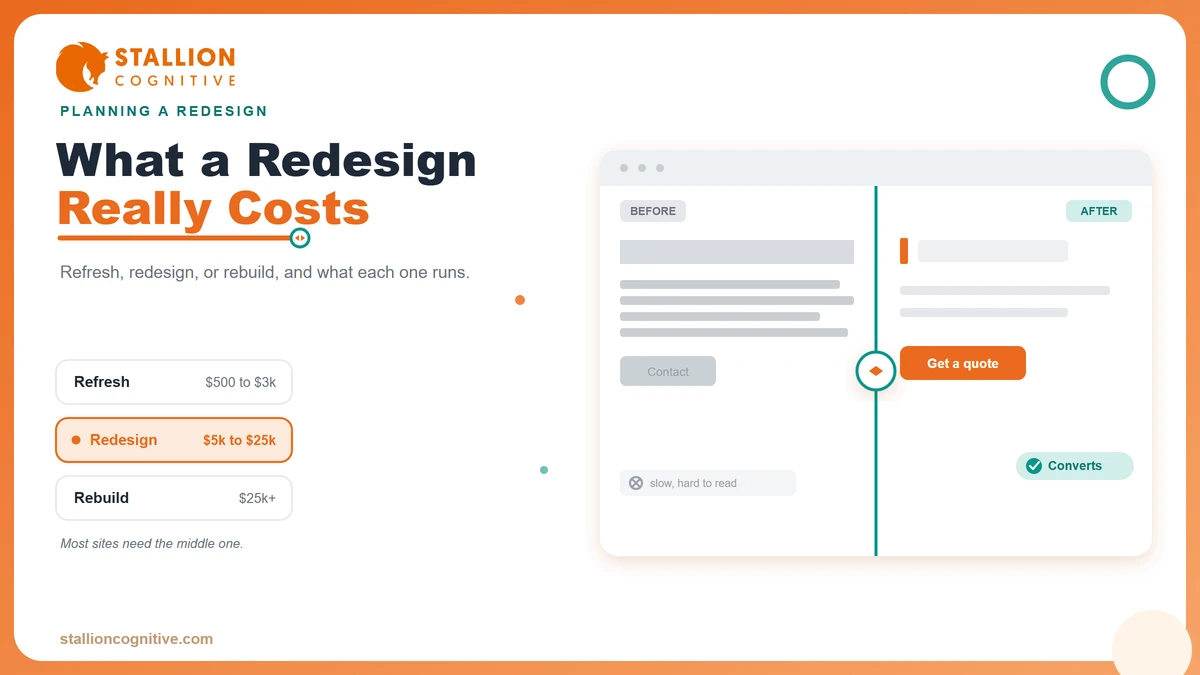
| Redesign | Page layouts, messaging, UX, some structure | $5,000 to $25,000 | Visitors arrive but do not convert |
| Rebuild | The whole foundation, CMS, and structure | $25,000 to $100,000+ | The site fights you and the tech is old |
Most owners assume they need a rebuild when a redesign would do the job, and a few hope a refresh will fix something only a rebuild can touch. An honest read of your foundation settles it.
If the code is sound and the structure still fits the business, you redesign on top of it, and that middle tier is where the value lives. When the foundation itself is the problem, patching it only delays the bill.
Where the Money Goes, and the Costs Nobody Quotes
The line that says "design" is a slice of the real work. A redesign budget spreads across discovery, content, build, and launch, and a good chunk of the true cost never shows up on the quote at all. It breaks down into a few buckets.
- Discovery and strategy: The research, sitemap, and UX plan that decide whether the new site actually performs. Skip it and you get a prettier version of the same problem.
- Design: Wireframes and visual design, the part everyone pictures when they hear the word redesign.
- Development: Building the thing, wiring up integrations, and making it work on every screen.
- Content and migration: Writing or reworking copy, moving pages, and setting redirects so your rankings survive the move.
Then come the costs nobody puts in the headline number. Ongoing hosting and website care plans keep running after launch. Staff time in reviews and approvals is real money even when no invoice names it. And the redirect mapping and SEO cleanup that protect the traffic you already earned is the first thing a cheap redesign quietly drops.
The Cost of Waiting on an Outdated Site
Doing nothing carries a price too.
It just never arrives as an invoice. An old site leaks leads month after month while you tell yourself the redesign is the expensive option.
Speed is the plainest example. Google's research found that as a page's load time climbs from one second to ten, the probability of a mobile visitor bouncing rises 123%. An old, heavy site is slow by default, and every one of those bounces is a visitor you paid to attract and then lost at the door.
An outdated site never sends you a bill. It just keeps costing you the leads you paid to bring in.
Good design pulls the other way. McKinsey tracked 300 companies over five years and found the top design performers grew revenue 32 percentage points faster than their industry peers. Design there means the whole experience, which is exactly what a redesign buys you.
So the real comparison is never redesign cost against zero. It is redesign cost against another year of a site that turns good traffic away. Close the website conversion rate leak and the math usually flips positive sooner than owners expect.
What a Redesign Costs High-Ticket and Regulated Firms
For a financial advisor, a law firm, or anyone selling a high-ticket service, the stakes on a redesign run higher, and so does the floor on what you should spend. These buyers judge harder, and they judge in seconds.
Stanford's web credibility research found that 46.1% of people weigh a site's visual design when they decide whether to trust the company behind it. For finance sites that figure climbs to 54.6%, the highest of any category in the study. A dated site does more than look old to a prospective client. It reads as a firm that has let things slip.
Regulated redesigns also carry line items a generic one skips.
- Usable for everyone: Accessibility compliance built to standard, so the site stays usable and legally defensible if a complaint ever lands.
- Clear disclosures: Room for the disclaimers and legal wording your compliance team signs off on.
- Secure data handling: Forms and client areas that protect sensitive information by design.
That is why a finance or healthcare redesign sits at the higher end of its tier. You are paying for trust and compliance, and both cost far less to build in than to bolt on after a problem shows up.
How to Get an Accurate Quote Without Overpaying
A vague brief gets priced for the worst case, every time. The tighter you describe what you want, the tighter and fairer the number that comes back. Get clear on a few things before you ask.
- Your real goal: More leads, a modern look, or a site you can finally edit yourself. The goal sets the scope.
- What you keep: Which pages, content, and features carry over, and which ones get cut.
- Refresh or rebuild: Whether you need a surface update or a new foundation, using the framework above.
- Content ownership: Who writes and migrates the copy, you or the agency.
- Launch and after: SEO migration, redirects, training, and support once the site is live.
When the quotes come back, a single lump sum with no breakdown is the one to question. Ask any agency to itemize discovery, design, development, and content, and watch how readily they do it. A team that has run a hundred redesigns will not flinch at the question.
Ready to Scope Your Redesign?
You know the ranges now, what moves them, and whether your site needs a light refresh or a full rebuild. The guessing part is over.
What is left is a real number for your site. Tell us what you are working with and what you need it to do, and we will scope it fairly, so the price matches the work in front of us. Our web design services build in the SEO, speed, and trust signals that make a redesign pay for itself rather than just look nicer.
So what is another year on the current site quietly costing you? Book a call and we will map the redesign that fixes it.
Frequently Asked Questions
How long does a website redesign take from start to launch?
A small business redesign usually takes six to ten weeks. Larger sites with custom functionality and heavy content migration run three to six months. The worst delays are rarely technical. They come from content and slow rounds of internal approval, so line those up early.
Is a website redesign tax deductible for my business?
In most cases the cost is written off as a business expense or spread across several years, depending on where you operate and how the work is classified. The rules vary by country and shift often, so confirm the treatment with your accountant before you file.
Will a redesign hurt my existing SEO rankings, and can I keep my content?
Rankings take a hit only when the migration is careless. A proper redesign keeps your best-performing content, maps old URLs to new ones with redirects, and preserves site structure. Handled well, traffic holds steady and often improves once speed and mobile get better.
Should I pay an agency hourly or a fixed project fee?
A fixed project fee suits most redesigns, since it caps your risk and forces a clear scope up front. Hourly can fit open-ended work or ongoing changes after launch. Ask which model a quote uses, and what happens when the scope shifts mid-project.
How often should a business redesign its website?
Every two to four years is the rough rhythm for most businesses, though the trigger should be performance rather than the calendar. If the site still converts, loads fast, and reflects the business, leave it alone. Redesign when it stops doing its job instead of on a fixed schedule.