
Hiring a web design agency means committing thousands of dollars to something you cannot see until it already exists. Most owners handle that discomfort by judging portfolios, which is the one thing every agency has already polished to a shine.
Knowing how to choose a web design agency comes down to what you ask before the money moves. Good teams answer with stages, dates, and names. Risky ones answer with confidence and very little else.
Below is the filter, ordered so the questions that save you the most money come first.
Decide what the site has to earn
Write down what the website has to produce before you open a single portfolio. Booked calls, qualified enquiries, higher-value clients, whatever your business actually runs on. The agency worth hiring asks about that number in the first conversation and treats the design as the route to it.
Most owners work in the opposite order. They shortlist on how the work looks, then hope results arrive later. Sites that look expensive and produce nothing are the most common thing we get asked to fix.
A high-converting website is built around one job. So define the job first.
Have these four answers ready before your first call.
- The single action you want a visitor to take, whether that is booking a call or asking for a quote.
- Who the buyer is, what makes them hesitate, and what proof would settle it.
- What a decent month of enquiries looks like right now, so the site can be measured against it later.
- A real budget range, since it decides which tier of help is worth discussing at all.
Any agency worth its fee will push on those answers and sharpen them. A homepage built to drive sales starts from exactly this kind of brief, and a team that skips the brief is guessing.
Agency, freelancer, or AI builder?
Your first real decision is who builds the site at all, and the answer depends on how much revenue the website carries. A freelancer, a full-service agency, and a DIY AI builder each suit a different budget and a different tolerance for risk.
The trade-offs sort out quickly.
| Option | Typical cost | Best for | The catch |
|---|---|---|---|
| AI site builder | $15 to $30 a month | Testing an idea before you commit | Template look, thin SEO control, all the work stays yours |
| Freelancer | $1,500 to $6,000 | Small builds and tight budgets | One person, so range and availability are the limits |
| Full-service agency | $6,000 to $20,000+ | Sites that carry real revenue | Costs more, so the fit has to be right |
Those figures move with scope and location. Treat them as directional and get a written quote before you plan around any of them.
When a freelancer is enough
For a five-page site with copy you already have, a good freelancer beats an agency on both price and speed. The risk is concentration. One person gets sick, lands a bigger client, or moves on, and your project sits still for a month.
Ask what happens to the work if they become unavailable, and listen for an actual answer instead of reassurance. You can also build a website with AI to get moving while cash is tight, as long as you know its ceiling and plan to outgrow it.
When the agency premium earns out
Once the site is a real source of leads, range starts to count for more than hourly rate. An agency puts design, development, SEO, and strategy under one roof, so nobody can point at another vendor when enquiries stay flat. That coordination is most of what the extra cost buys.
Before you decide the number is too high, look at what a business website really costs at each tier, including the parts that get billed later.
The questions that separate a real agency from a risky one
Ask how they work, then listen for specifics. A team that has run fifty projects answers with stages, timelines, and names. A team that has not answers in adjectives.
Bring these six to every first call.
- What is your process? You want defined stages from discovery through launch, written down before anybody starts designing.
- Who actually works on my project? Meet the designers and developers, beyond whoever is selling to you.
- What is the timeline, with milestones? Real dates for wireframes, design, build, and launch beat a vague few weeks.
- How many revision rounds are included? Know exactly where free edits stop and change orders begin.
- Can I speak to two past clients? References in your industry are worth more than any showreel.
- How do you measure success after launch? The answer should involve leads and rankings six months out, well past launch day.
How to read the answers
Write everything down during the call. Side by side after two or three conversations, the gaps are obvious in a way they never are in the room.
Then pay attention to the questions they cannot answer neatly. An agency that says a deadline is tight, or admits a feature sits outside what they do well, is showing you how it will behave when something goes wrong mid-project. The one that promises everything, quickly and cheaply, is telling you what you want to hear.
Confidence is easy to fake. Specifics are harder.
Who owns the website when it is done?
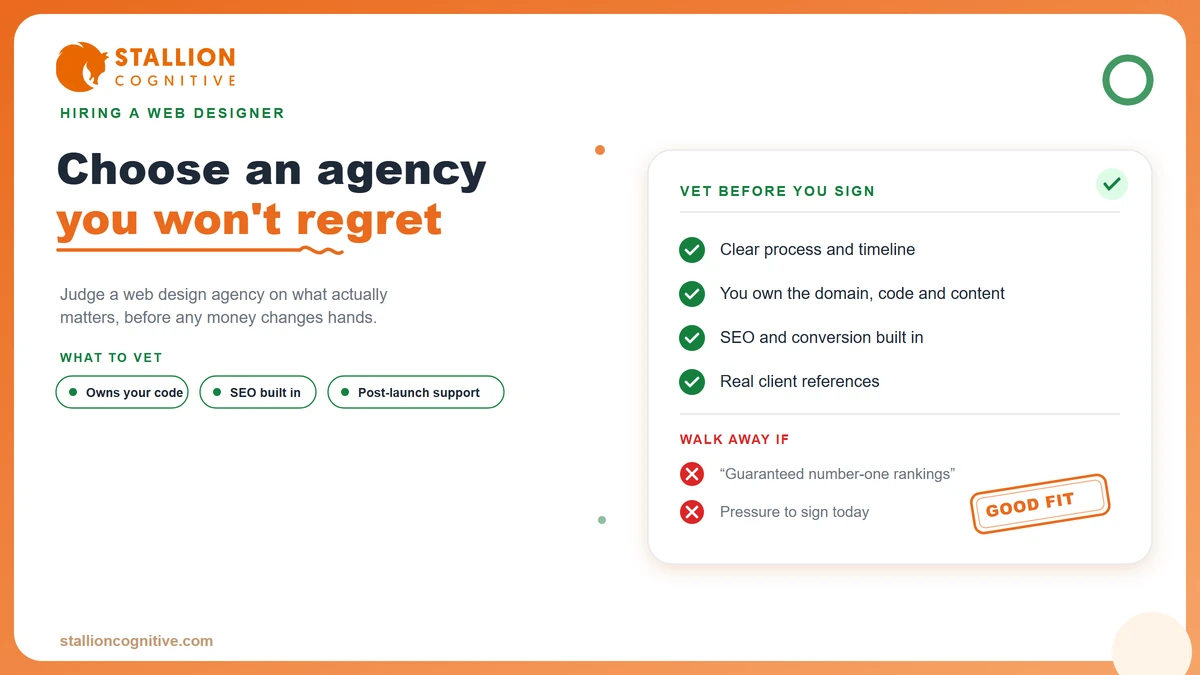
Settle this before you sign, because the answer can hold you in place for years. You should own the domain, the content, the design files, and the code, with the access to move all of it elsewhere the day the relationship ends.
Plenty of owners find out too late that they own almost none of it.
Check the domain before you sign
Look up your own domain in a WHOIS search right now and read the registrant field. If an agency's name sits there instead of yours, that is the account controlling your website, your email, and every link pointing at you.
Getting it back is slower than people expect. Under ICANN's transfer policy, a change of registrant can lock a domain for 60 days, so an agency that finally hands it over can still leave you unable to move it for two more months.
The same principle covers your data. Your Google Analytics 4 property and your Search Console verification belong in accounts you own, with the agency added as a user. When it runs the other way round, your entire traffic history walks out with them.
Get the rest in writing
- Content and design files: The copy, the images, and the Figma or source files you paid to have made.
- The code and CMS: Something standard like WordPress or Webflow that any future developer can pick up without a rebuild.
- Admin logins: Full access to hosting, the CMS, and analytics from day one, without having to ask each time.
- A redirect map on any rebuild: The old-URL-to-new-URL list that protects the rankings you already earned.
Put all four in the contract rather than in an email thread.
Is SEO and conversion built in from the start?
The best agencies build search visibility and conversion into the wireframe. The weakest sell you both as an upsell three months after launch, once the site is live and quiet.
Four questions tell you which one you are dealing with.
- On-page structure: Clean headings, fast templates, and crawlable pages as standard, so you are not paying for a retrofit. A team working from an on-page SEO checklist has done this before.
- Core Web Vitals: Ask which of LCP, INP, and CLS they check before launch, and on what device. A team that cannot name them has not been measuring.
- Conversion paths: Clear calls to action, trust signals, and a short enquiry form belong in the first draft.
- Tracking at launch: Analytics and goal tracking configured on launch day, so you can tell which page brought you the client.
HubSpot rebuilt its own site around user experience and reported doubling its conversion rate in the process. Design decided by how people behave tends to pay for itself.
Then ask for proof. A site they built that ranks and converts today, with numbers you can check yourself. We have watched a financial planner's conversion rate climb because the enquiry path was designed in at wireframe stage instead of stapled on later.
So what would their last three clients say about the results?
Extra vetting for finance and high-ticket firms
Standard vetting stops short if you run a financial, legal, or healthcare business. Your site carries compliance exposure and a higher bar for trust, and most general agencies have never had to think about either.
Trust is the whole sale in these fields. Stanford's long-running web credibility research found that people judge a site's believability on how it looks before they read a word about you. First impressions form in roughly 50 milliseconds, according to peer-reviewed work in Behaviour & Information Technology, which lands well before your credentials get a chance to.
Vet a high-trust agency on four points beyond design.
- Whether they have built for finance, legal, or healthcare clients, and how they handled the rules.
- Whether they raise accessibility, disclaimers, privacy, and data handling before you have to ask.
- How they secure forms, client data, and admin logins when the information is sensitive.
- Whether they build WCAG 2.2 AA conformance into the site instead of bolting an overlay widget on afterward.
That last one has teeth. Accessibility complaints against websites are routine now, and an overlay widget is a weak defense against one. A mobile-friendly build covers a fair amount of the same ground, since the standards work that makes a site accessible also makes it fast on a phone.
Red flags that should end the conversation
Some signals are worth walking away over regardless of the price. Spot them on the first call and you save yourself a painful year and a rebuild bill.
- No clear process or timeline: A team that cannot explain how the project runs will run it over.
- Guaranteed number-one rankings: Nobody controls Google's results, and anyone claiming otherwise is bluffing or planning something that gets you penalized.
- Hedging on ownership: Vagueness about the domain, code, or content is disqualifying on its own.
- No references and no live work: A real agency shows you sites you can open in a browser and clients you can call.
- A price with no scope: The cheap quote with no detail becomes the expensive one through change orders.
- Pressure to sign this week: Expiring discounts are a sales tactic wearing a partnership costume.
One of these might be a bad day. Two in the same call is a pattern.
What happens after launch
Launch is day one, and a site starts decaying from there. Plugins need patching, content goes stale, and something always breaks quietly around week six.
Three questions settle it.
- Who applies updates, backups, and security fixes, and at what monthly cost.
- How fast they respond when the site goes down, and through which channel.
- Whether you can edit your own pages afterward without booking their time.
An agency that prices support openly is planning to still be there. One that goes quiet on the question has already described year two.
Ready to choose with confidence?
You now have the whole filter, from defining what the site has to earn through to the red flags that end a call early. The agency worth hiring asks about your business before it shows you its portfolio, hands over every login without being chased, and builds for leads from the first wireframe.
Run every name on your shortlist through the same questions in the same order. The gaps show up faster than you would expect, usually by the second call.
When the website carries real revenue, and especially when it carries compliance weight, the build is worth getting right the first time. Our web design and development work is built for that, with ownership handed to you on day one.
So which of these questions are your shortlisted agencies dodging? Book a call and we will show you what a straight answer to every one of them sounds like.
Frequently Asked Questions
How long should a web design project take?
Six to twelve weeks is normal for a small-business site, depending on page count, how ready your content is, and how many revision rounds you use. Custom builds run longer. Treat a promised launch in a few days as a warning rather than a feature.
Is a bigger agency always better than a small one?
Size predicts very little. Large teams bring depth but can hand a small account to junior staff. Judge the people actually assigned to your project.
Should I pay the full amount upfront?
Standard practice is a deposit of a third to a half, with the balance tied to milestones or launch. Paying everything before work starts leaves you nothing held back if the project stalls, and asking for no deposit at all is its own warning sign.
Can I use my own content and photos to save money?
Supplying copy and images does lower most quotes, since content is usually billed separately. Weak content undercuts strong design though, so send your own only if it holds up.
What is the difference between web design and web development?
Design covers layout, color, and how the page feels to use, often built in Figma first. Development is the code that makes it load, work on a phone, and connect your forms. A full-service team does both, which is why the site holds together as it grows.