
We sell SEO. So read this the way you should read any agency telling you how to pick an agency, which is with your guard up, and then run every test below on us too.
That is the point of the post. Most articles on this topic hand you a list of warning signs and stop there. A list only helps if you also know what a good answer sounds like, because you will hear both in the same meeting, thirty seconds apart, from someone who sounds confident either way.
So below is the vetting instrument we would want a client to use on us.
What counts as a red flag when hiring an SEO agency?
A red flag is any claim that collapses when you ask one follow-up question. That is the whole definition. The warning sign is rarely the promise itself. It is what happens to the promise under three seconds of pressure.
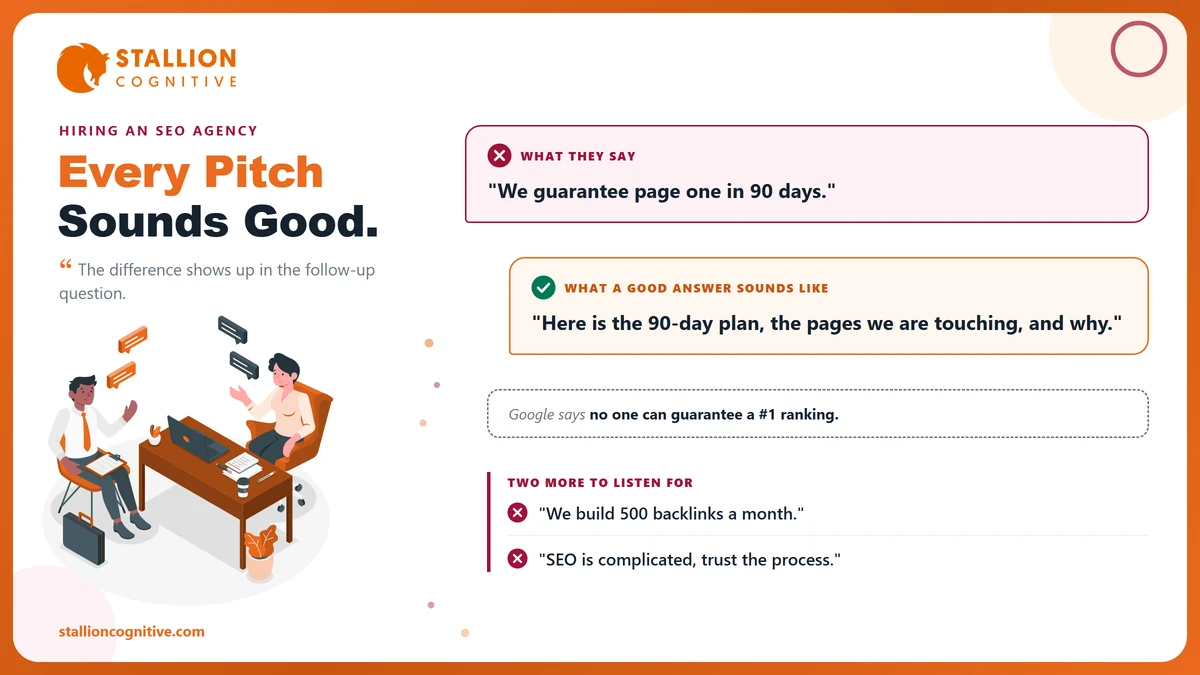
Google says this plainly in its own guidance for people hiring help. In "Do you need an SEO?" the company writes that "no one can guarantee a #1 ranking on Google," and tells you to beware of anyone claiming a "special relationship" with Google or a "priority submit." It also flags firms that are "secretive or won't clearly explain what they intend to do."
Read that last one twice. Secrecy is the tell, and it hides inside confident language.
Two things separate a red flag from ordinary unfamiliarity.
- A red flag survives no scrutiny: Ask how, and the answer gets vaguer instead of more specific.
- Unfamiliar is different: Technical terms you have not heard are not warning signs. An unwillingness to translate them is.
You are hiring for a service you cannot personally inspect, which is exactly why the interview carries so much weight. If you are hiring for the build rather than the traffic, knowing how to choose a web design agency is a separate vetting job with different questions.
Which promises should stop the conversation?
Six claims come up constantly. Each one has a version that should end the meeting and a version that should reassure you, and the difference is always specificity. Take this table into the call and use the right column as your answer key.
| What they say | Why it fails | What a good answer sounds like |
|---|---|---|
| "We guarantee page one in 90 days." | Nobody owns the ranking system. Google says no one can guarantee a number one spot. | "Here is what we think moves in six months, and the leading indicator we will watch in month one." |
| "We have a contact at Google." | Not a thing that exists to buy. Google names this claim specifically. | "We work from Google's published documentation, and here is the page we follow." |
| "We build 500 backlinks a month." | Volume-priced links are the textbook definition of link spam. | "We will earn a small number of links from sites your buyers actually read, and show you every one." |
| "SEO is complicated, trust the process." | Secrecy is the warning sign Google names in its own guidance. | "Here is the 90-day plan, the pages we are touching, and the reason for each." |
| "We are experts in AI search visibility." | Unverifiable without evidence, and easy to assert. | "Here are queries where a client's brand gets cited, and here is how we tracked it." |
| "Rankings are up across the board." | Rankings are an input. They are not money. | "Here are the qualified leads, and the pages that produced them." |
The pattern is hard to miss once you see it laid out. Bad answers describe outcomes. Good answers describe work.
One more thing about that first row. We will not quote a ranking timeline on a first call, because we have not seen the site, the competition, or the history yet. Anyone who gives you a date before the audit is guessing, and a guess delivered confidently is still a guess.
How do you test whether they own their process?
Plenty of agencies sell work they do not perform. The test is not whether they subcontract, because good firms sometimes do. The test is whether they can describe the work in specific terms without checking with someone else.
Ask what they would audit first
A capable agency has an opinion before the contract. Ask what they would look at in week one, and listen for whether the answer is about your business or about a tool.
Weak answers name a product. Strong answers name a problem, usually one they already spotted on your site while preparing for the call.
If nobody looked at your website before pitching you, that tells you what the next twelve months feel like.
Ask for the deliverables in writing
Get the scope in the contract, in plain language, with quantities. Vague scope is where retainers go to die.
Pricing tells you something too. Semrush surveyed roughly 400 SEO providers and found US agencies average $147.93 an hour, with half of providers worldwide charging under $3,000 a month. Run the math on a cheap retainer. A $300 a month buys about two hours of senior time, so ask what two hours is supposed to accomplish, and watch whether the answer gets uncomfortable.
Cheap is not automatically bad. Cheap plus a long list of promised deliverables is arithmetic that cannot work, and understanding local SEO cost for professional services makes those gaps easier to spot.
Ask who actually does the work
Four questions settle this quickly.
- Who writes the content, and can I see something they wrote?
- Who will I email on a Tuesday with a question?
- Is any of this subcontracted or white labeled, and to whom?
- How many other clients does that person carry?
None of these are hostile. An agency that treats them as hostile has answered them.
Who owns your data and accounts when you leave?
Ownership is the question almost nobody asks and almost everybody regrets. It gets decided during onboarding, quietly, and only becomes visible on the day you try to leave.
Every account below belongs in your company's name, with the agency added as a user.
- Your domain registrar
- Your hosting account
- Your website admin, at owner level
- Your GA4 property
- Your Search Console property
- Your Google Business Profile
- Your Google Ads account
- The content itself, assigned to you in writing
Then ask the offboarding question directly. What happens on day one after I cancel? A good answer is boring. They remove their users, you keep everything, they send a handover document. A bad answer involves the words "we would need to discuss" or a migration fee.
Local citations deserve a specific mention. If an agency built your listings on their own logins, your NAP syndication can decay for months after they leave, and you will not know until customers arrive at an address you moved out of.
What does their reporting have to show?
Reporting should answer one question. Did this produce business? A report full of ranking screenshots and traffic arrows can sit on top of a completely stalled account, which is exactly how bad retainers survive for years.
A wealth-management firm came to us with fourteen months of invoices and a folder of monthly reports. Every report showed keyword positions improving. Their non-brand traffic was flat the entire time. The agency had built around 900 directory links and published sixty posts nobody read, and the domain was carrying a manual action the firm had never been told about.
Three things belong in every report.
- Non-brand performance: Searches that are not your own company name, because branded search measures your reputation rather than their work.
- Qualified leads by page: Which URLs produced inquiries a salesperson would want.
- What changed and why: The actual work done last month, in sentences.
Ask how they separate brand from non-brand. Ask how conversions are tracked, and whether you can track AI traffic in GA4 as its own channel, since visitors arriving from AI answers often land misattributed in default reports.
Watch how they handle bad months too. When traffic falls, a good agency shows you the diagnosis, because the causes behind a website traffic drop are knowable and specific. "Google update" as a standing explanation is an excuse with a calendar. And if rankings really do climb while nothing else moves, the problem may sit past the visit entirely, which is where a website isn't getting leads diagnosis starts.
What extra risk do regulated firms carry?
Financial, legal, accounting, and medical firms carry exposure a retailer does not. Search engines treat this content more harshly, your regulator has opinions about claims, and the penalty for shortcuts lands on your domain rather than the agency's.
That last part deserves emphasis. The agency walks away. Your website keeps the damage.
| The shortcut | What it risks | What to require instead |
|---|---|---|
| Bought or bulk-built links | Google's spam policies define link spam as links created mainly to manipulate rankings. Sites may rank lower in results or not appear in results at all, and can pick up a manual action. | A written no-paid-links commitment, plus a monthly list of every link earned and the anchor text used |
| Mass-produced or AI-spun pages | The same policies name scaled content abuse, meaning many pages generated primarily to manipulate rankings without helping users. | Named authors, subject review, and a publishing pace a human could sustain |
| Faked reviews and testimonials | Regulators have taken a hard line on fabricated reviews, and the firm that buys them carries the reputation damage and the legal exposure while the vendor who supplied them walks away. | A documented process for requesting real reviews only |
Compliance review is the other requirement. Ask who reads the content before it publishes and whether your compliance officer sits in that loop. Firms handling regulated advice need financial advisor SEO compliance built into the workflow rather than bolted on afterward, and practices serving a local market should confirm the agency has actually done local SEO for accountants or something close to it.
What looks like a red flag but isn't?
Some of the most reassuring things an agency can say will sound alarming if you have been reading warning-sign lists all week. Five in particular get good agencies rejected.
- They refuse to guarantee rankings: Correct, the ones who guarantee are the problem.
- They quote six to twelve months: Ahrefs studied about a million URLs and found that only 6.11% of pages reached the top 10 within a year. A six-month horizon is honesty, and a 30-day promise is fiction.
- They will not name every client, because some contracts include an NDA. Ask for an anonymized case study and a reference call instead.
- They say no to your keyword idea: An agency that agrees with everything is selling rather than advising.
- Month three looks flat. Ahrefs also found that 40.82% of pages which do reach the top 10 get there within a month, so movement tends to be lumpy rather than smooth. Judge the trend across quarters.
Sound familiar? If you rejected someone for one of these, you may have turned down the better firm.
Before you sign anything
Take the table from section two into your next call and write down the answers verbatim. Vague answers look much worse in your own handwriting than they sound in a meeting.
Then check the accounts. Ownership is the part that costs real money to undo.
If you already have an agency and this post made you uneasy, get an outside read before you renew. Our team will review your current setup, reporting, and link profile and tell you plainly whether the work is real, starting with our SEO services.
Frequently asked questions
Should I hire a freelancer instead of an agency?
For a single site with focused needs, a strong freelancer often beats a mid-tier agency and costs less. The tradeoff is capacity and cover. One person gets sick, takes holidays, and cannot audit, write, and fix technical issues all at once.
Should I sign a 12-month contract or go month to month?
Six months is a fair middle. SEO needs runway, so month-to-month can encourage quick wins over compounding work. Twelve months with no exit clause hands away every bit of your bargaining power. Look for a defined term with a 30-day out after month three.
Can I hire an agency for a one-time audit instead of a retainer?
Paid audits are one of the best ways to test a firm before committing. You see how they think, what they prioritize, and whether their writing is clear. Insist on owning the deliverable and check that fixes are quoted separately.
Does an agency's own Google ranking prove they are good?
Ranking for their own brand name proves nothing at all. Plenty of excellent agencies rank poorly because client work absorbs their time, and some visible firms rank well through pure link buying. Judge client outcomes.
What if the agency wants to rebuild my website first?
Sometimes that recommendation is correct, since a broken foundation caps everything built on it. Ask them to show you which specific problems block SEO progress and what a fix-in-place option would cost. Two options mean advice, and one option means a sales pitch.