
A partner types the firm name into Google Maps from the office, finds nothing, and by lunchtime somebody has been asked to look into a penalty.
Most of the time there is no penalty.
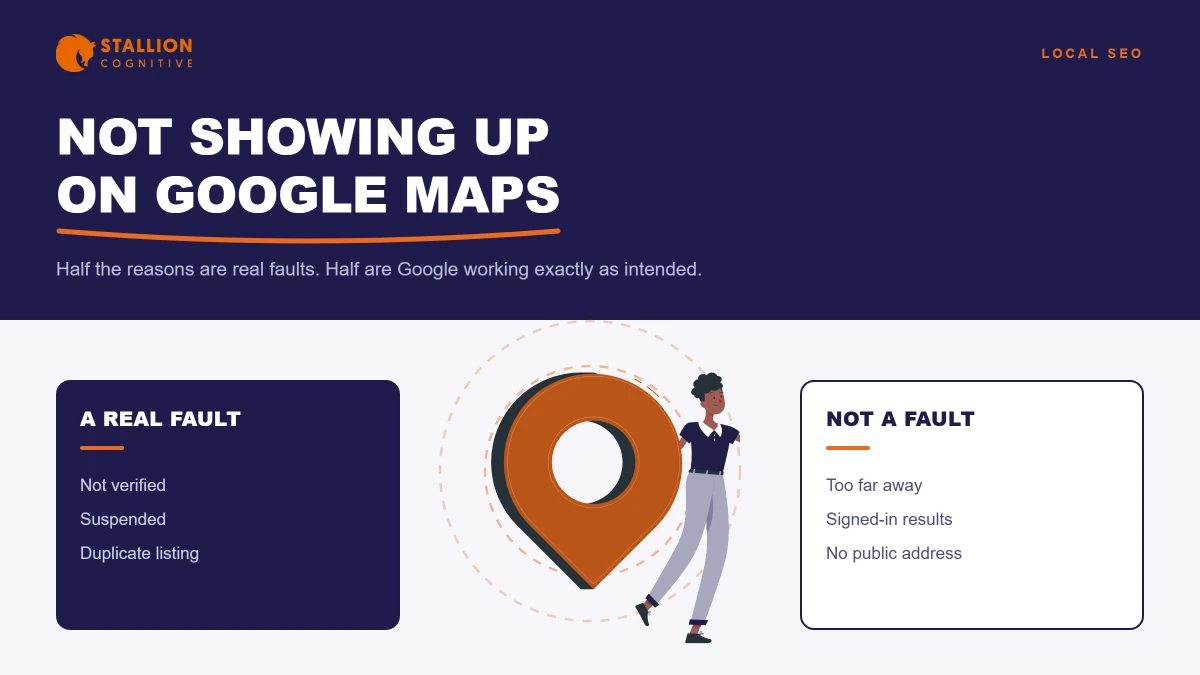
Your business might not be showing up on Google Maps for six or seven plain reasons. They split into two groups, and the two groups need completely different work. One means the listing is hidden from everybody. The other means the listing is healthy and you are the wrong person to test it.
Telling them apart takes about fifteen minutes.
Getting it wrong costs a quarter, and sometimes a bill. Let's draw the line first.
Why is your business not showing up on Google Maps?
Either the listing does not exist yet, or it exists and you cannot see it. Every real cause sits in one of those two buckets.
The fixes share almost nothing.
Competing articles hand you a flat list of five or twelve reasons, with suspension sitting next to distance. Those two belong in different buckets and cost different money.
- Nobody can see it: Never verified, still pending, suspended, or folded into a duplicate.
- Only you cannot see it: You are too close, signed in, or looking at a listing with no address by design.
Sort yourself into a bucket before you touch a setting. Firms that skip this step tend to rebuild a profile that was working fine. If the trouble is your website rather than your map pin, the website is missing from search problem runs on different rules.
Does the listing exist, or can you just not see it?
Start with existence. It is quick to settle and it rules out the costly half.
Open Google Maps on a phone that is not signed into your business account. Search the firm name plus the town.
| What you find | Who can see it | What it means | Typical fix |
|---|---|---|---|
| Nothing at all | Nobody | Never created, or still unverified | Claim and verify it |
| A pin with limited detail | Everybody | Verification pending | Wait, and stop editing |
| Gone after months of working | Nobody | Suspended | Appeal with evidence |
| Two entries, one stale | Split | A duplicate is absorbing you | Merge and claim |
| Fine on the phone, absent at your desk | You only | Location or account, rather than the listing | Nothing on the profile |
Three of those five need real work. Two need none at all.
It was never verified
Verification is what makes a profile public. An unverified profile can sit in your dashboard looking complete for months while the map shows nothing.
- Check the dashboard for a verify prompt rather than assuming it went through.
- Video checks are common now for firms with no shopfront.
- Never open a second profile while one is pending, because that reads as a duplicate.
It was suspended
A suspended profile often vanishes with no email, which is why owners find out by searching. Suspension has its own appeal path and its own evidence, so it is a process rather than a settings review.
- Do not edit anything else while an appeal is open.
- Do not build a fresh profile to fill the gap, because it will be pulled too.
A duplicate is absorbing it
Old listings survive office moves, partner changes and mergers. When two entries share an address or a phone number, Google picks one and quietly buries the other.
- Search the old firm name, the old suite number and any former partner name.
- Claim what you find rather than deleting it, since the older entry often holds the reviews.
- Holding NAP consistency across directories stops the duplicate coming back.
How does Google decide which listings show?
On three things, and Google publishes them. Its local ranking guidance is short and worth reading in full.
"Local results are mainly based on relevance, distance, and popularity."
Distance is the one that surprises people. Google calls it "how far each business is from the customer who's searching", so the same firm rises and falls with where the searcher stands.
The same page shuts a door that several vendors lean on.
"There's no way to request or pay for a better local ranking on Google."
Read that before you accept a quote for guaranteed map placement. Lifting your map pack ranking is real work on real signals. None of it is a payment to Google.
Did you hide your own address without meaning to?
Quite possibly, and it may have been the right call. Firms run from a home office, a shared floor or a client site are service-area businesses, and Google's service-area rules are direct.
"If you don't serve customers at your business address, remove your address from your Business Profile."
A profile with no address does not carry a map pin the way a shopfront does. Nothing is broken. The firm followed the rule and took the cost, usually without being told there was one.
- If clients do visit you: Keep the address, and match the suite number to your lease and your website.
- If they never do: Remove it, set the service area by county or drive time, and expect a weaker map showing.
- If you took an office to win a pin: Google also wants permanent on-site signage before it treats a spot as a shopfront.
That trade catches accounting, advisory and legal practices more than any other kind of business we work with, because so many of them meet clients somewhere else.
Why does it show for you and vanish for a client across town?
Because you are standing next to it and they are not. Distance is a ranking factor rather than a filter. A healthy listing simply slides down the results as the searcher moves away.
Being signed in makes it worse. Google knows the business is yours, so the map you see is not the map a stranger gets.
Two habits fix the whole thing.
- Search from a phone on mobile data, signed out, from a different part of town.
- Read the profile's own performance report instead of trusting your eyes.
Local search has stayed oddly stable while the rest of search moved. Ahrefs found that only 7.9% of local searches trigger an AI Overview, so the map itself is still where local visibility is won or lost.
Is your main category quietly doing the damage?
Often, and it is the cheapest thing here to fix. Your primary category tells Google which searches you can show up for. A wrong one drops you out of the results you want while the profile stays perfectly healthy.
We see three versions of the mistake.
- A firm listed as "Business Center" or "Office Space" rather than the trade it practises.
- A tax practice carrying a category that never mentions tax.
- A category picked to sound broad, which leaves the listing suited to nothing.
Set the main category to what you actually are. Add secondary ones for real service lines. The wider set of local ranking factors counts for very little while this one is wrong.
How do you check this without guessing?
Run the same sequence we run, in this order. Fifteen minutes, no cost.
- Search the firm name plus the town on a signed-out phone using mobile data. Existence is settled here.
- Open the dashboard and read the status line, looking for pending or suspended rather than assuming.
- Search the old firm name, the old address and any former partner name to flush out duplicates.
- Read the main category aloud. If it does not name your trade, it is wrong.
- Open the performance report and read searches and map views over 90 days.
- Ask somebody five miles away to run the same search and tell you what they see.
| What the check shows | What it rules out | What to do next |
|---|---|---|
| Nothing on a signed-out phone | Proximity and personalisation | Treat it as existence, and verify |
| Status reads pending | Suspension and category faults | Wait, and stop editing the profile |
| Two entries appear | A verification problem | Claim the older one for its reviews |
| Views steady, calls falling | A visibility problem | Work on the profile content and reviews |
| Fine at five miles, absent at fifteen | Every fault on this page | Nothing. That is distance working |
A two-partner advisory firm in Saratoga County brought us this last spring, holding a $1,900 quote to lift a penalty. The profile had never been suspended. Two plain things were happening at once. They work from a home office, so the address had been removed correctly, and the main category read "Financial Consultant" while every enquiry they wanted used the words wealth management. We changed the category and set a proper service area in an afternoon. Map views rose over the next six weeks and the $1,900 stayed in the business.
Our limit, stated plainly. We will not judge a map problem from a screenshot of your own screen. We ask for the performance report and a search run from outside your network and your account, and we have turned down two of these jobs where that access was refused.
When is nothing actually wrong?
More often than this field admits, and saying so costs us work. Three cases look like faults and are not.
- You are checking from the office: Distance and your own account both favour you, so your screen is the weakest evidence you own.
- You removed the address on purpose: The pin behaves differently by design, and putting it back may break the rule you were following.
- A rival sits closer to the searcher: Distance is doing what Google documents, and no profile work moves your building.
The honest answer to the third one is to widen where you get found rather than fight the map. That means content, reviews and plain local SEO audit work, on a longer timeline than any quick reinstatement pitch will quote. It also costs what local SEO costs, which is worth knowing before the call.
What should you fix first?
Settle existence before anything else. It decides whether the rest of this page applies to you at all.
- If nobody can see it: Verification and duplicates come first, and profile content can wait.
- If only you cannot see it: Change nothing, and go and check properly from somewhere else.
Which bucket are you in? If you would rather not guess, our local SEO work opens with that check run from outside your account, and it is the same fifteen minutes described above.
Frequently Asked Questions
How long does verification usually take?
Postcard checks run a couple of weeks and video review is faster, though Google commits to no timeline for either. Editing the profile while a review is open tends to restart it.
Do two partners at one firm need separate profiles?
Individual profiles work where each partner is a distinct, publicly reachable professional. Most small practices do better with one strong firm entry, because splitting reviews across three thin entries helps nobody at all.
Can a rival take our profile down?
Anyone can suggest an edit or flag a profile, and Google reviews what gets reported rather than acting on it automatically. Watch the dashboard for pending edits, and keep proof of your address and signage ready.
Does posting weekly updates widen how far you reach?
Posts add freshness and give searchers something to read once they arrive. They do not extend the radius Google will serve you across. Treat them as material that converts people who already found you.
Should we rent a virtual office to get a map pin?
Google wants staff present during your stated hours and permanent signage on site, and a mailbox address gives it neither. Firms that try it usually end up suspended, and a suspension is far harder to undo than a missing pin. Take the service-area route instead.