
Someone has started drafting your blog posts with AI. Maybe your marketing lead, maybe the agency, and the invoice arrived looking just as it always did. Then a peer sends you a piece claiming Google buries machine-written pages, and a year of work starts to look like a risk.
So does Google penalize AI content? No. The longer version takes a minute, because the thing that really does sink pages has a different name and a different trigger.
We read content plans and search data for accounting practices, advisory firms and law offices most weeks. The sites in trouble were almost never undone by the tool that typed the words. They were undone by how many pages went out, how little each one added, and the fact that nobody who knew the subject read them first.
Does Google Penalize AI Content?
No. Google's stance has not moved since February 2023, and its guidance about AI-generated content puts the weight on "the quality of content, rather than how content is produced". The same page states that "appropriate use of AI or automation is not against our guidelines".
That settles the question people type. It leaves the useful one open, because the word penalty gets used for two events that feel nothing alike.
- A ranking effect: Your pages sit lower than they should, nothing shows up in any report, and traffic stays flat for months while you keep paying for more posts.
- A manual action: A reviewer at Google flags the site, a notice lands in Search Console, and the pages named can drop out of results until you fix the cause and ask for a review.
Almost every owner who asks about a penalty is describing the first event while picturing the second.
Ranking effects are common and quiet, and editing usually repairs them. Manual actions of this kind are rare, and Google files them under aggressive spam tactics rather than under anything to do with AI. Nothing in the guidance treats a machine-drafted page as worse than a human one that says the same nothing.
The worry is real. It has simply been aimed at the wrong target since the week ChatGPT launched, which is also when AI in marketing stopped being a choice for most firms.
What the Spam Policy Actually Catches
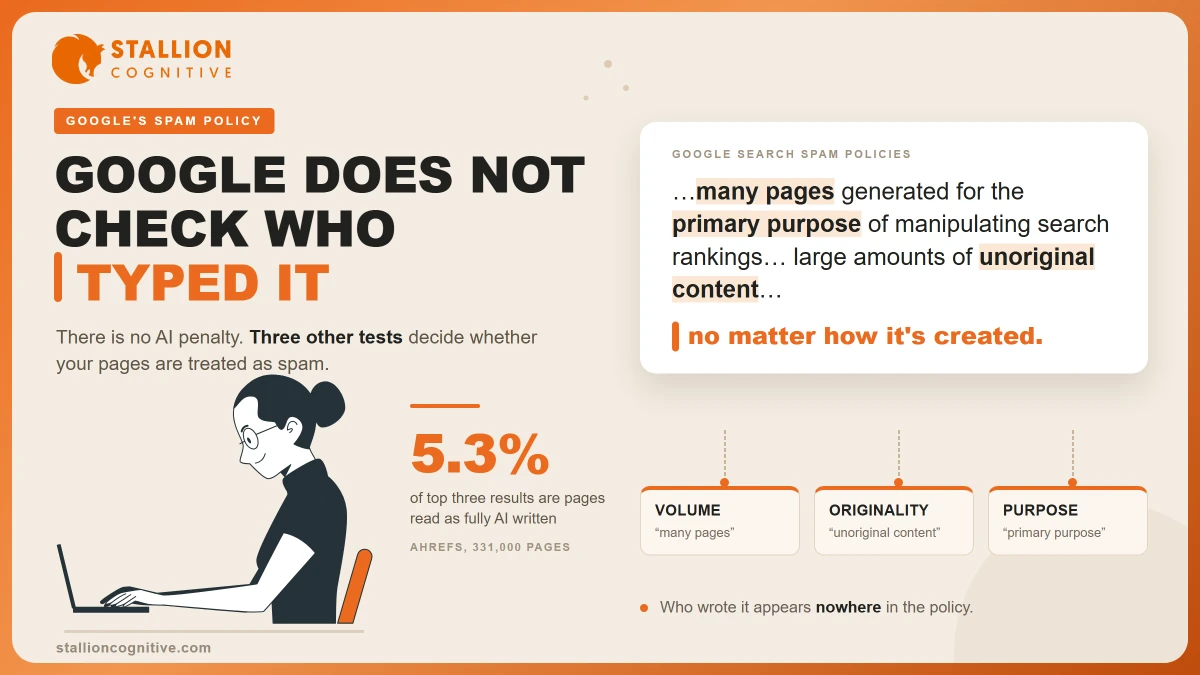
The rule that ends up mattering is called scaled content abuse, and its first line never mentions AI. Google calls it "when many pages are generated for the primary purpose of manipulating search rankings and not helping users".
Read the rest of the wording twice. Google is describing "large amounts of unoriginal content that provides little to no value to users, no matter how it's created".
Who typed it sits outside the test, while volume, originality and purpose all sit inside it.
| The test | What Google is looking at | Where a professional firm usually sits |
|---|---|---|
| Volume | Whether many pages were generated at once to catch searches | Four reviewed posts a month is nowhere near the pattern |
| Originality | Whether the page repeats material that already exists elsewhere | The real exposure, since a model writes from what exists |
| Purpose | Whether the page exists to rank or to answer a person | Decided by who picked the topic, and why they picked it |
Google's AI content policy does name the tools, once, as an example rather than as the offence. The same page lists "using generative AI tools or other similar tools to generate many pages without adding value for users" beside scraped feeds and machine translation.
So your exposure scales with how much you publish and how little each page adds. Two careful posts a month barely register against a rule written about mass production. Sixty city pages built from one template register at once, and it makes no odds whether a person or a model filled in the town names.
What Ranking Data Shows About AI Pages
Policy tells you what Google says. Ranking data tells you what Google does, and the biggest test yet ran in July 2026, when Ahrefs sorted 331,000 ranking pages drawn from the top ten results of 100,000 searches.
Their headline finding was blunt enough to quote in full.
"There are no obvious hard cutoffs suggesting a binary AI classifier is preventing AI-generated pages from ranking highly or making it into the index."
| What the study measured | The figure |
|---|---|
| Top three results held by pages under 50% AI text | 82.2% |
| Top three positions held by pages read as fully AI written | 5.3% |
| Average detected AI share at position one | 27.1% |
| Average detected AI share at position ten | 30.9% |
| Impressions for low and moderate AI pages, against heavily AI pages | 2 to 3 times higher |
Both halves of that table matter to you.
- No filter at the door: Fully machine-written pages do reach the top three, so nothing is refusing them entry on sight.
- A weaker bet all the same: Pages carrying less AI text still take the bulk of those spots and pick up several times the impressions.
Is AI content bad for SEO? On this evidence, no. Heavy use of it costs you traffic rather than access, and the gap turns up in how many people see the page instead of whether it gets indexed.
The same team also looked at where the web has landed. In April 2025 they sampled 900,000 new pages and found 74.2% contained AI text, with only about a quarter reading as purely human.
That takes away the last real argument for it. If three quarters of new pages are made the way yours is, the way yours is made cannot be what earns you the ranking.
Where a Firm Crosses the Line Without Meaning To
Nobody sets out to break a spam policy. The pattern arrives through choices that each looked sensible in the meeting where someone made them.
- The city page copy trick: One decent service page becomes twenty two town versions with the name swapped in, which is the most common way a firm makes "many pages" of "unoriginal content" without ever using those words.
- Publishing straight out of the tool: A draft goes from prompt to live site the same afternoon with no expert in between, so the post knows nothing your rivals do not know already.
- Rewriting the top three results: Ask a model what to cover and it sums up the pages already ranking, which hands you a page whose whole content sits at a better address.
- One reviewer, twenty drafts: Sign-off turns into a formality once the queue is long enough, and the step that protects you stops being a real check.
Each of those has a fix that costs nothing but care. Pick fewer topics, give every draft to someone who knows the answer, and check the page says something the first page of results does not.
The slower failure looks different and hurts for longer. Pages made this way age badly, because there was never a person behind them who could tell you what has changed since, so content decay sets in with nobody watching. Fixing the basics on those pages is ordinary work, and the on-page SEO checklist covers the mechanics.
Should You Tell Readers That AI Helped?
Google goes further here than most SEO writing does, which is why hardly anyone quotes this part. In the same guidance, Google says "AI or automation disclosures are useful for content where someone might think 'How was this created?'", and asks publishers to consider adding them "when it would be reasonably expected".
On bylines it is blunter still. Giving AI an author credit is "probably not the best way to follow our recommendation to make clear to readers when AI is part of the content creation process".
So the pair Google advises is a human name on the post and a plain note about the process where a reader would wonder. Both feed the same trust signals that decide whether you get cited by ChatGPT and Perplexity as well as ranked by Google.
Google's own list turns that into questions you can answer in writing.
- Is it self-evident who wrote the content? A byline that leads somewhere real, with the author's background and the subjects they cover.
- Have you given background on how AI was used? One sentence, in plain words, wherever a reader might ask.
- Can you say why AI was useful here? If the only honest answer is speed and cost, you have also answered the question about the page.
Most firms we work with land on one short note rather than a label on every post.
"Our team drafts with AI assistance where it helps, and a chartered accountant reviews and signs off every article before it goes out."
One line, on a page a reader can find. It earns more in trust than it ever will in rankings.
What Changes When the Content Is Regulated Advice
Ranking risk is the smaller of your two risks, and firms in licensed fields tend to spot the other one late.
A post telling a client what to do about a tax position, a settlement or a portfolio is marketing about a regulated service. Whoever reads it before it goes out is also the record that it was read, and an AI draft does not change who that person has to be.
What we see working is dull.
- A named reviewer per post, with the date, filed wherever your other marketing sign-offs live.
- A rule about claims, so no post states a figure, a return or an outcome nobody has checked against a source.
- A hard stop on client detail, because a model will happily invent a plausible case study, and a made-up client is a far bigger problem than a thin page.
None of that is legal advice, and your compliance lead will have views worth more than ours. The point is narrower. Speed is where AI drafting earns its keep, and the review step is the one place you cannot take the speed.
Volume is also the first thing an agency raises when a retainer needs to look busy. If yours reports pages published instead of naming who read them, add it to the SEO agency red flags you check at renewal.
The Check to Run Before Anything Goes Live
You do not need a policy document for this. Two short gates do the work, and both are cheap enough to run every time.
- Gate one happens before anybody writes, and it decides whether the page should exist.
- Gate two happens before anybody clicks publish, and it decides whether the page is any good.
Before the draft is ordered
- Name the searcher: Who types this, and what do they want in the next ten minutes?
- Check that somebody is asking: A topic nobody searches makes a page nobody reads, whatever wrote it.
- Decide what the post knows: Name the case, the number or the local rule that only your firm can supply.
Before the post is published
- Read it against the top three results. If a reader gets the same answer there, your page has nothing to rank on.
- Have your expert edit it rather than approve it. Sign-off catches errors, and editing adds the part a model could not know.
- Fix the byline and the note. A real author, a link to their background, and a line about process where a reader expects one.
Gate two is where this falls apart, because editing needs a busy person and sign-off needs a click. Book that time into somebody's week, or the whole thing drifts back into publish-and-hope, which is the failure the content retainer argument has been having with itself for years.
How Would You Know If Something Went Wrong?
Two places tell you, and they say very different things.
The loud one is the Manual Actions report in Search Console. If a human at Google has acted, it shows up there, filed under major spam problems as a site that "appears to use aggressive spam techniques such as scaled content abuse, cloaking, and/or other repeated or egregious violations". The report also names which URL patterns are hit, so you can tell whether it covers one folder or the lot. Fixing the cause and then choosing Request Review is the route back that Google names.
An empty report is the normal reading. Nearly nobody publishing a few reviewed posts a month will ever see an entry in there.
The quiet one is your own impression trend, and it takes longer to read. Group the pages you made this way, look at impressions across three months rather than clicks across three weeks, and set them beside the pages a human researched from scratch. A widening gap is the ranking effect showing up, and it answers to editing rather than to appeals.
- Flat impressions from week one usually means the topic had no audience to start with.
- Impressions with no clicks points at the title and the snippet, since the pages are clearly findable.
- A whole group sliding together is worth checking against your publishing dates before you blame an algorithm.
Where This Leaves Your Content
Google will not punish you for using AI. Your risk sits in what gets easy once you are using it, which is publishing more, checking less, and saying what a hundred other sites have said already.
So the questions worth taking into the next content meeting have nothing to do with tools.
- Which ten questions will the next ten posts answer, and who is asking them?
- Who edits, by name, and is that time in their diary?
- What does each post know that the first page of results does not?
We read a lot of content plans for professional firms, and the ones that work are usually shorter than the ones that got sold. Talk to our search team before you commission another twelve months of posts.
Frequently Asked Questions
Do AI detection tools tell us anything useful?
Treat a score as a smoke alarm rather than a verdict. Detectors flag patterns, misfire on plain human writing, and Google has never said it runs one. A tool reporting ninety percent on your draft is a reason to reread it, nothing more.
Is it safe to use AI for title tags and meta descriptions?
Nothing in Google's policies treats them any different from body copy. Check each one against the page it describes, because a model will cheerfully write a promise the article never keeps, and that costs you the click.
What about AI-generated images on our blog?
The same standard applies. A picture that helps someone understand the point is fine, and generic filler adds nothing either way. Avoid anything a reader could mistake for a real client, office or file.
Does rewriting an old page with AI count as fresh content?
Only where the rewrite changes what it says. Refreshing the date and reshuffling sentences leaves the same words at the same address, which is how a stale page keeps looking cared for while it carries on losing ground.
Forty of these are already on our site. What now?
Start where there is something to save. Pull the twenty pages with the most impressions and the fewest clicks, then rewrite those with your expert in the room. Merge or drop anything nobody has ever seen.