
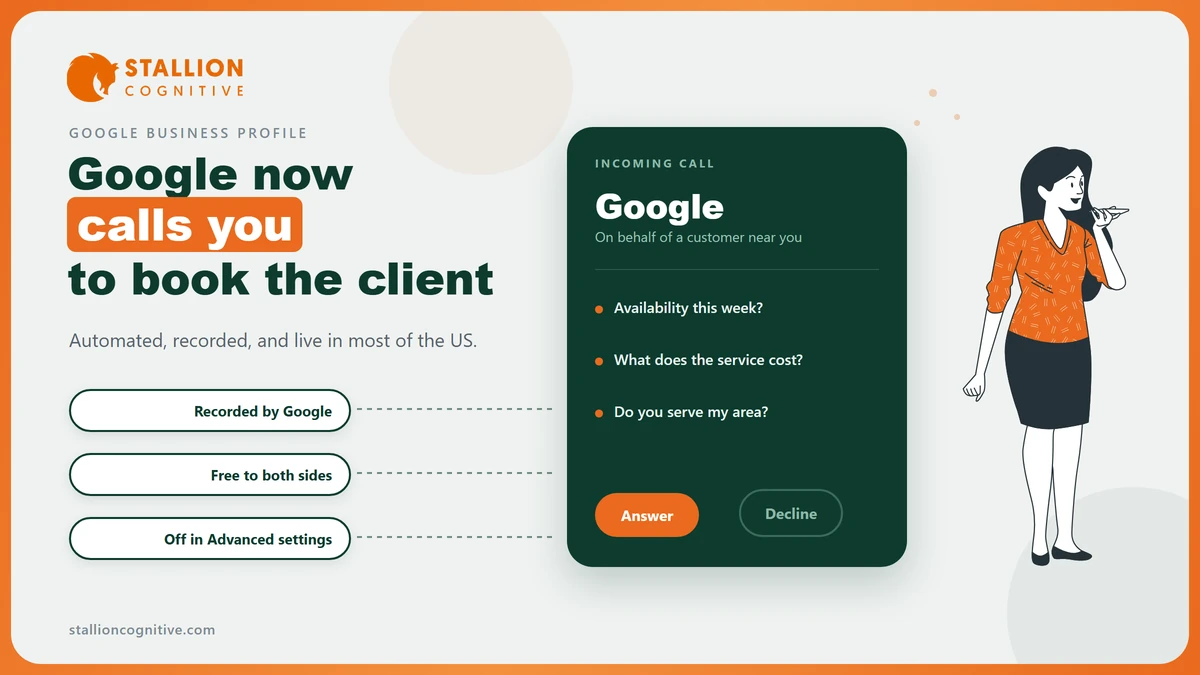
Your phone rings, and the voice on the line is Google.
Google automated calls to businesses went live across the US over the summer. A customer asked for a booking, and Google is placing the call on their behalf.
The call announces itself, and Google records it. It asks about your prices, your open slots and your service area.
Your front desk has probably taken one already and logged it as a wrong number.
What Google's automated calls actually ask for
Google names three reasons it will ring a business. All three start with a customer in Search or Maps who asked Google to finish the job.
- Booking appointments: Once the customer gives the details, like preferred time, service type and party size, Google calls the business to book it.
- Checking restaurant wait times: A customer asks how long the wait is right now, and Google phones to find out.
- Confirming price and availability: Google rings nearby businesses to check the price and stock of products and services.
Both sides get this free. Google says it costs the business and the customer nothing.
The customer-facing half arrived at Google's developer conference in 2026. The wording there was that "for select categories like home repair, beauty or pet care, you can ask Google to call businesses on your behalf", and those features then reached everyone in the US.
Read that category list closely. Advisory, accounting and legal work is not on it yet, while the booking trigger in Google's help pages carries no category limit at all. The mechanism is live and the doorway is widening.
Is that really Google on the phone?
A real one says who it is and why it is calling. Google's sample script opens along the lines of calling from Google Maps to update business hours, then states that the call is automated and recorded.
A scam call can open the same way, which is the whole problem.
| Signal | A real Google call | An impersonator |
|---|---|---|
| Opening | Says it is from Google and gives the reason | Says it is from Google and gives urgency |
| Money | Never asks for payment | Asks for payment to keep or fix your listing |
| Information | Asks about your hours, prices or availability | Asks for passwords, bank details or a verification code |
| Pressure | Accepts a refusal and ends | Threatens removal or suspension of your listing |
| Caller ID | Can be faked, so it proves nothing either way | Can be faked, so it proves nothing either way |
Google's own wording settles most of these calls. A caller asking for money to keep your business on Google is not Google, and Google will never ask you for private or sensitive details.
The FTC makes the same point about every brand that gets copied. Its guidance on business impersonators says not to trust caller ID, and to reach a company using details you looked up yourself. For your team that turns into a habit worth writing down.
Nobody gives out anything beyond hours, prices and open slots on an inbound call, whoever the caller says they are.
Is your listing really the thing being fixed? Check it yourself in a minute of your own time. Start by verifying your Business Profile directly, and treat every cold offer to do it for you as noise.
The five states where these calls do not happen
Google says the feature runs in the US in every state but five.
- Indiana
- Louisiana
- Minnesota
- Montana
- Nebraska
Google prints the list without explaining it, so take it as a fact and not as a pattern to reason from. It does not line up with the states that demand all-party consent to record a call, which is the first answer most people reach for.
Two things follow for a firm with more than one office. A branch in one of those five states will not take these calls while a branch two states over will, so your offices now behave differently by default. Whatever script you write has to work for both.
What should your front desk do with the call?
Treat it as a live prospect who happens to be represented by software. The person who asked for the call is real, they are shopping right now, and they get a written summary of what every business said.
- Let the caller finish the opening, because the reason for the call arrives in the first two sentences.
- Answer only what was asked, sticking to hours, service types, open slots and any price you already publish.
- Name a real day. A vague answer competes badly against a rival who gave one.
- Say nothing that could count as advice. Fees and scheduling are safe ground, and anything client-specific is not.
- Log it like any other enquiry, with the date, what was asked and what was said.
That last step is the one firms skip, and it is the one that pays. An unlogged call from Google shows up in no report, so the channel stays invisible while you keep guessing about where leads come from.
What a regulated firm settles before an agent books a client
Google records the call. Your firm does not get the recording, and no transcript arrives later.
For most businesses that is an oddity. For a firm under a communications rule it is worth raising with compliance before these calls arrive in volume, because what your staff says about services and fees on a recorded line is a statement about the firm.
Would your manual cover a recorded call you cannot keep?
- Who is speaking to whom: The call comes from Google's system, so your answers reach the customer inside a written summary you never see.
- What has to be kept: FINRA's rule on communications with the public requires retail communications to be kept for the period set by the SEC books and records rule, and nobody can keep what they have no copy of.
- Who answers the phone: A receptionist quoting a fee range on a recorded call is doing something your compliance manual probably covers already, under a different heading.
Registered investment advisers sit under the SEC's parallel duty instead of FINRA's, so which rule applies depends on how your firm is registered. The practical answer is the same either way. Write down what your team may say on these calls, and keep your own note of every one.
How to switch the calls off, and what that costs
Two routes exist, and the first one works while you are still on the phone.
- Tell the caller to stop. Google names the phrasings "Please remove my business from your list" and "Please stop calling my business."
- Change the setting. In Business Profile, open More, then Business Profile settings, then Advanced settings, and find the entry for Google automated calls and text messages.
Be clear about what leaves with it.
The customer on the other end is choosing between the businesses that answered.
A firm that opts out is missing from that comparison while its rivals sit inside it. Silence reads as unavailable, and the summary the customer gets will simply not mention you.
Which of the two would you rather be? For a busy practice with a full book, opting out is fair enough. For anyone still buying leads, switching off a free inbound channel to dodge an awkward phone call is the more expensive habit.
The agent's questions are the ones your site should answer
Google asks about price, open slots and service area. Those are the three things most advisory websites refuse to state, which is why the call has to happen at all.
| What the caller asks | Where it should already live |
|---|---|
| Do you have availability this week? | A booking page showing real open slots |
| What does this service cost? | A published fee range or a starting-from figure |
| Do you serve my area? | A service-area statement on the site and the profile |
| What exactly do you handle? | A service page per offering, named the way clients say it |
| Are you taking new clients? | A one-line status on the contact and booking pages |
Every row you fill in is a call that no longer needs to be placed. It is also a question an AI answer can settle without ringing anybody. The cost row is the one firms argue about, and the case for publishing your prices stands on its own merits.
Your profile carries as much weight here as the site does. The number on it is the number the system dials, so a stale one sends the call to a dead line. Firms that are missing from Google Maps never enter the comparison at all, and the calls that do arrive show up in the Business Profile performance report.
Where that leaves your phone
The phone stopped being a channel that only humans use. A customer's software now calls a business, compares the answers, and reports back in writing.
- Brief the front desk this week: One page on what a Google call sounds like and what may be said.
- Decide the setting on purpose: Leave it on or turn it off, with a reason either way.
- Publish the three answers: Open slots, price range and service area, so the call becomes needless.
Firms that read the phone as a cost centre will keep filing these calls as an interruption. If you would rather have the enquiry, the fix runs through your profile and your booking page. That is where our local SEO team starts, and it is the same work that makes your consultation booking page convert a human.
Frequently Asked Questions
Does handling a booking well affect our Maps position?
Google has published nothing tying call handling to local ranking, so treat any claim otherwise as made up. The gain is the booking itself.
What happens if nobody picks up?
The customer's summary reports what each business said, so a missed ring becomes a blank space in a comparison they are reading. A voicemail box nobody clears has the same effect as opting out.
Is this the same as the calls Google makes to check our hours?
Those belong to a separate programme, where Google contacts a business to confirm its own listing details. The calls covered here start with a person asking for a booking, a wait time or a price.
Is there a separate control for text messages?
The Business Profile setting governs automated calls and texts together, with no split between them. A firm that wants one and not the other will have to raise it with Google support.
Does the customer see our phone number?
Google places the call from its own system, so what the customer sees is the written summary it sends back. Your number stays where it always was, on your Business Profile for anyone who wants to dial it.