
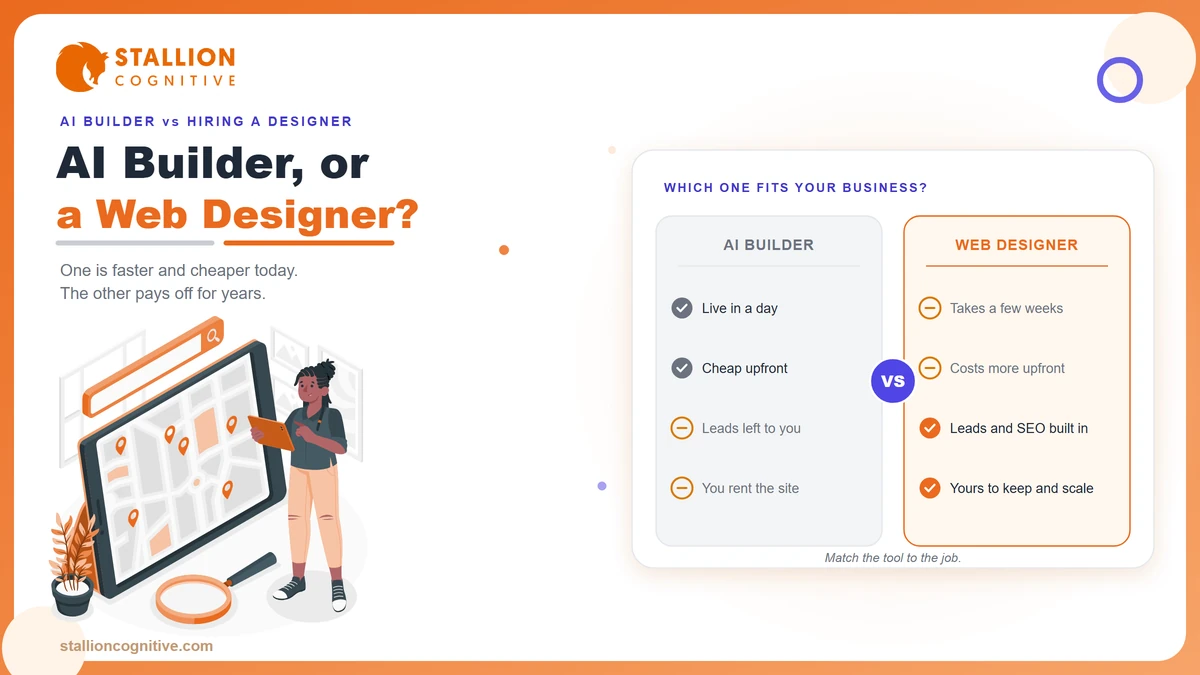
An AI website builder can put a decent-looking site online this afternoon, for about the price of two coffees a month. That is real. It is also why more owners keep asking us the same thing. Do you still need to hire a web designer in 2026?
Fair question, and the honest answer starts somewhere other than price. If you are weighing an AI website builder vs hiring a web designer, the choice is less about which one looks cheaper today and more about what you need the site to do over the next three years.
Here is the part most comparison articles skip. Almost every "builder vs designer" piece ranking on Google right now was written by an AI builder company grading its own homework. So we wrote the version we actually give our clients, financial firms and other high-ticket businesses who came to us after a cheap site quietly stopped bringing in work.
What does an AI website builder actually do, and what does it quietly skip?
An AI website builder turns a few answers and a logo into a live, mobile-friendly site, often in under an hour. Tools like Wix ADI, Durable, and Hostinger's builder pick a template, drop in starter copy, and hand you something you can edit yourself. For a lot of solo businesses, that is a fine place to start. The tools have gotten good, and we even published a walkthrough on how to build a website with AI because they are worth using.
On speed and price, it is not close. The builder wins both, every time.
So where is the catch?
The catch lives in the word "builder." It builds a page. It does not build a plan for turning visitors into clients, and a page that merely exists will not bring you work.
What an AI builder is actually good at
Every honest list of AI website builder pros and cons starts here.
- Speed: You can go from nothing to published in an afternoon.
- Low upfront cost: Most plans sit somewhere around fifteen to thirty dollars a month.
- Control: You can change your hours or a headline without emailing anyone.
Those three are real, and vendors are right to lead with them. The cons are the part they mention quietly, if at all.
What an AI builder leaves on your plate
An AI builder hands you a template that thousands of other businesses are also using. It writes copy that sounds like everyone else. It rarely sets up proper lead tracking, and it will not tell you when your one contact form has been silently failing for a month. All of that becomes your job, on top of running the business.
Ask yourself one thing. When was the last time a template made a stranger trust you enough to call?
What are you really paying for when you hire a web designer?
With a designer, you are paying for judgment more than pixels. A good designer starts with questions about your buyers, your sales process, and where your leads come from today, then builds the site around the answers. That is the real split between hiring a web designer and buying a website builder. One asks what you want it to look like. The other asks what you need it to do.
One myth is worth killing right now. Designers use AI too. We use it to draft, to prototype, and to speed up the boring parts. The difference is that a professional points those tools at a strategy instead of letting them pick a template and call it done.
There is a reason design work pays off. Companies in the top quartile for design outgrew their industry peers on revenue over five years, by McKinsey's analysis. Design in that study means a site built around how customers actually decide, from the layout to the flow.
People often ask about developers in the same breath. A developer builds what you spec. A designer works out what to spec in the first place, and for most owners that thinking is the thing they cannot get from a prompt box.
Which one actually costs more over three years?
Cheaper today is not the same as cheaper by year three. This is where the cost of hiring a web designer starts to look different once you run the real numbers.
The honest math, in ranges we see across real projects, looks like this.
| Cost over 3 years | AI website builder | Freelance designer | Agency |
|---|---|---|---|
| Upfront build | $0 to a few hundred | $1,500 to $6,000 | $6,000 to $20,000+ |
| Monthly | ~$15 to $30 (plan plus apps) | Hosting ~$20 to $50 | Care plan $100 to $500 |
| Your own time | High (you build and maintain) | Low | Low |
| Conversion and SEO help | Rarely included | Sometimes | Usually built in |
| Likely rebuild inside 3 years | Common once you outgrow it | Possible | Rare |
Look at the last row. That is the one that bites.
When does an AI website builder cost more than a designer? It happens the day you outgrow it. The site that felt free suddenly needs features the builder cannot add, so you pay to rebuild from scratch, and you often pay again to move your content and recover your rankings. We break those numbers down further in our guide to business website cost, and the website redesign cost piece covers the rebuild trap in detail.
The gap between a builder and custom web design shows up here too. A custom website vs Wix build costs more on day one and less over three years, because you are not renting the foundation. Once a rebuild enters the picture, the three-year comparison against an agency usually flips.
Will an AI-built site bring in leads, or just look nice?
A pretty site that does not convert is an expensive brochure. This is the question that actually decides the money, and it is the one the vendor comparisons barely touch.
The average website converts under two percent of its visitors, per Statista. So the whole game is what happens in those few seconds when a stranger lands on your page and silently decides whether you are worth a call. An AI builder gives you a page. It does not give you the strategy behind a high-converting website.
A builder usually leaves out four things.
- Conversion strategy: Where the eye goes first, what the one clear next step is, and why anyone should take it.
- Lead capture that fits your buyer: A short, smart form instead of a wall of fields nobody finishes.
- Lead routing: The email or CRM handoff that gets a hot enquiry to you before the prospect cools off.
- Real tracking: So you can see which page actually brought you the client, instead of a vague bump in the numbers.
Miss those, and you can pour visitors into a site that leaks every one of them. We wrote a whole piece on how to boost conversion rate because this is where most sites, builder or not, lose the deal.
Sound familiar? A lot of owners come to us with steady traffic and an empty inbox. The traffic was never the problem.
Who owns your site, your content, and your rankings?
You own less than you think on many builder plans. Read the fine print and you find that your design lives inside their platform, your content is tied to their editor, and moving out is deliberately awkward. Do you own your website with an AI website builder? You own your domain and your words. The rest can be surprisingly hard to take with you.
Domain, data, and code portability
That gap shows up the day you want to leave. Your domain travels with you. Your content and design often do not, because they were built for that platform and nowhere else. So ask any vendor two plain questions before you commit. Can I export everything, and will it actually work somewhere else?
Plenty of owners find that out the hard way.
What happens to your rankings when you outgrow it
Can an AI-built website rank on Google? A basic builder site can rank for easy terms. The trouble starts when you need real SEO control, faster pages, or clean structure, and the builder will not let you reach under the hood. Move to a real platform later and you have to protect your SEO equity, the rankings and links you spent years earning. Done wrong, a migration wipes them out. We put together a guide on how to migrate without losing traffic precisely because so many builder-to-custom moves go sideways.
Rent your site and you can only grow inside someone else's walls.
What about accessibility, compliance, and legal risk?
The gap that can turn into a lawsuit is the one nobody in this comparison mentions. If your business is in finance, law, healthcare, or any regulated field, your website is held to a standard whether you know it or not.
That standard is WCAG, maintained by the W3C, and US courts increasingly treat it as the benchmark for whether a site is accessible. Most AI builder templates were never checked against it. Low-contrast text, images with no alt text, forms a screen reader cannot follow, these are common, and they are exactly what accessibility complaints target.
A professional building for a regulated client bakes this in from the start. A template does not know your industry, so it cannot protect you from your industry's rules. We covered the stakes in our piece on whether your site is an ADA lawsuit risk, and for high-ticket firms this alone often settles the debate.
Do AI website builders work for professional services? For a simple brochure, maybe. For a firm that handles client money or sensitive data, the compliance blind spot is a real reason to bring in help.
So which should you choose, and when does a hybrid make sense?
Match the tool to the job, and be honest about the job. So is it better to use an AI website builder or hire a web designer? It depends on how much your business leans on the site to find and win clients. The short version looks like this.
| If this is you | Best starting point |
|---|---|
| Testing an idea, tiny budget, no leads yet | AI website builder |
| Solo service business, simple needs | AI builder, revisit in a year |
| The site is a main source of your leads | Web designer or agency |
| Regulated field (finance, legal, health) | Designer or agency, for compliance |
| Growing, need real SEO and integrations | Agency |
| Builder site that stalled out | Hybrid, an audit then a targeted rebuild |
Choose an AI website builder if
You are early, cash is tight, and the site is a business card more than a lead engine. An AI website builder is a reasonable call for a small business at that stage, and there is no shame in starting lean.
Hire a web designer if
Your leads, your credibility, or your compliance ride on the site. That is the whole answer to when to hire a web designer. The moment the website is doing a job, pay someone to make sure it does that job well.
The hybrid path a lot of owners take
Launch on a builder to get moving. Then, once you know what your buyers respond to, bring in a designer to rebuild the pages that drive revenue. You get speed now and strategy where it counts. It is the most common route we see from smart owners who did not want to wait, and did not want to stay stuck either.
Conclusion
The AI website builder vs hiring a web designer question really comes down to one thing. How much does your business depend on the site to bring in work? A builder is a fast, cheap way to exist online. A designer is how you turn that presence into leads and keep what you own, without walking into legal trouble.
If your site is the main way strangers find you, judge you in about five seconds, and decide whether to reach out, then the few hundred dollars you saved on a builder can quietly cost you more in lost work than a designer ever would.
Not sure which side of the line you are on? That is exactly the conversation we have every week. Start a project and we will tell you straight whether a builder is fine for now or whether it is holding you back.
Frequently Asked Questions
How long does it take to launch with an AI builder versus a designer?
A builder can get you live the same day. A designer usually takes two to six weeks, because the time goes into strategy, custom copy, and testing before launch instead of template-picking.
Do AI website builders include hosting and a domain name?
Most plans bundle hosting and throw in a free domain for the first year, then charge to renew it. Check one thing. Make sure the domain is registered in your name so you keep control of it.
Can I use my own logo and brand colors in an AI website builder?
Builders let you upload a logo and set your brand colors. The layouts stay template-based, so two businesses using the same theme can end up looking almost identical.
How do I know whether my current website even needs replacing?
Watch the results rather than the looks. If traffic is steady but enquiries are flat, the page loads slowly, or you cannot edit or track anything easily, the site is likely working against you.
Do AI website builders offer real support when something breaks?
Support is usually a chat or email on the vendor's schedule rather than a person who knows your business. When a form fails or a page goes down, you are often the one who has to notice it first.